Q1: Define Lathe Machine.
Ans: A lathe machine is a machine tool used to rotate a workpiece against a cutting tool to shape, cut, or finish it.
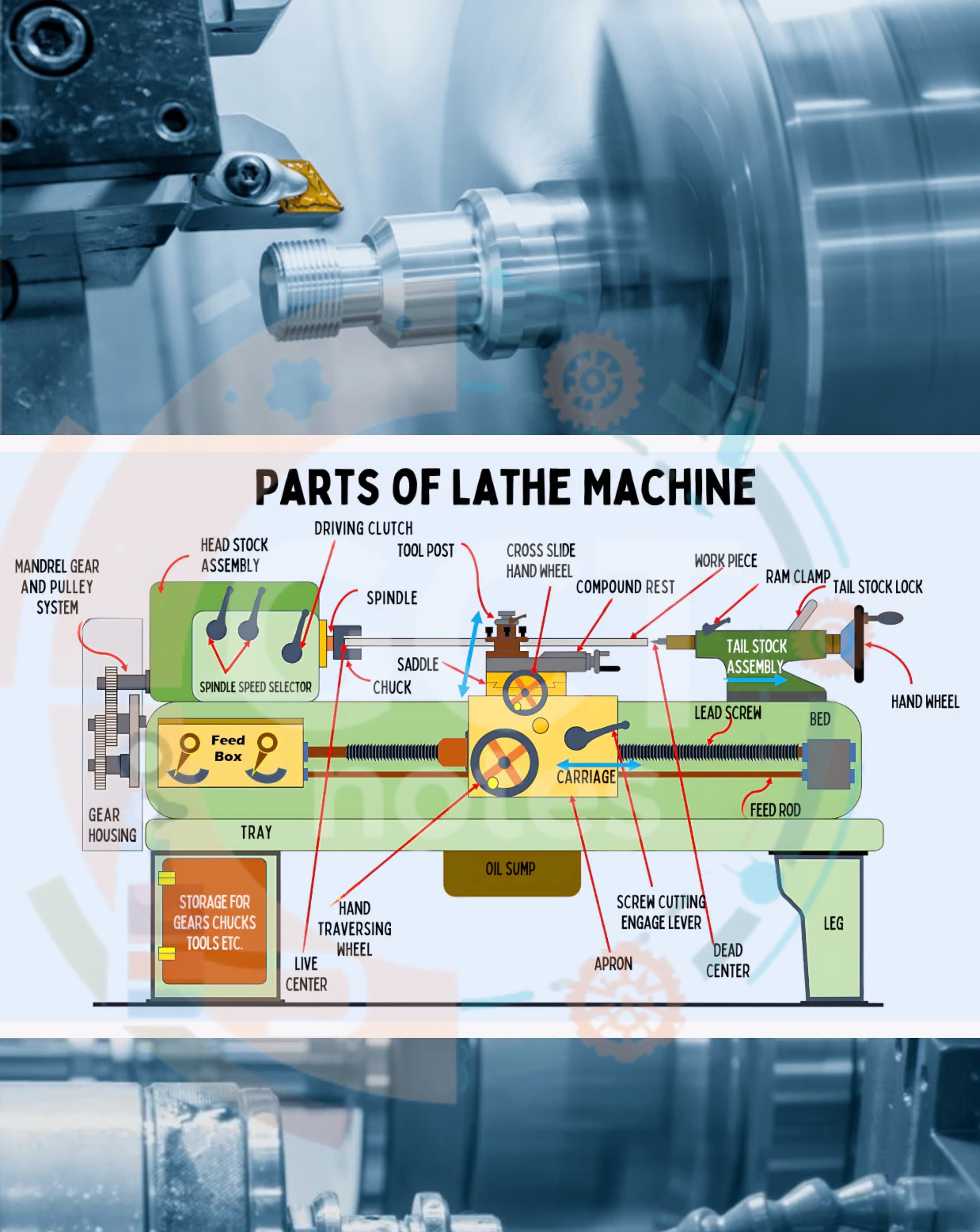
Q2: State some parts of a Lathe Machine.
Ans:
Some important parts of a lathe machine are:- ➔ Bed
- ➔ Headstock
- ➔ Tailstock
- ➔ Carriage
- ➔ Feed rod
- ➔ Lead screw
- ➔ Chuck
- ➔ Tool post
Q3: Define Feed box.
Ans: A feed box is a mechanism in the lathe that controls the speed and direction of the feed motion of the carriage.
Q4: Define Tail stock assembly.
Ans: The tailstock assembly supports the end of the workpiece and can hold tools like drill bits for operations along the lathe axis.
Q5: Define Spindle clamp.
Ans: A spindle clamp locks the spindle in position to prevent rotation during certain operations like drilling or tapping.
Q6: Define Feed rod.
Ans: A feed rod is a shaft used to transmit power from the lathe to the carriage for automatic feeding during turning operations.
Q7: Define Compound Slide.
Ans: The compound slide is a small adjustable slide mounted on the carriage to perform angular cuts or fine feeding operations.
Q8: Define rack.
Ans: A rack is a toothed bar mounted on the lathe to convert rotary motion of the pinion into linear motion for the carriage or tool slide.
Q9: Define Carriage.
Ans: The carriage is the part of the lathe that moves along the bed and supports the tool post and cross-slide for cutting operations.
Q10: Define Apron.
Ans: The apron is the front part of the carriage that houses gears, levers, and controls for feeding and moving the carriage.
Q11: Define Lathe centers.
Ans: Lathe centers are pointed tools mounted in the headstock or tailstock to support and rotate the workpiece accurately.
Q12: Define Face plate.
Ans: A face plate is a circular metal plate attached to the spindle to hold irregularly shaped workpieces for turning.
Q13: Define Angle plate.
Ans: An angle plate is a tool used to hold workpieces at a specific angle on the lathe for precise machining.
Q14: Define Catch plate.
Ans: A catch plate is a device used to support and rotate workpieces that cannot be held in a chuck during machining.
Q15: Define Chucks.
Ans: Chucks are devices used to hold and rotate the workpiece securely on the lathe spindle.
Q16: Define Magnetic chuck.
Ans: A magnetic chuck uses magnetic force to hold ferromagnetic workpieces during machining operations.
Q17: Define Collet chuck.
Ans: A collet chuck holds small cylindrical workpieces with high precision using a tapered collet that grips the workpiece.
Q18: Define Diamond chuck.
Ans: A diamond chuck holds workpieces with a small, precise gripping area, often used for delicate or thin workpieces.
Q19: Define Straight chuck.
Ans: A straight chuck is a conventional chuck with jaws that hold the workpiece along its axis for turning operations.
Q20: Define Combination chuck.
Ans: A combination chuck is a versatile chuck that can hold various shapes of workpieces using adjustable jaws or inserts.
Q21: Define Drill chuck.
Ans: A drill chuck is used to hold drill bits or small tools in the tailstock or tool post for drilling operations.
Q22: Define Mandrels.
Ans: Mandrels are tools used to support workpieces internally while being machined on a lathe, ensuring accurate rotation.
Q23: Define the Bed of Lathe machine.
Ans: The bed is the base of the lathe that provides rigid support and guides the carriage and tailstock along a straight path.
Q24: List the materials used for cutting tools.
Ans:
Common materials for cutting tools are:- ➔ High-speed steel (HSS)
- ➔ Carbon steel
- ➔ Carbide
- ➔ Ceramics
- ➔ Diamond
Q25: List the types of cutting tools according to their use.
Ans:
Cutting tools can be classified as:- ➔ Turning tools
- ➔ Boring tools
- ➔ Facing tools
- ➔ Knurling tools
- ➔ Drilling tools
Q26: Define Boring tool.
Ans: A boring tool is used to enlarge or finish the internal diameter of an existing hole in a workpiece.
Q27: Define Knurling tool.
Ans: A knurling tool is used to create a patterned texture on cylindrical surfaces to improve grip or aesthetics.
Q28: Define Feed.
Ans: Feed is the distance the cutting tool advances along the workpiece in one revolution of the spindle.
Q29: Define Cutting speed.
Ans: Cutting speed is the speed at which the workpiece surface moves past the cutting tool, usually measured in meters per minute or feet per minute.
Q30: Define depth of a cut.
Ans: The depth of cut is the thickness of the material removed from the workpiece in a single pass of the cutting tool.
Q31: Describe the calculation of cutting speed.
Ans: Cutting speed (V) can be calculated using V = π × D × N / 1000, where D is the diameter of the workpiece in mm and N is the spindle speed in RPM.
Q32: State the factors affecting cutting speed and feed.
Ans:
Factors affecting cutting speed and feed include:- ➔ Material of the workpiece
- ➔ Material of the cutting tool
- ➔ Type of operation (roughing or finishing)
- ➔ Depth of cut
- ➔ Machine rigidity and condition