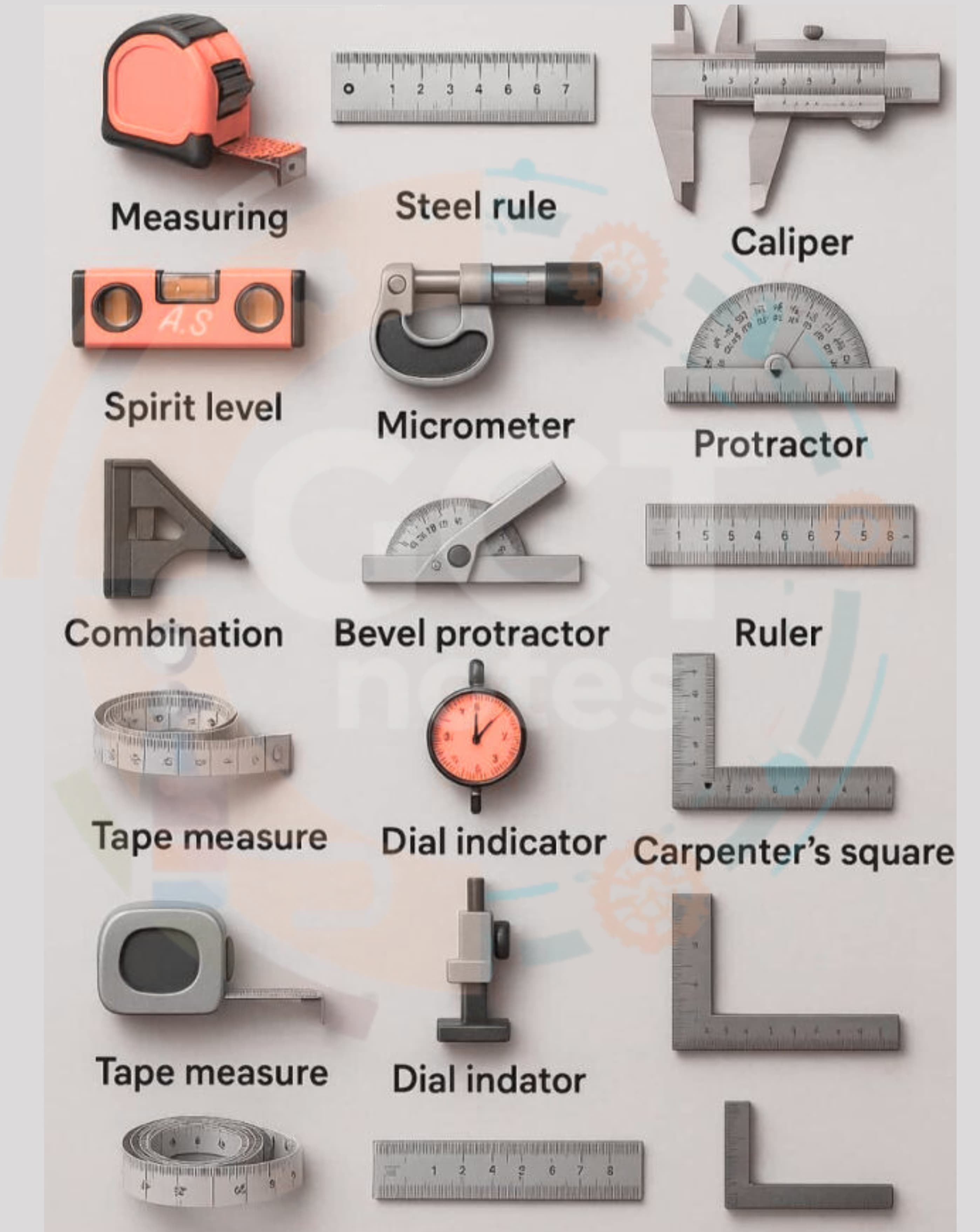
Q1: Define Metal Work.
Ans: Metal work is the process of shaping, cutting, and joining metal to make useful parts or products.
Q2: Define Machine.
Ans: A machine is a mechanical device that uses power to perform work and make tasks easier and faster.
Q3: Define Foot Rule.
Ans: A foot rule is a measuring tool used to measure lengths accurately in metal and wood work.
Q4: Write the usage of the foot rule.
Ans: A foot rule is used to measure linear dimensions and to check straightness of metal work pieces.
Q5: Name any three layout tools used in metal work.
Ans:
The layout tools used in metal work are:- ➔ Scriber
- ➔ Divider
- ➔ Centre punch
Q6: What is Cold Chisel?
Ans: A cold chisel is a hand cutting tool used to cut metal at room temperature.
Q7: Define Micrometer.
Ans: A micrometer is a precision measuring instrument used to measure very small dimensions accurately.
Q8: Name 4 parts of a Micrometer.
Ans:
The main parts of a micrometer are:- ➔ Anvil
- ➔ Spindle
- ➔ Sleeve
- ➔ Thimble
Q9: Name 4 types of a Micrometer.
Ans:
The types of micrometer are:- ➔ Outside micrometer
- ➔ Inside micrometer
- ➔ Depth micrometer
- ➔ Digital micrometer
Q10: State the working principle of the micrometer.
Ans: A micrometer works on the principle of screw and nut, where rotational movement is converted into linear movement.
Q11: What is meant by Chipping?
Ans: Chipping is the process of removing excess metal from a workpiece using a chisel and hammer.
Q12: Define Vice and V block work holding tools.
Ans: A vice and V-block are work holding tools used to hold metal pieces firmly during machining operations.
Q13: Define measuring tools.
Ans: Measuring tools are instruments used to measure the size, length, and thickness of workpieces accurately.
Q14: Name any 4 measuring tools.
Ans:
The measuring tools are:- ➔ Vernier caliper
- ➔ Micrometer
- ➔ Steel rule
- ➔ Vernier height gauge
Q15: Differentiate between internal and external Callipers.
Ans: Internal callipers are used to measure internal dimensions, while external callipers are used to measure outer dimensions.
Q16: What is Taping Operations?
Ans: Taping operation is the process of cutting internal threads inside a drilled hole using a tap.
Q17: Define Drilling.
Ans: Drilling is the operation of making a circular hole in a workpiece using a drill bit.
Q18: Define impact tools.
Ans: Impact tools are tools that work by striking or hammering action to shape or cut materials.
Q19: Name 4 impact tools.
Ans:
The impact tools are:- ➔ Hammer
- ➔ Chisel
- ➔ Punch
- ➔ Mallet
Q20: What is a Scriber?
Ans: A scriber is a sharp-pointed tool used to mark lines on metal surfaces.
Q21: Define Surface Plate.
Ans: A surface plate is a flat and smooth reference surface used for marking and inspection work.
Q22: Define Surface Gauge.
Ans: A surface gauge is a marking tool used to draw lines parallel to a reference surface.
Q23: Define Vernier Caliper.
Ans: A vernier caliper is a precision measuring instrument used to measure internal, external, and depth dimensions.
Q24: Name the parts of Vernier Caliper.
Ans:
The parts of a vernier caliper are:- ➔ Main scale
- ➔ Vernier scale
- ➔ Inside jaws
- ➔ Outside jaws
Q25: What is a vernier caliper used for?
Ans: A vernier caliper is used to measure internal, external, and depth measurements accurately.
Q26: What is a Threading Die?
Ans: A threading die is a cutting tool used to cut external threads on rods or bolts.
Q27: How will you identify a right hand and a left hand threading die?
Ans: A right-hand die cuts threads in clockwise direction, while a left-hand die cuts threads in anti-clockwise direction.
Q28: Name the types of file according to cut.
Ans:
The types of files according to cut are:- ➔ Single cut file
- ➔ Double cut file
- ➔ Rasp cut file
- ➔ Curved cut file
Q29: Name 4 cutting tools used in metal work.
Ans:
The cutting tools used in metal work are:- ➔ Hacksaw
- ➔ Chisel
- ➔ File
- ➔ Drill bit
Q30: Define Precision Measuring Tools.
Ans: Precision measuring tools are instruments used to measure very small dimensions accurately.
Q31: Name different Layout tools.
Ans:
The layout tools are:- ➔ Scriber
- ➔ Divider
- ➔ Surface gauge
- ➔ Centre punch
Q32: What is a Power Hacksaw?
Ans: A power hacksaw is a machine used to cut metal automatically using a motor-driven blade.
Q33: What is a Bending Machine?
Ans: A bending machine is used to bend metal sheets and rods into required shapes.
Q34: State any 4 safety precautions while working in a metal shop.
Ans:
Safety precautions in a metal shop are:- ➔ Wear safety goggles
- ➔ Use proper tools
- ➔ Keep the workplace clean
- ➔ Avoid loose clothing
Q35: State any 4 ways to take care of working tools and machines.
Ans:
Care of tools and machines includes:- ➔ Clean after use
- ➔ Proper storage
- ➔ Regular lubrication
- ➔ Avoid misuse
Q36: Define Hand Tools.
Ans: Hand tools are tools operated by hand without using electrical or mechanical power.
Q37: Define Non-precision Measuring Tools.
Ans: Non-precision measuring tools are used for rough measurements where high accuracy is not required.
Q38: Name 4 Non-precision Measuring Tools.
Ans:
Non-precision measuring tools are:- ➔ Steel rule
- ➔ Inside caliper
- ➔ Outside caliper
- ➔ Divider
Q39: Name 4 Precision Measuring Tools.
Ans:
Precision measuring tools are:- ➔ Micrometer
- ➔ Vernier caliper
- ➔ Vernier height gauge
- ➔ Dial gauge
Q40: Define Folding Rule.
Ans: A folding rule is a measuring tool made of hinged sections that can be folded for easy storage.
Q41: Define Hook Rule.
Ans: A hook rule is a steel rule with a hook at one end used to measure edges accurately.
Q42: Define Calipers.
Ans: Calipers are measuring tools used to measure internal and external dimensions of objects.
Q43: What is a Combination set?
Ans: A combination set is a measuring tool used to check angles, depth, and right angles.
Q44: Name 4 parts of a combination set.
Ans:
The parts of a combination set are:- ➔ Steel rule
- ➔ Square head
- ➔ Protractor head
- ➔ Centre head
Q45: What is the least count of a micrometer?
Ans: The least count of a micrometer is 0.01 mm.
Q46: What is the least count of a vernier caliper?
Ans: The least count of a vernier caliper is 0.02 mm.
Q47: What is the working principle of a vernier caliper?
Ans: A vernier caliper works on the principle of the difference between main scale and vernier scale divisions.
Q48: What is the working principle of a micrometer?
Ans: A micrometer works on the screw and nut principle to provide accurate measurements.
Q49: Name 4 parts of a vernier caliper.
Ans:
The parts of a vernier caliper are:- ➔ Main scale
- ➔ Vernier scale
- ➔ Depth rod
- ➔ Locking screw
Q50: Name 4 types of a vernier caliper.
Ans:
The types of vernier caliper are:- ➔ Mechanical vernier caliper
- ➔ Digital vernier caliper
- ➔ Dial vernier caliper
- ➔ Height vernier caliper