Q1: Write the main function of brick.
Ans: The main function of a brick is to serve as a strong and durable building unit used for constructing walls, foundations, and other structural elements.
Q2: Write the size of the brick in inches.
Ans: The standard size of a brick in inches is 9 in × 4.5 in × 3 in.
Q3: Write the size of the brick in centimeters.
Ans: The standard size of a brick in centimeters is 23 cm × 11.5 cm × 7.5 cm.
Q4: Write the size of the brick in millimeters.
Ans: The standard size of a brick in millimeters is 230 mm × 115 mm × 75 mm.
Q5: Name the ingredients used in making a brick.
Ans: The ingredients used in making a brick are clay, sand, water, and sometimes lime and iron oxide.
Q6: State the percentage of the ingredients used in making a brick.
Ans: A typical brick contains:
- ➔ 50—60% silica
- ➔ 20—30% alumina
- ➔ 5—10% lime
- ➔ 5—10% iron oxide
- ➔ Small amounts of magnesia
Q7: Write the classification of bricks.
Ans: Bricks are classified as:
- ➔ First Class Bricks
- ➔ Second Class Bricks
- ➔ Third Class Bricks
- ➔ Fourth Class (Overburnt) Bricks
Q8: Define Frog in bricks.
Ans: A frog is a rectangular depression on the top surface of a brick provided to form a proper key for mortar.
Q9: Define Over burnt bricks.
Ans: Over burnt bricks are bricks that are burnt too much in the kiln and become dark, distorted, and brittle.
Q10: Define Under burnt bricks.
Ans: Under burnt bricks are bricks that are not burnt sufficiently and remain soft, weak, and absorb more water.
Q11: Write the formula of water absorption of bricks.
Ans: 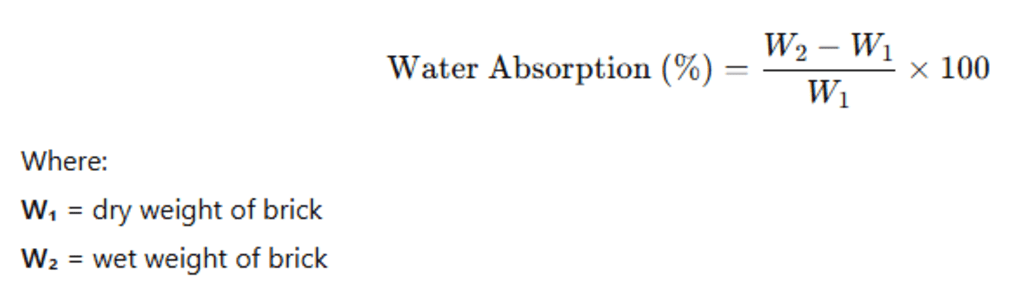
Q12: Enlist the tests of standard brick.
Ans: Tests for standard bricks include:
- ➔ Water Absorption Test
- ➔ Compressive Strength Test
- ➔ Efflorescence Test
- ➔ Hardness Test
- ➔ Soundness Test
- ➔ Shape and Size Test
Q13: Write 4 classifications of first class bricks.
Ans: First class bricks:
- ➔ Have sharp edges and smooth surfaces.
- ➔ Are well-burnt and uniform in color.
- ➔ Have a water absorption of less than 15%.
- ➔ Give a clear ringing sound when struck.
Q14: Write 4 classifications of second class bricks.
Ans: Second class bricks:
- ➔ Have slightly irregular shapes and rough surfaces.
- ➔ May contain small cracks.
- ➔ Have a water absorption of about 20%.
- ➔ Are moderately burnt and less strong than first class bricks.
Q15: State the efflorescence test for bricks.
Ans: The efflorescence test checks the presence of soluble salts by drying a brick after soaking it in water and observing white salt deposits on its surface.
Q16: What is the hardness of stone?
Ans: The hardness of a stone is its ability to resist scratching and abrasion.
Q17: Name the methods of quarrying of stone.
Ans: Methods of quarrying stone include:
- ➔ Blasting
- ➔ Channeling
- ➔ Heating
- ➔ Wedging
- ➔ Digging
Q18: Define Explosive Materials.
Ans: Explosive materials are substances that produce a sudden and violent expansion of gases when ignited.
Q19: Name some Explosive Materials.
Ans: Some explosive materials are:
- ➔ Dynamite
- ➔ Gunpowder
- ➔ TNT
- ➔ Nitroglycerin
- ➔ Blasting gelatine
Q20: Write the types of dressing of stone.
Ans: Types of stone dressing include:
- ➔ Hammer Dressing
- ➔ Chisel Dressing
- ➔ Fine Dressing
- ➔ Rough Tooling
- ➔ Polishing
Q21: State the requirement of good building stone.
Ans: A good building stone must be:
- ➔ Strong
- ➔ Durable
- ➔ Hard
- ➔ Easily workable
- ➔ Resistant to weathering
Q22: Write the characteristics of good building stone.
Ans: A good building stone has:
- ➔ High compressive strength
- ➔ Low water absorption
- ➔ Good appearance
- ➔ Resistance to fire
- ➔ Resistance to decay
Q23: Enlist different methods used in dressing of stone.
Ans: Methods of dressing stone include:
- ➔ Hammer dressing
- ➔ Chisel dressing
- ➔ Fine dressing
- ➔ Rough tooling
- ➔ Polishing
Q24: What type of stone is recommended for the construction of an external wall?
Ans: A hard, durable, and weather-resistant stone like granite or sandstone is recommended for external walls.
Q25: What is pitch in timber?
Ans: Pitch in timber is the resin or sticky substance found in the wood that protects it from insects and decay.
Q26: What is pith in timber?
Ans: Pith in timber is the soft, central core of the tree trunk that represents the earliest growth of the tree.
Q27: Define Sap wood.
Ans: Sapwood is the outer, younger part of the tree trunk that is lighter in color and helps in the transport of sap.
Q28: What are Annual Rings?
Ans: Annual rings are the visible circular layers in a tree trunk that show the growth of the tree during each year.
Q29: What is Bark wood?
Ans: Bark wood is the outer protective layer of a tree that covers and shields the inner wood.
Q30: What are Medullary Rays in timber?
Ans: Medullary rays are narrow radial bands that carry nutrients from the inner part of the tree to the outer part.
Q31: Define Heart wood.
Ans: Heartwood is the inner, older, darker, and harder part of a tree that provides strength to the timber.
Q32: Define Soft wood.
Ans: Softwood is wood obtained from coniferous trees, which is light, less dense, and easy to work with.
Q33: Define Hard wood.
Ans: Hardwood is wood obtained from broad-leaved trees, which is dense, strong, and more durable.
Q34: Define seasoning of timber.
Ans: Seasoning of timber is the process of removing moisture from wood to make it stronger, lighter, and more durable.
Q35: Name two methods of seasoning of timber.
Ans: Two methods of seasoning timber are:
- ➔ Natural seasoning (air seasoning)
- ➔ Artificial seasoning (kiln seasoning)
Q36: What is decay in timber?
Ans: Decay in timber is the decomposition of wood fibers caused by fungi, moisture, or insects.
Q37: Write the factors that lead to the decay of wood.
Ans: Factors that lead to decay include:
- ➔ Moisture
- ➔ Fungal attack
- ➔ Insect attack
- ➔ Lack of ventilation
- ➔ Poor seasoning
Q38: What is Artificial seasoning?
Ans: Artificial seasoning is the controlled drying of wood using machines or kilns to remove moisture quickly.
Q39: What are the types of artificial seasoning?
Ans: Types of artificial seasoning include:
- ➔ Kiln seasoning
- ➔ Chemical seasoning
- ➔ Electrical seasoning
- ➔ Hot-air seasoning
Q40: What are the defects during the growth of trees?
Ans: Defects during growth include:
- ➔ Knots
- ➔ Shakes
- ➔ Twisted fiber
- ➔ Rind galls
- ➔ Uneven rings
Q41: What are the characteristics of good timber?
Ans: Good timber is:
- ➔ Strong
- ➔ Durable
- ➔ Elastic
- ➔ Free from defects
- ➔ Well-seasoned
- ➔ Resistant to insects and moisture
Q42: Could soft wood be stronger than hard wood?
Ans: Yes, some softwoods can be stronger than certain hardwoods because strength depends on the wood’s density and structure, not only on its classification.
Q43: Why should timber be seasoned before constructional use?
Ans: Timber should be seasoned before use because seasoning removes excess moisture, increases strength, reduces weight, and prevents decay and shrinkage.
Q44: Define Water seasoning.
Ans: Water seasoning is a method of soaking timber in flowing water to remove sap and moisture from the wood.
Q45: Define Endogenous trees.
Ans: Endogenous trees are trees that grow inward by adding layers on the inside; examples include bamboo and palm.
Q46: Define Exogenous trees.
Ans: Exogenous trees are trees that grow outward by adding annual rings; examples include teak, oak, and pine.
Q47: Define Wet concrete.
Ans: Wet concrete is freshly mixed concrete that is soft, plastic, and workable before it hardens.
Q48: How does concrete mix gain strength?
Ans: Concrete gains strength through the chemical reaction between cement and water, known as hydration.
Q49: Write down the composition of concrete.
Ans: Concrete is made of cement, sand, aggregate, and water.
Q50: Define Batching in concrete.
Ans: Batching in concrete means measuring the correct quantity of each material before mixing.
Q51: Write the role of vibrator in compaction.
Ans: A vibrator removes air bubbles, makes the concrete dense, and increases its strength and durability.
Q52: Name the methods used for transporting fresh concrete.
Ans: Fresh concrete can be transported by:
- ➔ Wheelbarrows
- ➔ Transit mixers
- ➔ Pumps
- ➔ Buckets
- ➔ Trucks
Q53: Name the methods used for compacting concrete.
Ans: Concrete is compacted using:
- ➔ Hand compaction
- ➔ Needle vibrators
- ➔ Surface vibrators
- ➔ Form vibrators
Q54: Explain methods of concrete finishing.
Ans: Concrete finishing includes:
- ➔ Screeding to level the surface
- ➔ Floating to smooth it
- ➔ Trowelling to give a hard, even finish
Q55: Define curing of concrete.
Ans: Curing is the process of keeping concrete moist so that it hardens properly and gains full strength.
Q56: Name the methods used for curing of concrete.
Ans: Methods of curing include:
- ➔ Ponding, spraying water
- ➔ Covering with wet burlap/jute bags
- ➔ Steam curing
- ➔ Using curing compounds
Q57: Write the properties of high carbon steel.
Ans: High carbon steel is very hard, strong, wear-resistant, and difficult to weld and cut.
Q58: Name the common construction steel used in construction works.
Ans: Common construction steels include:
- ➔ Mild steel
- ➔ High-strength deformed steel bars (TMT bars)
- ➔ Structural steel sections
Q59: Define steel.
Ans: Steel is an alloy made mainly of iron and carbon, with small amounts of other elements.
Q60: Write the carbon content of Mild steel.
Ans: Mild steel contains 0.05% to 0.25% carbon.
Q61: Define Mild steel.
Ans: Mild steel is a low-carbon steel that is ductile, easily weldable, and commonly used in construction.
Q62: Define Medium Carbon steel.
Ans: Medium carbon steel is steel with moderate carbon content, making it stronger and harder than mild steel but less ductile.
Q63: Write the carbon content of High Carbon steel.
Ans: High carbon steel contains 0.6% to 1.5% carbon.
Q64: Write the carbon content of Medium Carbon steel.
Ans: Medium carbon steel contains 0.25% to 0.60% carbon.
Q65: Define Plain steel.
Ans: Plain steel is steel that has a smooth surface and does not contain ribs or deformations.
Q66: Define Deformed steel.
Ans: Deformed steel is steel that has ribs or projections on its surface to increase the bond with concrete.
Q67: Define Cold twisted steel bars.
Ans: Cold twisted steel bars are steel bars that are twisted after cooling to increase their strength and bond with concrete.
Q68: Why do we need joints in concrete construction?
Ans: Joints are needed to control cracking, allow expansion and contraction, and make construction easier.
Q69: Define Forsterite bricks.
Ans: Forsterite bricks are refractory bricks made from magnesium silicate, used in high-temperature furnaces.
Q70: Define Kiln seasoning of wood.
Ans: Kiln seasoning is the process of drying timber in a closed chamber using controlled heat, air, and humidity.
Q71: Define Elasticity.
Ans: Elasticity is the ability of a material to return to its original shape after the load is removed.
Q72: Define Plasticity.
Ans: Plasticity is the ability of a material to be permanently deformed without breaking.
Q73: Define Hardness.
Ans: Hardness is a property of material that tells how hard or soft a material is.
Q74: Define Creep.
Ans: Creep is the slow, permanent deformation of a material under a constant load over time.
Q75: Define Ductility.
Ans: Ductility is the ability of a material to be stretched into a wire without breaking.
Q76: Define Malleability.
Ans: Malleability is the ability of a material to be hammered or rolled into thin sheets.
Q77: Define Toughness of metal.
Ans: Toughness is the ability of a metal to absorb energy and resist fracture.
Q78: Name some types of sand.
Ans: Types of sand include:
- ➔ River sand
- ➔ Pit sand
- ➔ Sea sand
- ➔ Manufactured sand (M-sand)
Q79: Define Aggregate.
Ans: Aggregate is a granular material such as sand, gravel, or crushed stone used in concrete.
Q80: Define Fine Aggregate.
Ans: Fine aggregate is sand or particles smaller than 4.75 mm used to fill gaps in concrete.
Q81: Define Coarse Aggregate.
Ans: Coarse aggregate is gravel or crushed stone with particles larger than 4.75 mm.
Q82: Define Slag Aggregate.
Ans: Slag aggregate is a by-product of metal industries used as an alternative to natural aggregates.
Q83: Define Admixtures.
Ans: Admixtures are materials added to concrete to improve its properties or performance.
Q84: Name 4 Admixtures.
Ans: Four admixtures are:
- ➔ Plasticizers
- ➔ Superplasticizers
- ➔ Accelerators
- ➔ Retarders
Q85: Write 4 uses of Admixtures.
Ans: Admixtures are used to:
- ➔ Improve workability
- ➔ Increase or decrease setting time
- ➔ Increase strength and durability
- ➔ Reduce water content in the mix
Q86: Define Rubble Masonry.
Ans: Rubble masonry is masonry made using rough, irregular, and undressed stones.
Q87: Name the types of Rubble Masonry.
Ans: Types of rubble masonry include:
- ➔ Random rubble masonry
- ➔ Coursed rubble masonry
Q88: Define Ashlar Masonry.
Ans: Ashlar masonry is masonry made using finely dressed stones laid in regular courses.
Q89: Name the types of Ashlar Masonry.
Ans: Types of ashlar masonry include:
- ➔ Ashlar fine
- ➔ Ashlar rough
- ➔ Ashlar block-in-course
- ➔ Ashlar chamfered
Q90: State some Man-made stones.
Ans: Man-made stones include:
- ➔ Cement concrete blocks
- ➔ Artificial stones
- ➔ Terrazzo tiles
- ➔ Hollow blocks
Q91: Define Mortar.
Ans: Mortar is a mixture of cement or lime, sand, and water used to bind building materials together.
Q92: State the types of mortar.
Ans: Types of mortar include:
- ➔ Cement mortar
- ➔ Lime mortar
- ➔ Mud mortar
- ➔ Composite mortar
Q93: Write 4 advantages of brick masonry.
Ans: Advantages of brick masonry:
- ➔ Bricks are durable and fire-resistant
- ➔ Brick masonry is economical
- ➔ Bricks provide good thermal insulation
- ➔ Brick masonry is easy to construct and maintain
Q94: Define Puca brick.
Ans: Puca bricks are well-burnt, strong, and durable bricks used in permanent construction.
Q95: Define Kutcha brick.
Ans: Kutcha bricks are sun-dried, weak, and temporary bricks used in low-cost structures.
Q96: Define Quoins.
Ans: Quoins are the corner stones or bricks used at the external corners of walls.
Q97: Define Quoin brick.
Ans: A quoin brick is a specially prepared brick used at the corners to give strength and a neat finish.
Q98: Define Queen closer.
Ans: A queen closer is a brick cut lengthwise into two equal parts to maintain proper bonding.
Q99: Define King closer.
Ans: A king closer is a brick cut diagonally from the corner to nearly half its width.
Q100: Name the types of brick bond.
Ans: Types of brick bond include:
- ➔ English bond
- ➔ Flemish bond
- ➔ Stretcher bond
- ➔ Header bond
- ➔ Rat-trap bond
Q101: Define English bond.
Ans: English bond is a brick bond formed by alternate courses of headers and stretchers.
Q102: Define Flemish bond.
Ans: Flemish bond is a brick bond in which each course consists of alternating headers and stretchers.
Q103: Define Stretcher bond.
Ans: Stretcher bond is a brick bond in which all bricks are laid as stretchers along the wall length.
Q104: Define Header bond.
Ans: Header bond is a brick bond in which all bricks are laid with their short face (header) on the wall face.
Q105: Write the soundness test of brick.
Ans: In the soundness test, two bricks are struck together; a good brick produces a clear ringing sound.
Q106: Define Weathering.
Ans: Weathering is the process of breaking down materials due to natural factors like wind, rain, temperature changes, and sunlight.