PRECAST CONSTRUCTION AND PRE-STRESSING
Other Chapters
FORMWORKFALSE CEILINGSTEEL STRUCTUREPRECAST CONSTRUCTION AND PRE-STRESSINGDEFECTS IN BUILDINGSTERMITE PROOFINGEarthquake IN BUILDINGS
- Q1: Define Pre-cast members.Ans: The members which are constructed in the factory and are assembled at the site are known as pre-cast members.
- Q2: Define Pre-stressing.Ans: Pre-loading of a structural member in such a way that stresses introduced due to this preloading are opposite to those that will be induced later on when external loads are applied on that member.
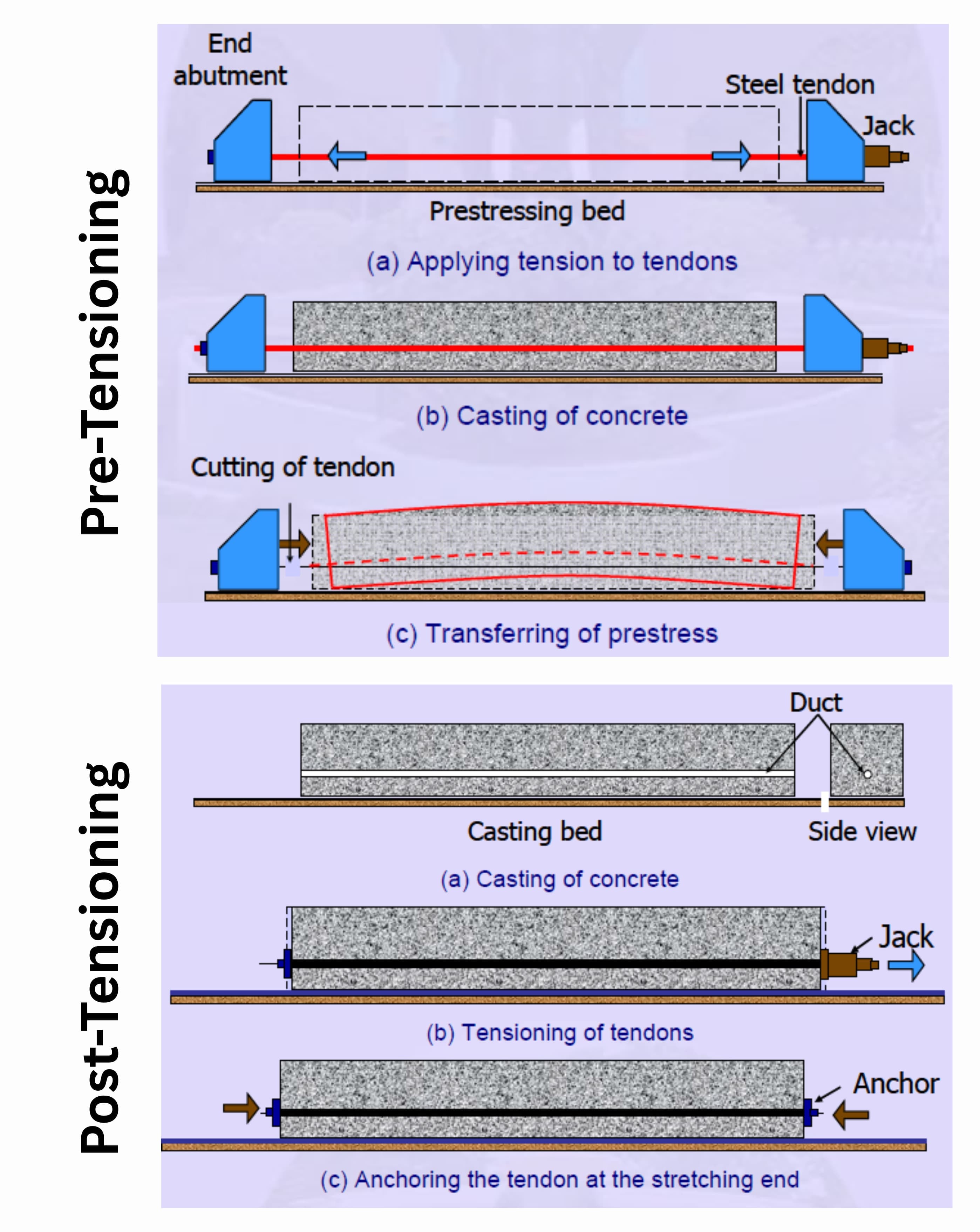
- Q3: Name the methods of Pre-stressing.Ans: The two methods of pre-stressing are:
- ➔ Pre-Tensioning
- ➔ Post-Tensioning
- Q4: What type of steel is used in pre-stressed concrete?Ans: High-strength steel, such as high-tensile steel wires, bars, or strands are used in pre-stressed concrete.
- Q5: Why is high strength concrete needed for pre-stressed concrete?Ans: High-strength concrete offers greater resistance to tension, shear, bond, and bearing, and is less susceptible to shrinkage and creep.
- Q6: Define Pre-Tensioning.Ans: In Pre-Tensioning, the prestressing force is applied to the steel tendons before the concrete is placed.
- Q7: Define Post-Tensioning.Ans: In Post-Tensioning, the prestressing force is applied to the steel tendons after the concrete is placed and cured.
- Q8: What is the ratio of concrete used in foundation?Ans: In Foundations, the ratio of concrete used is 1:1.5:3.
- Q9: What are the advantages of precasting?Ans: Some of the advantages are:
- ➔ Improved quality
- ➔ Faster construction
- ➔ Reduced on-site labor cost
- ➔ Overall cost reduction
- Q10: What are some limitations of precasting?Ans: Some limitations include:
- ➔ Transportation cost
- ➔ Cost of custom design
- Q11: What are the advantages of prestressing?Ans: Advantages of prestressing include:
- ➔ Good quality
- ➔ High strength
- ➔ Larger span
- ➔ Reduced cracking
- Q12: Name some pre-cast members.Ans: Common precast members include:
- ➔ Columns
- ➔ Beams
- ➔ Stairs
- ➔ Floor slabs
- Q13: Name some forms of prestressing steel.Ans: Forms of pre-stressing steel include:
- ➔ Wires
- ➔ Cables
- ➔ Strands
- ➔ Tendons
- Q14: Define Wires.Ans: Pre-stressing wire is a single unit made of steel. The diameters of the wires are 2.5, 3.0, 4.0, 5.0, 7.0 and 8.0 mm.
- Q15: Define Strands.Ans: Two, three or seven wires are wound together to form a pre-stressing strand.
- Q16: Define Tendons.Ans: A group of strands or wires are wound to form a pre-stressing tendon. A tendon is a tensioned element that introduces the prestressing force into the concrete.
- Q17: Define Cable.Ans: A group of tendons form a pre-stressing cable. The cables are primarily used in bridges.
- Q18: Define Bars.Ans: A tendon can be made up of a single steel bar. The diameter of a bar is much larger than that of a wire. Bars are available in sizes: 10, 12, 16, 20, 22, 25, 28, and 32 mm.
- Q19: Name some industries in Pakistan that do precasting.Ans: Some of the industries are:
- ➔ Izhar Concrete Pvt. Ltd.
- ➔ Precast Building Systems (Agro Group)
- ➔ Gammon Pakistan Precast
- ➔ TEG (Taha Engineering Group)
- ➔ Shaheen Precast Associates