TERMITE PROOFING
Other Chapters
FORMWORKFALSE CEILINGSTEEL STRUCTUREPRECAST CONSTRUCTION AND PRE-STRESSINGDEFECTS IN BUILDINGSTERMITE PROOFINGEarthquake IN BUILDINGS
- Q1: Define Termites.Ans: Termites are social insects that primarily feed on wood and other cellulose-based materials. They are known for causing significant damage to structures and are often called 'white ants'.
- Q2: What are different types of Termites?Ans: Termites are of the following types:
- ➔ Dampwood Termites
- ➔ Drywood Termites
- ➔ Subterranean Termites
- Q3: Name the food of Termites.Ans: Termites feed on:
- ➔ Wood sap
- ➔ Cellulose
- ➔ Paper
- ➔ Rotten wood
- ➔ Note: Teak wood (Burma) is not attacked.
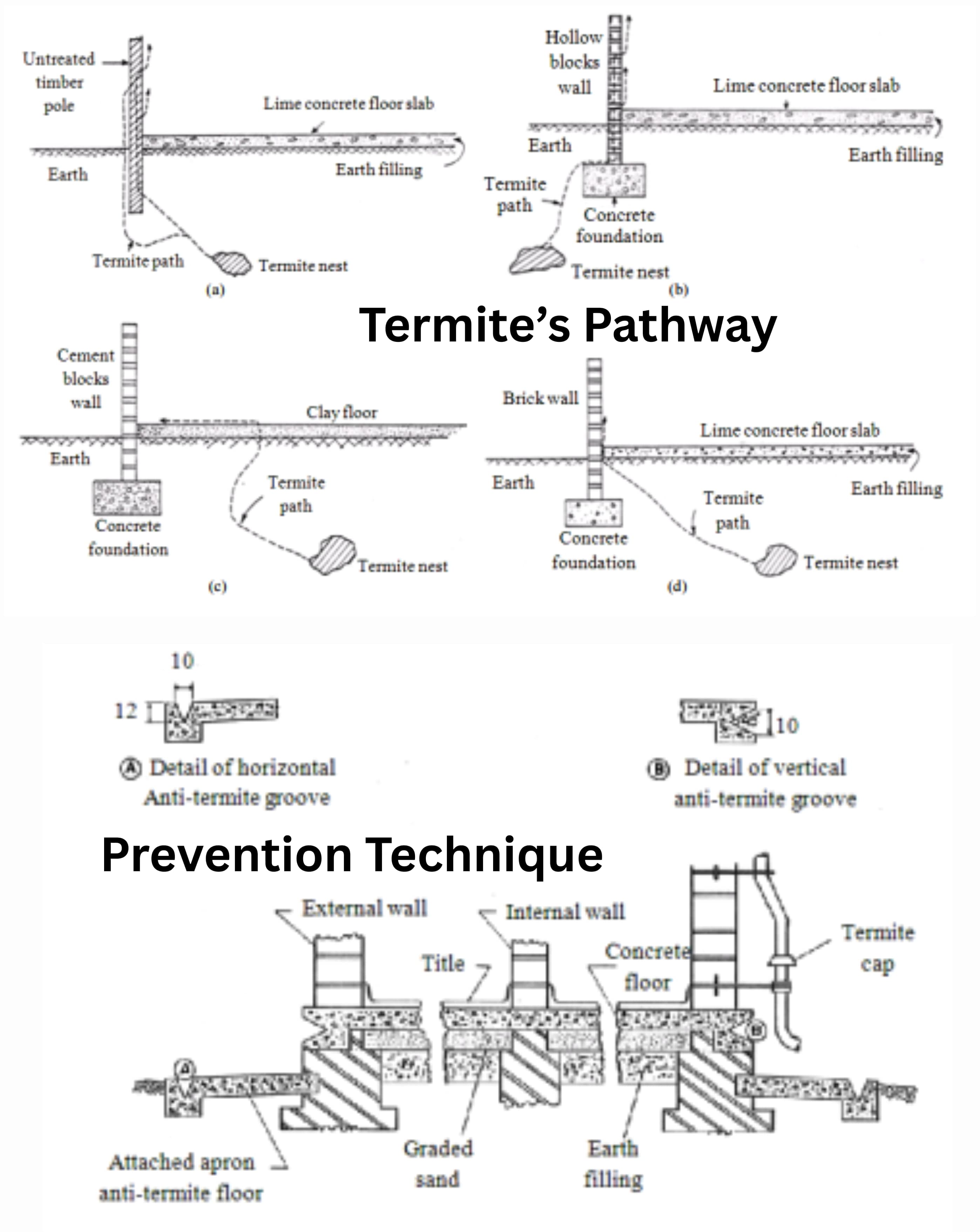
- Q4: Define Termite Proofing.Ans: The process of treating chemically or physically to save the structure & wood from the attack of termites and pests is termite proofing.
- Q5: How do termites enter a building?Ans: Termites may enter a building through:
- ➔ Cracks
- ➔ Voids
- ➔ Overlaps
- ➔ Cavities
- ➔ Sill plates
- ➔ Studs
- Q6: What is the purpose of termite proofing?Ans: The purpose of Termite Proofing is:
- ➔ To prevent the possible attack of subterranean termites from the ground to the building and its contents.
- ➔ To eliminate the effect of dry-wood termite and subterranean termites on wood work.
- Q7: Name some medicines used for termite proofing.Ans: Some of the medicines are:
- ➔ Chlorpyrifos
- ➔ Imidacloprid
- ➔ Bifenthrin
- ➔ Fipronil
- ➔ Permethrin
- ➔ Termidor (Fipronil-based branded chemical)
- Q8: Define Subterranean Termites.Ans: The termites are commonly called subterranean termites because they live underground.
- Q9: Name 6 Pesticides.Ans: Some of the pesticides are:
- ➔ DDT (Dichlorodiphenyltrichloroethane)
- ➔ Malathion
- ➔ Glyphosate
- ➔ Chlorpyrifos
- ➔ Carbaryl
- ➔ Paraquat
- Q10: How do you detect termite in a building?Ans: Termites can be detected by the presence of the following:
- ➔ Wood that sounds hollow when tapped.
- ➔ Temporary swarm of winged insects in your home or around soil.
- ➔ Cracked or bubbling paint or presence of Frass (termite droppings).
- ➔ Mud tubes on exterior walls, wooden beams, or crawl spaces.
- ➔ Discarded wings from swarmers.
- Q11: Write the classification of Anti-termite Treatment.Ans: The classification is as follows:
- ➔ Pre-constructional treatment
- ➔ Constructional treatment
- ➔ Post-constructional treatment
- Q12: Define Post-constructional Treatments.Ans: The anti-termite treatment measures adopted in existing buildings are known as Post-constructional treatments. It consists of treating the wood work and wooden based materials of an existing building with a suitable chemical solution.
- Q13: Define Pre-constructional Treatments.Ans: The anti-termite treatment measures adopted at the time of construction of a building are known as Pre-Constructional treatments. It consists of treating the soil adjacent to and under a building at the time of construction.
- Q14: Name the methods of termite proofing.Ans: Termite proofing can be done by the following methods:
- ➔ Soil treatment
- ➔ External and internal termite protections
- Q15: How termite proofing is done in the RCC foundation?Ans: In case of R.C.C framed structures with column and plinth beams and basements:
- ➔ The concrete mix is rich and dense, so treatment is not started from the bottom of column excavations.
- ➔ Treatment starts from a depth of 500mm below ground level.
- ➔ Backfill around columns, beams, and R.C.C basement walls is treated at a rate of 15 liters/m² of vertical surface.