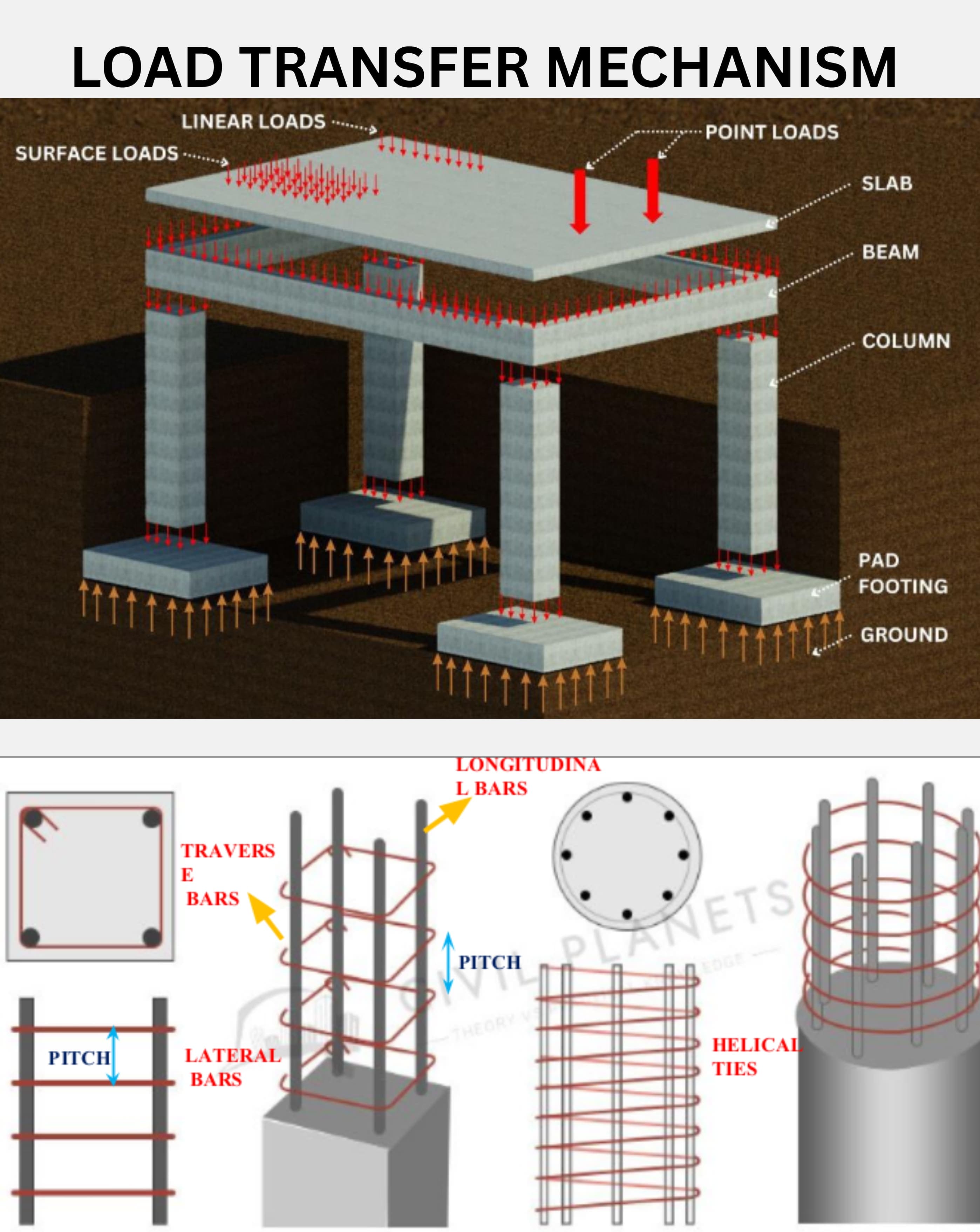
DESIGN OF RCC COLUMN & FOOTING
Other Chapters
STRESSSTRAINELASTICITYCENTER OF GRAVITYMOMENT OF INERTIASHEAR FORCE & BENDING MOMENTSOIL MECHANICSDEFLECTION IN BEAMSDESIGN OF BEAM & LINTELDESIGN OF RCCDESIGN OF RCC COLUMN & FOOTINGDESIGN OF RCC STAIRS
- Q1: Define column.Ans: A column is a vertical structural member designed to support compressive loads, transferring the weight from beams or slabs to the foundation.
- Q2: What is the function of column?Ans: the primary function of column is to transfer the load of slab and beam to the footing. A column resists compressive forces.
- Q3: What is axially loaded column?Ans: An axially loaded column is the column in which all loads(forces) are acting at the centroid of the column.
- Q4: Define slender column.Ans: A slender column is a column where the diameter is thin compared to the height and it fails by buckling.
- Q5: What is meant by lateral ties?Ans: Lateral ties are small-diameter steel bars used in reinforced concrete columns to hold the main longitudinal reinforcement in position and prevent buckling.
- Q6: Define longitudinal bars.Ans: Longitudinal bars are the main reinforcement bars placed along the length of structural members like columns and beams to resist axial and bending stresses.
- Q7: Define helical ties.Ans: Helical ties are spiral-shaped reinforcement bars wound around the longitudinal bars in circular columns to provide confinement and increase ductility.
- Q8: Define pitch of lateral ties.Ans: The pitch of lateral ties is the center-to-center distance between two consecutive lateral or transverse ties in a reinforced concrete column.
- Q9: What is slenderness ratio?Ans: Slenderness ratio is the ratio of the effective length of a column to its least radius of gyration.
- Q10: Define short column.Ans: A short column is one that fails mainly due to direct compression. It has a slenderness ratio less than 80 or its height is less than 10 times its least lateral dimension.
- Q11: Define long column.Ans: A long column is one that fails mainly due to bending. It has a slenderness ratio greater than 80 or its height is more than 30 times its least lateral dimension.
- Q12: What is footing?Ans: Footing is the lowest part of a structure that distributes the load from columns or walls to the ground.
- Q13: What is the function of footing?Ans: The function of footing is to safely transfer the load of the structure to the soil, preventing excessive settlement or failure.
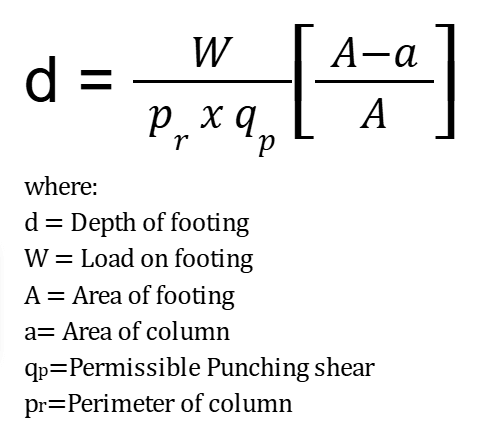
- Q14: Write the formula to calculate depth of footing.Ans: The depth of footing (D) can be calculated using the formula:
- Q15: Define stirrups.Ans: Stirrups are closed-loop steel bars used in reinforced concrete beams and columns to hold the main reinforcement in place and to resist shear and torsional forces.
- Q16: What should be the bending angle of stirrups?Ans: The bending angle of stirrup should be 1350.
- Q17: Define ties.Ans: Ties are tensile members used in reinforced concrete and steel structures to resist pulling forces and hold structural elements in position, commonly used in columns to confine reinforcement.
- Q18: Define struts.Ans: Struts are compressive members used in trusses and other structural systems to resist axial compression and transfer loads to supports.