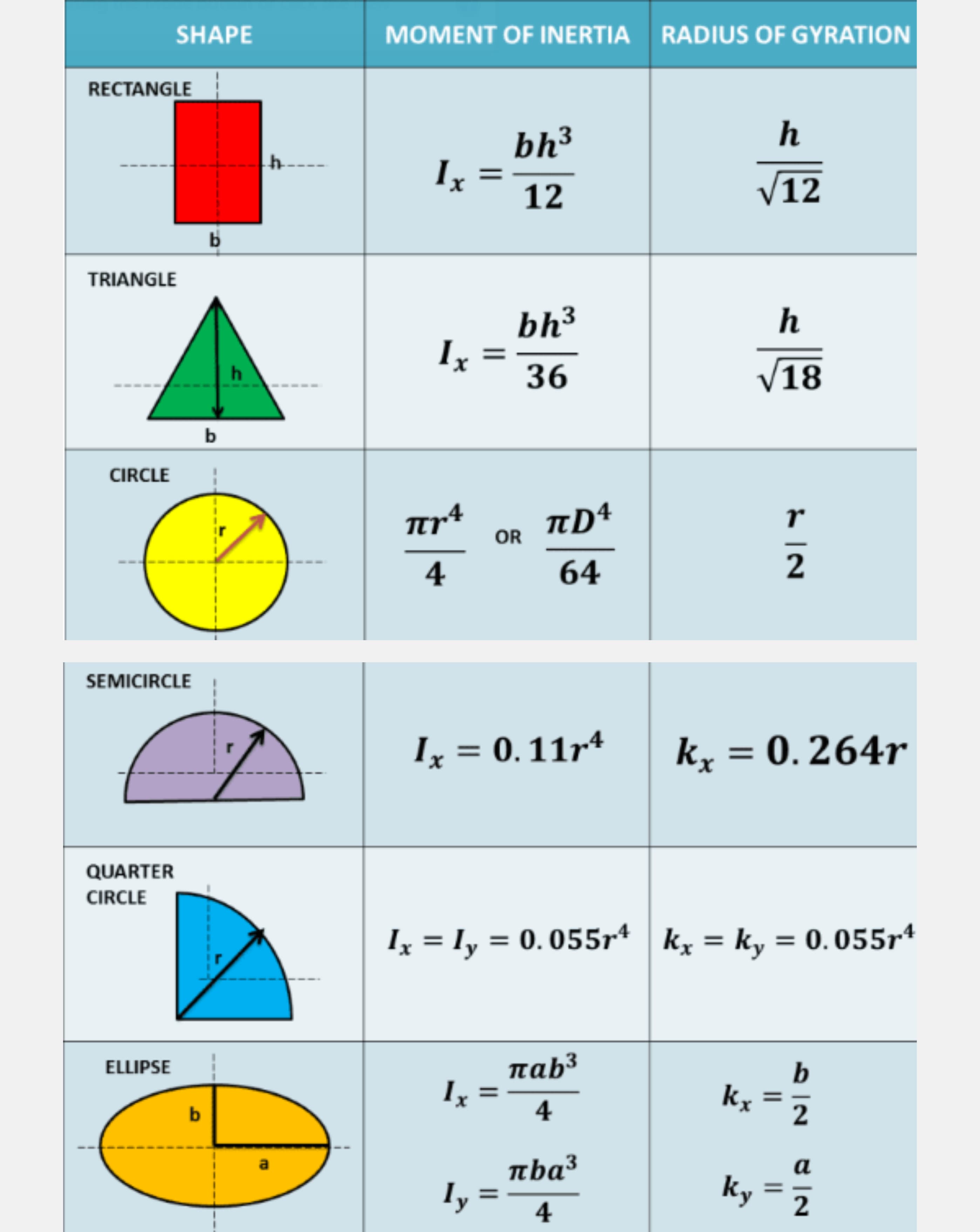
MOMENT OF INERTIA
Other Chapters
STRESSSTRAINELASTICITYCENTER OF GRAVITYMOMENT OF INERTIASHEAR FORCE & BENDING MOMENTSOIL MECHANICSDEFLECTION IN BEAMSDESIGN OF BEAM & LINTELDESIGN OF RCCDESIGN OF RCC COLUMN & FOOTINGDESIGN OF RCC STAIRS
- Q1: What do you know about inertia?Ans: The property of a body by which it resists its state of rest or uniform motion is called inertia.
- Q2: Define Moment of Inertia.Ans: The product of the first moment of area (ax or ay) with centroidal distance (x or y) is called Second Moment of Area.
Example: “ax2” or “ay2” - Q3: Define First Moment of Inertia.Ans: The product of the area of an object and its centroidal distance is called the First Moment of Area.
Example: “ax” or “ay” - Q4: Define Second Moment of Inertia.Ans: The product of the first moment of area (ax or ay) with centroidal distance (x or y) is called Second Moment of Area.
Example: “ax2” or “ay2” - Q5: Write down the units of following in MKS and FPS systems.Ans:
Terms MKS FPS First Moment of area m3 ft3 Second Moment of area m4 ft4 Moment of inertia m4 ft4 Radius of gyration m ft - Q6: Define Radius of gyration.Ans: Radius of gyration is the imaginary distance from the centroid of the given axis to a point where the whole mass of a body is supposed to be concentrated. It tells about the stiffness of the columns.

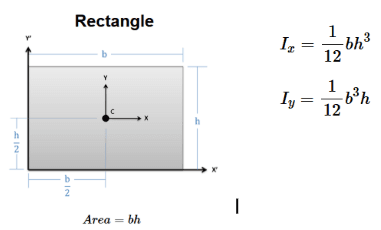
- Q7: Express moment of inertia of a rectangular section. Also draw diagrams.Ans:
- Q8: State parallel axis theorem.Ans: Parallel Axis Theorem states:
“The moment of inertia of a body about an axis parallel to the body passing through its centre is equal to the sum of the moment of inertia of the body about the axis passing through the centre and the product of the mass of the body times the square of the distance of between the two axes.” - Q9: What is the perpendicular axis theorem?Ans: Perpendicular Axis Theorem states:
“For any plane body, the moment of inertia about any of its axes which are perpendicular to the plane is equal to the sum of the moment of inertia about any two perpendicular axes in the plane of the body which intersect the first axis in the plane.” - Q10: Define composite section. Give examples.Ans: Two or more basic shapes combine to form a composite section or a composite figure. Examples:

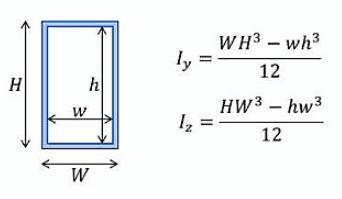
- Q11: Write moment of inertia of a rectangular hollow section.Ans:
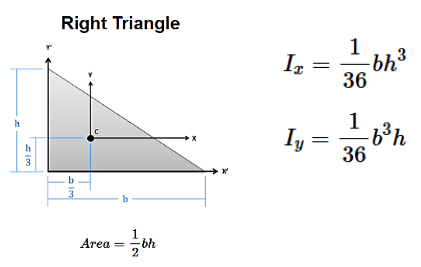
- Q12: Write the moment of inertia of a right-angle triangle.Ans:
- Q13: Why does the moment of the area always have a positive value?Ans: It is because the second moment uses the square of the distance, and squares are positive.
- Q14: What is the alternate name of moment of inertia?Ans: The other names of moment of inertia are:
- ➔ Second Moment of Area
- ➔ Angular Mass
- ➔ Rotational Inertia
- Q15: Express moment of inertia of I-section.Ans: