COMPASS SURVEY
Other Chapters
SURVEYINGCHAIN SURVEYCOMPASS SURVEYPLANE TABLE SURVEYLEVELLINGVERNIERLASER LEVELLERTHEODOLITETOTAL STATION
- Q1: What is the principle of compass surveying?Ans: Compass surveying is based on the principle of traversing. In this method, the framework consists of a series of connected lines, the lengths of which are measured using a chain or tape, and the directions are determined with a compass.
- Q2: What is the difference between traversing and triangulation?Ans: Traversing involves a series of connected lines forming a path, whereas triangulation divides the area into triangles to determine positions more accurately.
- Q3: Define traverse.Ans: Traverse is defined as a series of connected lines whose lengths and directions are measured to establish control points.
- Q4: What is open traverse?Ans: An open traverse consists of a series of connected lines whose starting and ending points do not meet. It is used for long, narrow surveys such as roads, railways, or river mapping.
- Q5: Define closed traverse.Ans: A closed traverse is one in which the starting and ending points coincide, forming a closed loop. It is useful for boundary and land surveys.
- Q6: Define fore bearing.Ans: Fore bearing (F.B.) is the bearing of a survey line measured from the starting point towards the endpoint.
- Q7: Define back bearing.Ans: Back bearing (B.B.) is the bearing of a survey line measured from the endpoint back to the starting point. The difference between the fore bearing and back bearing is always 180°.
- Q8: What is true bearing?Ans: True bearing is the horizontal angle measured from the true north to the line in a clockwise direction.
- Q9: What is magnetic bearing?Ans: Magnetic bearing is the angle measured from the magnetic north to a survey line using a magnetic compass.
- Q10: Define arbitrary bearing.Ans: Arbitrary bearing is an assumed bearing used when there is no reference to true or magnetic north.
- Q11: Define WCB system.Ans: The Whole Circle Bearing (WCB) system measures the bearing of a line in degrees clockwise from the north, ranging from 0° to 360°.
- Q12: Define quadrantal bearing system.Ans: The Quadrantal Bearing (QB) system measures the bearing from either the north or south towards the east or west, expressed in degrees from 0° to 90° within each quadrant.
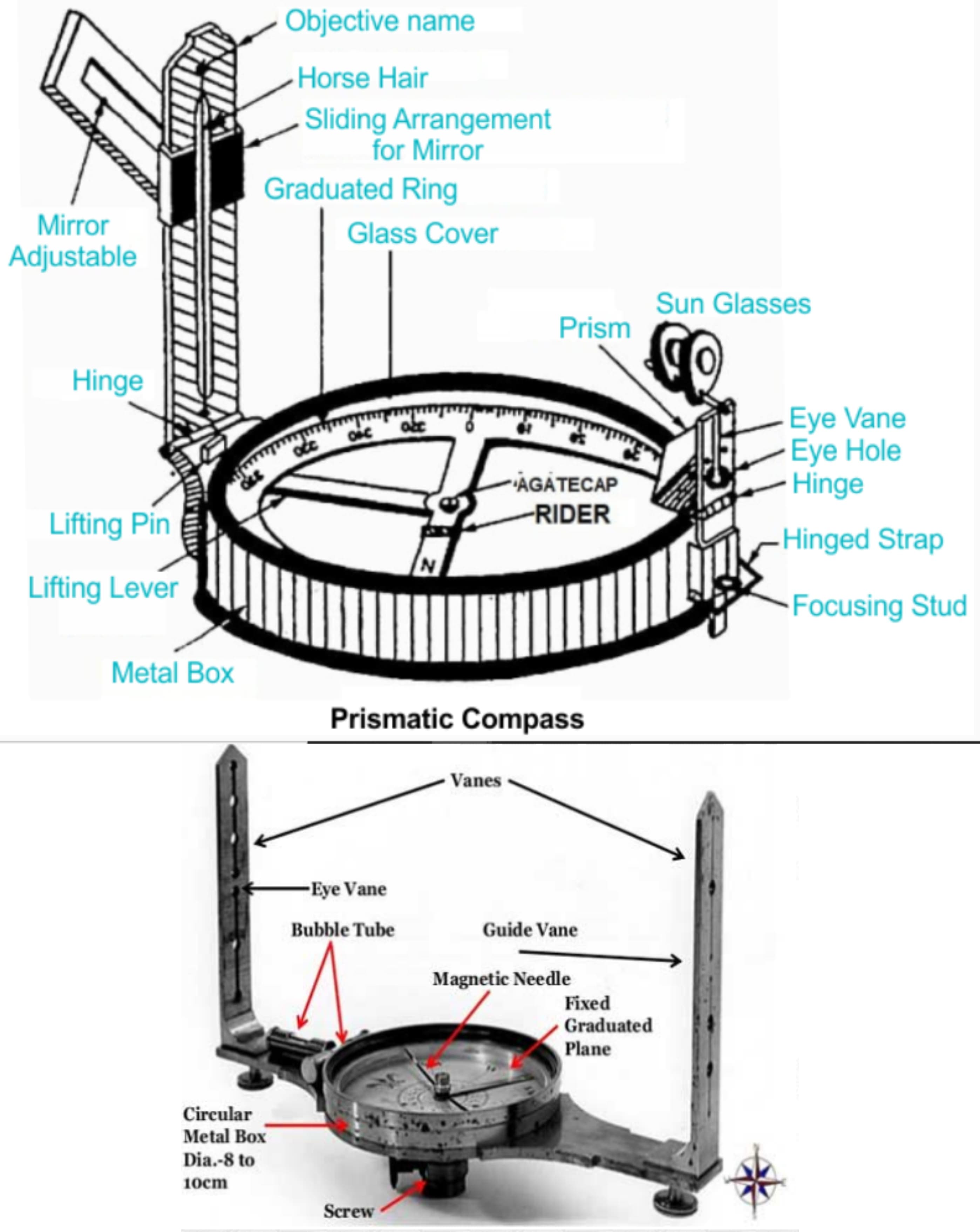
- Q13: What is prismatic compass?Ans: A prismatic compass is an instrument used to measure angles and bearings. It has a prism for reading values and a magnetic needle that points north.
- Q14: Define surveyor’s compass.Ans: A surveyor’s compass is similar to a prismatic compass but lacks a prism. It uses a fixed needle and is divided into four quadrants for measuring angles.
- Q15: What is local attraction?Ans: Local attraction occurs when nearby magnetic substances disturb a compass needle, causing incorrect readings.
- Q16: What is declination?Ans: Declination is the angle between the true north and the magnetic north at a particular location and time.
- Q17: What is an isogonic line?Ans: An isogonic line is a line on a map connecting points of equal magnetic declination.
- Q18: Define meridian.Ans: A meridian is a reference line used in surveying to measure bearings. It can be true, magnetic, or arbitrary.
- Q19: Enlist types of meridians.Ans: The types of meridians are:
- ➔True meridian
- ➔Grid meridian
- ➔Magnetic meridian
- ➔Arbitrary meridian
- Q20: Define true meridian.Ans: The true meridian is the line passing through the geographical north and south poles and a given point on the earth’s surface.
- Q21: What is meant by magnetic meridian?Ans: A magnetic meridian is the direction indicated by a freely suspended magnetic needle unaffected by nearby objects.
- Q22: Define arbitrary meridian.Ans: An arbitrary meridian is an assumed direction chosen for convenience when surveying a small area.
- Q23: Define grid meridian.Ans: A grid meridian is an artificial reference meridian used for mapping, often chosen by state agencies for a specific zone.
- Q24: Define bearing of a survey line.Ans: The bearing of a survey line is the horizontal angle between the line and a reference meridian, measured in degrees.