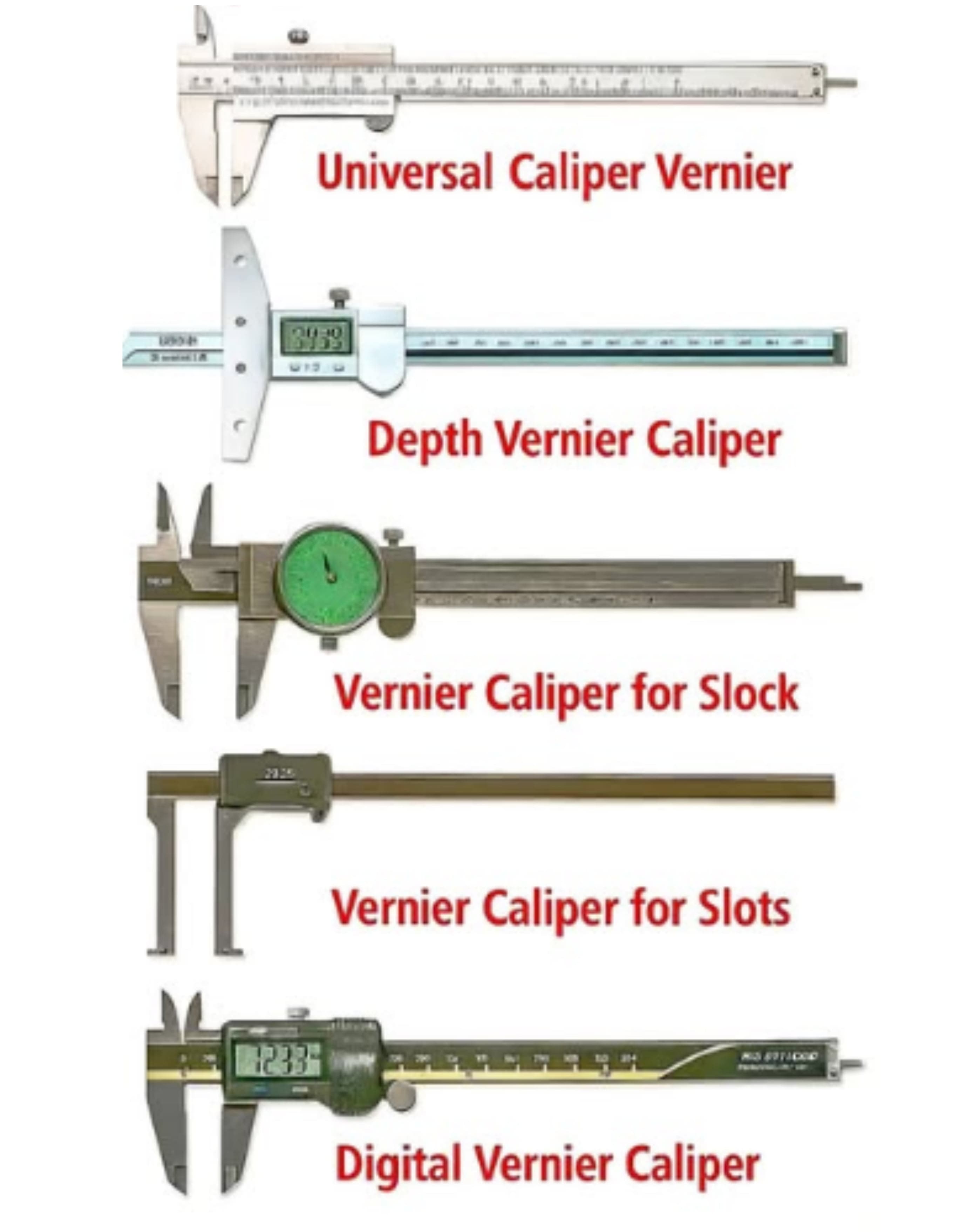
VERNIER
Other Chapters
SURVEYINGCHAIN SURVEYCOMPASS SURVEYPLANE TABLE SURVEYLEVELLINGVERNIERLASER LEVELLERTHEODOLITETOTAL STATION
- Q1: Define vernier?Ans: A vernier is a small movable graduated scale for obtaining fractional parts of subdivisions on a fixed main scale of any measuring instrument. It is used for precise measurements of internal and external distances.
- Q2: Define direct vernier.Ans: A direct vernier is a type of vernier where the scale divisions are shorter than the main scale divisions. Both scales are graduated in the same direction.
- Q3: Name parts of vernier.Ans: The main parts of a vernier are:
- ➔ Main Scale
- ➔ Vernier Scale
- ➔ Thumbscrew
- ➔ Lock Screw
- ➔ Depth Rod
- ➔ Upper Jaws
- ➔ Lower Jaws
- Q4: What are types of Vernier w.r.t accuracy?Ans: Types of Vernier according to accuracy:
- ➔ Type A Vernier
- ➔ Type B Vernier
- ➔ Type C Vernier
- Q5: What are types of Vernier w.r.t scale divisions?Ans: Types of Vernier according to scale divisions:
- ➔ Direct Vernier
- ➔ Retrograde Vernier
- ➔ Double Vernier
- Q6: Define least count?Ans: Least count is the smallest value that can be measured by a vernier scale. It is the difference between one main scale division and one vernier scale division.
- Q7: Define retrograde Vernier?Ans: A retrograde vernier is a type where the vernier scale divisions are longer than the main scale divisions and are marked in the opposite direction.
- Q8: Define type A and B Vernier?Ans:
- ➔ Type A: Has one scale on the front and jaws on both sides.
- ➔ Type B: Has one scale on the front and jaws only on one side.
- Q9: State principle of Vernier.Ans: The principle of the vernier is based on alignment of line segments. The vernier scale aligns with the main scale at a certain point, allowing more accurate readings.
- Q10: What is difference between lower and main jaw?Ans:
- ➔ Lower jaws: Used for external measurements.
- ➔ Upper jaws: Used for internal measurements.
- Q11: What is purpose of depth rod?Ans: The depth rod is used to measure the depth of holes or steps.
- Q12: Write two precautions while using Vernier.Ans:
- ➔ Ensure the vernier scale and main scale are clean before taking measurements.
- ➔ Avoid parallax error by keeping the eye directly above the scale.
- Q13: What are the causes of error in reading Vernier?Ans: Errors can occur due to improper alignment, parallax errors, or mechanical defects in the instrument.
- Q14: Define double Vernier.Ans: A double vernier has two simple verniers placed end-to-end to allow readings in both clockwise and anticlockwise directions.
- Q15: What is digital Vernier?Ans: A digital vernier is an advanced version of a vernier caliper that displays readings digitally for higher accuracy.
- Q16: Define zero error.Ans: Zero error occurs when the zero mark of the vernier scale does not align with the zero mark of the main scale.
- Q17: What are types of zero error?Ans:
- ➔ Positive zero error: When the vernier zero is ahead of the main scale zero.
- ➔ Negative zero error: When the vernier zero is behind the main scale zero.
- Q18: Define Positive Zero Error.Ans: Positive zero error: When the vernier zero is ahead of the main scale zero.
- Q19: Define Negative Zero Error.Ans: Negative zero error: When the vernier zero is behind the main scale zero.
- Q20: What is the Main scale?Ans: Main Scale is the fixed scale that is graduated in standard units.
- Q21: What is the Vernier scale?Ans: Vernier Scale is a movable scale attached to the main scale to measure finer increments.
- Q22: What is the purpose of lock screw?Ans: The lock screw is used to fix the position of the jaws once the object is measured, preventing movement while taking readings.
- Q23: What is the purpose of thumb screw?Ans: The thumb screw is used to adjust the position of the jaws smoothly for precise measurements.