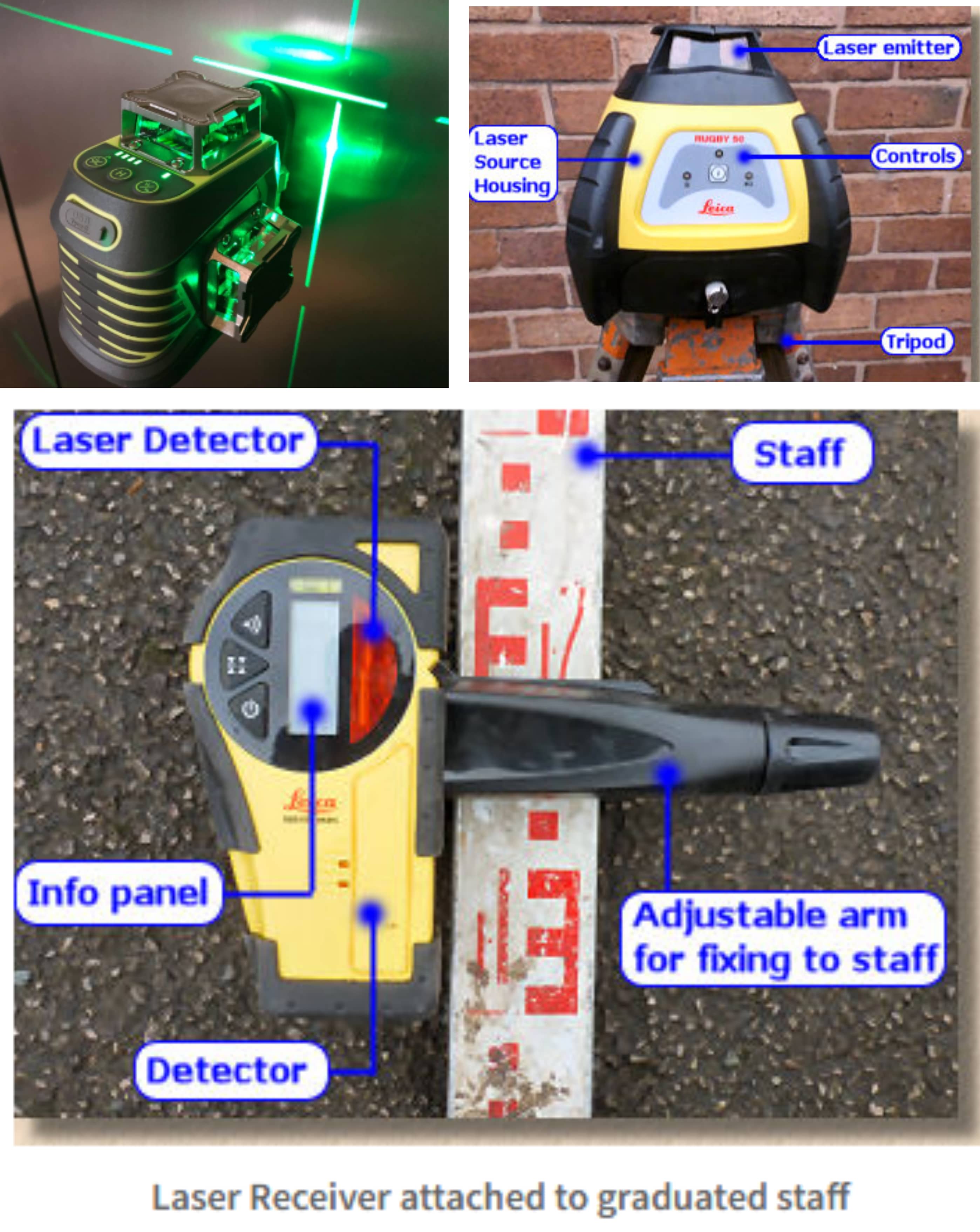
LASER LEVELLER
Other Chapters
SURVEYINGCHAIN SURVEYCOMPASS SURVEYPLANE TABLE SURVEYLEVELLINGVERNIERLASER LEVELLERTHEODOLITETOTAL STATION
- Q1: Define Laser Level?Ans: A laser level is a control tool consisting of a rotating laser beam projector that can be affixed to a tripod. It is used in surveying and construction for accurate measurements.
- Q2: Define self-leveling.Ans: Self-leveling is an automatic adjustment mechanism in laser levels that ensures accuracy by maintaining a level line of sight even if the instrument is slightly tilted.
- Q3: Define IP rating.Ans: IP (Ingress Protection) rating indicates the level of protection a device has against dust and water.
- Q4: What is Amp-Hour Rating?Ans: Amp-hour rating refers to the battery capacity, indicating how long a rechargeable battery will last before requiring a recharge.
- Q5: What is Vast Operating Temperature?Ans: Vast operating temperature refers to the temperature range within which the laser level can function accurately.
- Q6: Name parts of Laser Level?Ans: The main parts of a laser level are:
- ➔ Laser transmitter
- ➔ Laser receiver
- ➔ Control box
- Q7: What are types of Laser level w.r.t Laser?Ans: Types include:
- ➔ Dot Laser Level
- ➔ Horizontal Laser Level
- ➔ Dual-Beam Laser Level
- ➔ Line Laser Level
- ➔ Rotary Laser Level
- Q8: What are types of Laser level w.r.t Its Functions/features?Ans: Types include:
- ➔ Tower-mounted laser level
- ➔ Manual-Leveling Lasers
- ➔ Automatic Laser Levels
- Q9: Describe accuracy of laser level.Ans: Good laser levels are accurate within 1/16 of an inch per 100 feet.
- Q10: Define Refraction?Ans: Refraction is the phenomenon where light changes direction when it passes from one medium to another.
- Q11: State benefits of laser level?Ans: Laser levels help reduce labor, increase work speed, and improve measurement accuracy.
- Q12: State Working of Laser level.Ans: Laser levels work by generating a laser beam inside a protective housing, which is then projected onto a surface for reference.
- Q13: What is difference between rotary and line laser level?Ans: A rotary laser level projects a 360-degree beam, while a line laser level projects a straight line or crosshair.
- Q14: What is laser beam orientation?Ans: Laser beam orientation determines whether the laser projects in a horizontal, vertical, or 360-degree plane.
- Q15: Write purpose of laser detector.Ans: A laser detector helps in identifying laser beams in bright light conditions.
- Q16: What is the purpose of laser transmitter?Ans: The laser transmitter emits the laser beam used for leveling.
- Q17: Define grade laser level.Ans: A grade laser level is used to set precise slopes for construction projects.
- Q18: What is the difference between Fixed and variable RPM?Ans: Fixed RPM keeps a constant rotation speed, while variable RPM allows adjustments based on project needs.
- Q19: Define RPM.Ans: RPM stands for Rotations Per Minute, indicating the speed of rotation of the laser head.
- Q20: What is rotary laser level?Ans: A rotary laser level emits a continuous rotating laser beam to create a reference plane.
- Q21: What is the difference between Line and dual beam laser level?Ans: A line laser level emits a straight beam, while a dual-beam laser level projects both horizontal and vertical beams.
- Q22: What is Line Laser level?Ans: A line laser level projects a straight reference line onto a surface.
- Q23: What is Dot laser level?Ans: A dot laser level emits a single or multiple reference dots on a surface.
- Q24: What is the purpose of eyepiece?Ans: The eyepiece helps in focusing and aligning the laser beam.
- Q25: Write two disadvantages of laser level.Ans:
- ➔ Requires power source.
- ➔ Limited visibility in bright light without a detector.