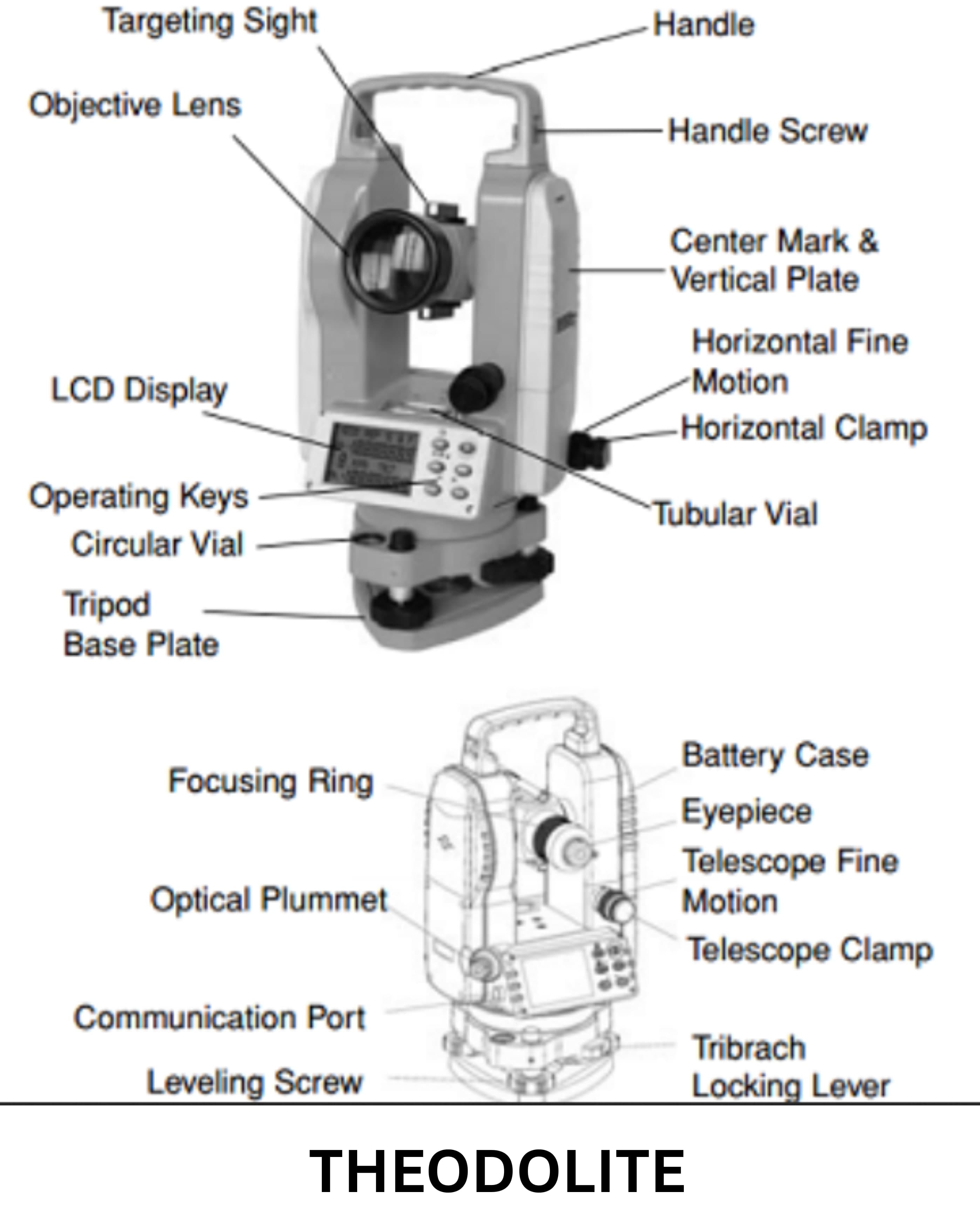
THEODOLITE
Other Chapters
SURVEYINGCHAIN SURVEYCOMPASS SURVEYPLANE TABLE SURVEYLEVELLINGVERNIERLASER LEVELLERTHEODOLITETOTAL STATION
- Q1: Define Theodolite surveying:Ans: Theodolite surveying is the system of surveying in which the angles (both horizontal & vertical) are measured with the help of a theodolite.
- Q2: What are the uses of a theodolite?Ans: Theodolites are used for measuring horizontal and vertical angles, locating points on a line, prolonging survey lines, setting out grades, and ranging curves.
- Q3: Why a type of theodolite is called a transit theodolite?Ans: A theodolite is called a transit theodolite when its telescope can be revolved through a complete revolution about its horizontal axis in the vertical plane.
- Q4: List the essential parts of a theodolite:Ans: The essential parts of a theodolite are:
- ➔ Levelling Head
- ➔ Shifting Head
- ➔ Lower Plate
- ➔ Upper Plate
- ➔ Plate Levels
- ➔ Standard (or A Frame)
- ➔ Vernier Frame
- ➔ Telescope
- ➔ Vertical Circle
- ➔ Altitude Bubble
- ➔ Tripod Stand
- ➔ Screws
- Q5: What is levelling head?Ans: The levelling head is the lowermost part of a theodolite consisting of two parallel plates separated by levelling screws, providing a means to level the instrument.
- Q6: Define Vernier theodolite.Ans: Vernier Theodolite uses verniers to read angles with a least count of 20.
- Q7: Define Micrometer theodolite:Ans: Micrometer Theodolite uses a micrometer for angle measurement with a least count of 1.
- Q8: List the essential qualities of a theodolite telescope:Ans:
- ➔ High magnification power
- ➔ Clear and sharp image formation
- ➔ Accurate line of sight adjustment
- Q9: What is purpose of Eye-piece?Ans: The eyepiece is used for focusing and adjusting the clarity of the image seen through the telescope.
- Q10: What is purpose of Diaphragm?Ans: The diaphragm holds the crosshairs or reticles in position to assist in accurate sighting of objects.
- Q11: What is purpose of object glass?Ans: The object glass collects and focuses the light to form an image on the crosshair.
- Q12: What are the temporary adjustments of the theodolite?Ans: The temporary adjustments of a theodolite include:
- ➔ Centering
- ➔ Levelling
- ➔ Focusing
- Q13: List out the permanent adjustments of Theodolite:Ans: The permanent adjustments include:
- ➔ Adjustment of vertical crosshair
- ➔ Adjustment of plate level axes
- ➔ Adjustment of line of sight
- ➔ Adjustment of horizontal axis
- ➔ Adjustment of vertical circle index
- Q14: List out the fundamental lines of Theodolite:Ans: The fundamental lines include:
- ➔ The Vertical Axis
- ➔ The Horizontal Axis
- ➔ The Line of Collimation
- Q15: Name the two methods of measuring horizontal angles:Ans:
- ➔ Repetition Method
- ➔ Reiteration Method
- Q16: Define closing error:Ans: Closing error is the difference between the sum of measured angles in a traverse and the theoretical sum of angles.
- Q17: Define Easting and Northing:Ans: Easting and Northing are coordinate values given by the perpendicular distances from the two main axes in a survey grid.