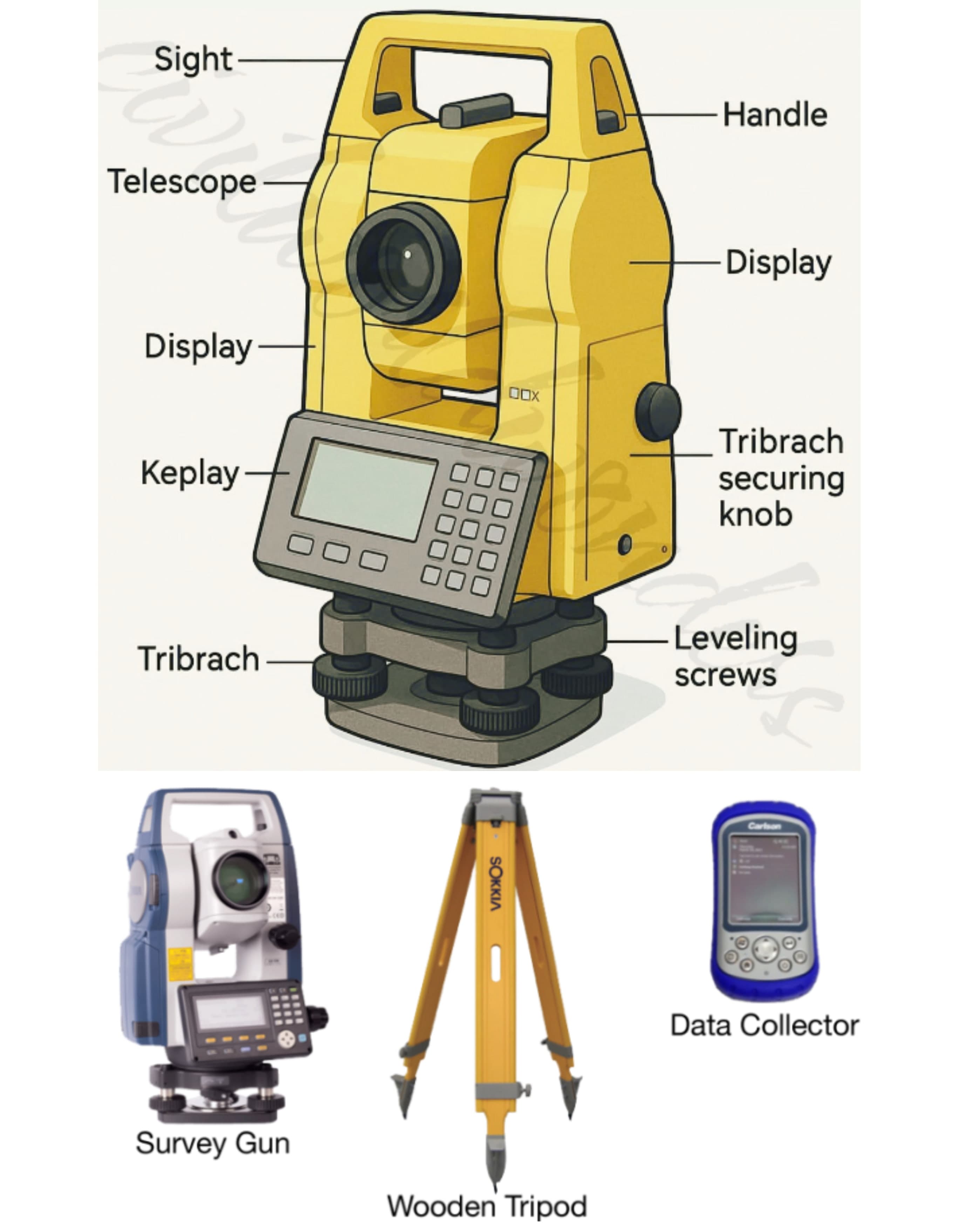
TOTAL STATION
Other Chapters
SURVEYINGCHAIN SURVEYCOMPASS SURVEYPLANE TABLE SURVEYLEVELLINGVERNIERLASER LEVELLERTHEODOLITETOTAL STATION
- Q1: What is Total Station?Ans: A Total Station is an electrical and digitally operated surveying instrument used for measurement and survey work. It combines an Electromagnetic Distance Measuring Instrument (EDM) and an electronic theodolite.
- Q2: What is the least Count of Total Station?Ans: The least count of total station for angle measurement is 1” and for distance measurement is 1mm.
- Q3: Define dual-Axis compensation.Ans: Dual-Axis Compensation ensures reliable horizontal and vertical readings by automatically correcting slight tilts of the instrument.
- Q4: Write any three features of total station.Ans:
- ➔ Absolute circle reading
- ➔ High-resolution LCD display
- ➔ Electronic laser distance measurement
- Q5: Write three uses of total station.Ans:
- ➔ Distance measurement using infrared signals
- ➔ Angle measurement
- ➔ Co-ordinate determination (X, Y, Z values)
- Q6: Name four parts of total station.Ans:
- ➔ Electronic distance meter (EDM)
- ➔ Microprocessor
- ➔ Electronic data collector & storage system
- ➔ Keyboard
- Q7: What is EDM?Ans: EDM (Electronic Distance Meter) is a component in total stations used for measuring distances with high accuracy.
- Q8: Define Reflector.Ans: A reflector in total station functions by reflecting infrared beams, which helps determine angles and distances.
- Q9: What are the main functions of total station?Ans:
- ➔ Distance measurement
- ➔ Angle measurement
- ➔ Elevation determination
- ➔ Data processing
- Q10: What are the types of total station?Ans:
- ➔ Mechanical Total Stations
- ➔ Robotic Total Stations
- ➔ Prism Total Stations
- ➔ Motorized Total Stations
- Q11: Define robotic total station.Ans: A robotic total station is an advanced instrument that allows remote operation and automatic target tracking.
- Q12: Define Prism Total Stations.Ans: Prism Total Stations use prisms to reflect infrared waves and determine angles and distances.
- Q13: Write formula for elevation.Ans: Elevation of Point B = Elevation of Point A + HI ± L sinφ – HR
- Q14: Define electronic book.Ans: An electronic book is a storage device in a total station where point data can be stored digitally for later use.
- Q15: Write three advantages of total station.Ans:
- ➔ High-speed data collection
- ➔ Increased accuracy
- ➔ Easy integration with CAD software
- Q16: What is meant by focusing on survey point?Ans: Focusing on a survey point ensures clear visibility of the target through the telescope by adjusting the focus ring.
- Q17: What is optical plummet?Ans: The optical plummet helps in centering the total station over a ground point accurately.
- Q18: How Verifying the Leveling Electronically?Ans: Leveling is verified electronically using an onboard electronic bubble and adjusting foot screws until centered.
- Q19: How Adjusting the Image & Focusing?Ans: The telescope is aimed at a light background, and the focus knob is adjusted until the image appears sharp.
- Q20: Write three Precautions for Using Total Station.Ans:
- ➔ Handle the instrument carefully with both hands.
- ➔ Avoid carrying the total station while mounted on a tripod.
- ➔ Use a charged battery and keep a spare one.