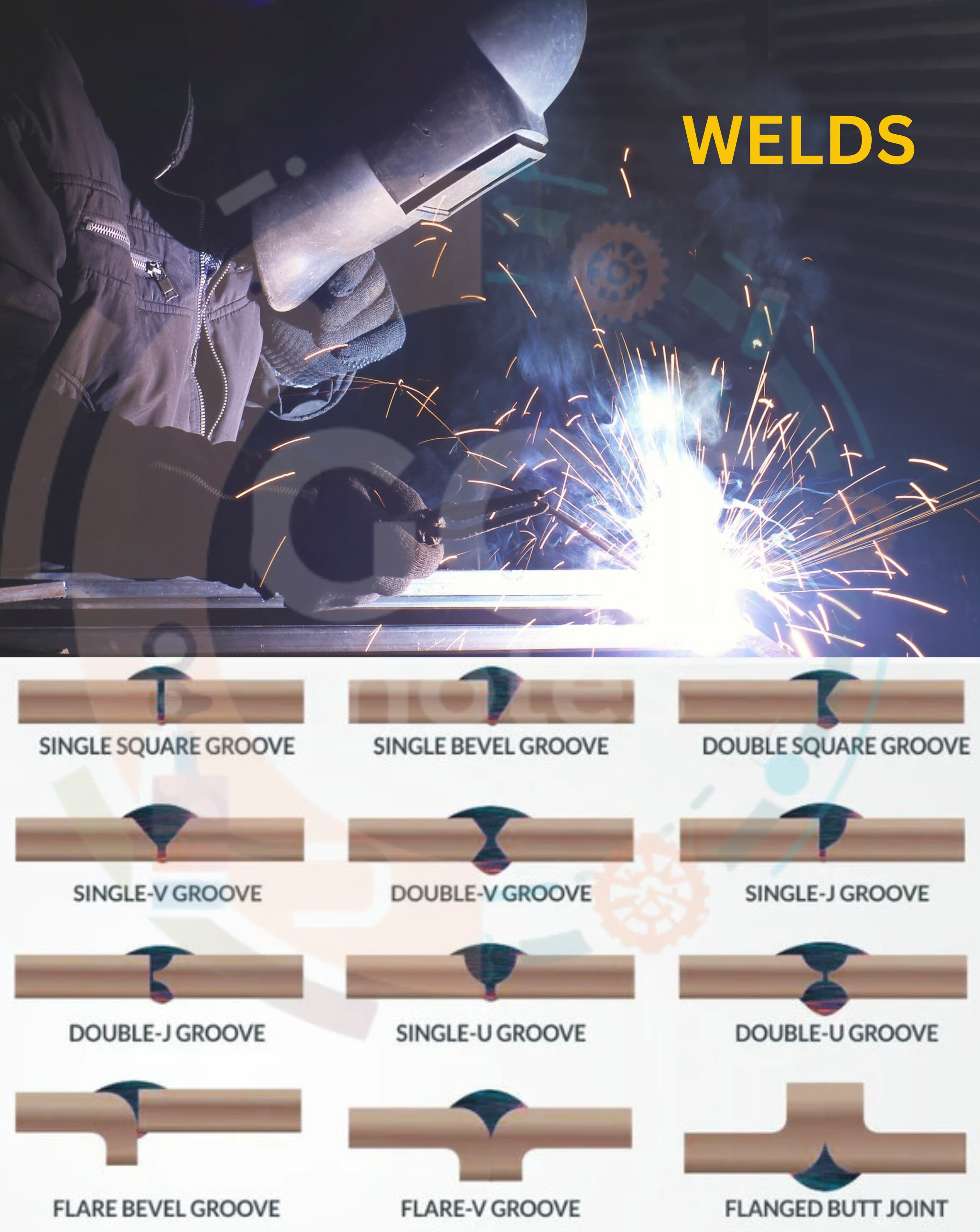
Q1: Define Welding.
Ans: Welding is a process of permanently joining two or more metal parts by heating them with or without pressure.
Q2: Name some types of weld joints.
Ans:
The types of weld joints are:- ➔ Butt joint
- ➔ Lap joint
- ➔ T-joint
- ➔ Corner joint
Q3: Describe the process of welding.
Ans: In welding, metal parts are heated to a high temperature and fused together with or without filler material to form a strong joint.
Q4: State the classification of welding.
Ans:
Welding is classified into:- ➔ Pressure welding
- ➔ Fusion welding
Q5: Define Pressure welding.
Ans: Pressure welding is a welding process in which metals are joined by applying pressure with or without heat.
Q6: State the process of Pressure welding.
Ans: In pressure welding, heated metal parts are pressed together to form a joint without melting the base metal.
Q7: Define Fusion welding.
Ans: Fusion welding is a process in which metal parts are joined by melting them without applying pressure.
Q8: State the process of Fusion welding.
Ans: In fusion welding, the base metal is melted using heat and allowed to cool to form a strong joint.
Q9: Define Forge welding.
Ans: Forge welding is a pressure welding process in which heated metals are joined by hammering.
Q10: State the process of Forge welding.
Ans: In forge welding, metal parts are heated to a plastic state and joined by applying hammer blows.
Q11: Define Spot welding.
Ans: Spot welding is a resistance welding process used to join thin metal sheets at specific points.
Q12: State the process of Spot welding.
Ans: In spot welding, electric current and pressure are applied to metal sheets to form weld spots.
Q13: What is F.O.W?
Ans: F.O.W stands for Fusion Oxygen Welding, a welding process using heat produced by gas flames.
Q14: Define work piece in welding.
Ans: A work piece is the metal part that is being joined during the welding process.
Q15: Define Seam welding.
Ans: Seam welding is a resistance welding process used to produce a continuous weld along metal sheets.
Q16: State the process of Seam welding.
Ans: In seam welding, rotating wheel electrodes apply pressure and current to form a continuous weld seam.
Q17: Define Flash welding.
Ans: Flash welding is a resistance welding process where heat is produced by electric flashing between metal parts.
Q18: State the process of Flash welding.
Ans: In flash welding, metal ends are heated by electric flashes and then pressed together to form a joint.
Q19: Define Arc welding.
Ans: Arc welding is a fusion welding process that uses electric arc heat to melt metals.
Q20: State the process of Arc welding.
Ans: In arc welding, an electric arc is formed between electrode and workpiece to melt and join metals.
Q21: Define Oxy-Acetylene gas welding.
Ans: Oxy-acetylene gas welding is a fusion welding process that uses heat from burning acetylene gas with oxygen.
Q22: State the process of Oxy-Acetylene gas welding.
Ans: In this process, a flame melts the base metal and filler rod to form a welded joint.
Q23: Define Filler rod.
Ans: A filler rod is a metal rod added to molten metal to fill the joint during welding.
Q24: Define Base metal.
Ans: Base metal is the main metal that is joined during the welding process.
Q25: Define Thermite welding.
Ans: Thermite welding is a welding process that uses heat from a chemical reaction between aluminum and iron oxide.
Q26: State the process of Thermite welding.
Ans: In thermite welding, molten metal produced by a chemical reaction is poured into the joint to form a weld.
Q27: Define TIG welding.
Ans: TIG welding is a fusion welding process that uses a non-consumable tungsten electrode.
Q28: State the process of TIG welding.
Ans: In TIG welding, an electric arc melts the metal while inert gas protects the weld area.
Q29: Define MIG welding.
Ans: MIG welding is a fusion welding process that uses a continuously fed consumable wire electrode.
Q30: State the process of MIG welding.
Ans: In MIG welding, electric arc heat melts the wire electrode and base metal to form a joint.
Q31: Define Submerged Arc welding.
Ans: Submerged arc welding is a fusion welding process where the arc is covered by granular flux.
Q32: State the process of Submerged Arc welding.
Ans: In submerged arc welding, the arc burns beneath flux, producing strong and clean welds.