Q1: Define Machine.
Ans: A machine is a device or combination of mechanisms that transmits and transforms energy to perform useful work.
Q2: Write the advantages of machines.
Ans: The advantages of machines are:
- ➔ It reduces human effort
- ➔ It increases efficiency and speed of work
- ➔ It saves time
- ➔ It improves accuracy of work
- ➔ It helps in performing heavy tasks easily
Q3: Define Kinematics.
Ans: Kinematics is the branch of mechanics which deals with the motion of bodies without considering the forces causing the motion.
Q4: Define Dynamics.
Ans: Dynamics is the branch of mechanics which deals with the motion of bodies and the forces causing that motion.
Q5: State the Theory of Machines
Ans: Theory of Machines is the study of relative motion between different parts of a machine and the forces acting on them.
Q6: Define Kinematic Link.
Ans: A kinematic link is a resistant body or a group of bodies which connects other parts of a machine and allows relative motion.
Q7: Define Kinematic Pair.
Ans: A kinematic pair is a connection of two links that permits a definite relative motion between them.
Q8: State the types of Kinematic Pairs.
Ans: The types of kinematic pairs are:
- ➔ Sliding Pair
- ➔ Turning Pair
- ➔ Rolling Pair
- ➔ Screw Pair
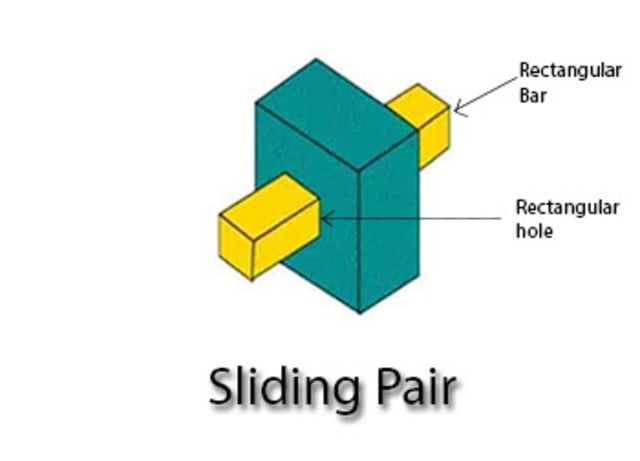
Q9: Define Sliding Pair.
Ans: A sliding pair is a kinematic pair in which one link slides over another.
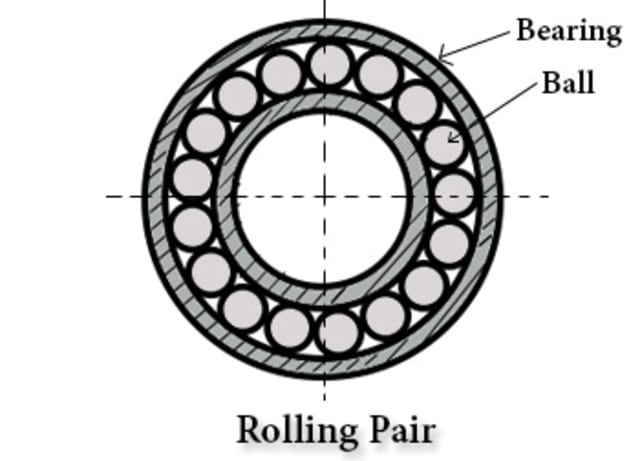
Q10: Define Rolling Pair.
Ans: The kinematic pair in which elements of the pair have rolling contact with each other is known as Rolling Pair.
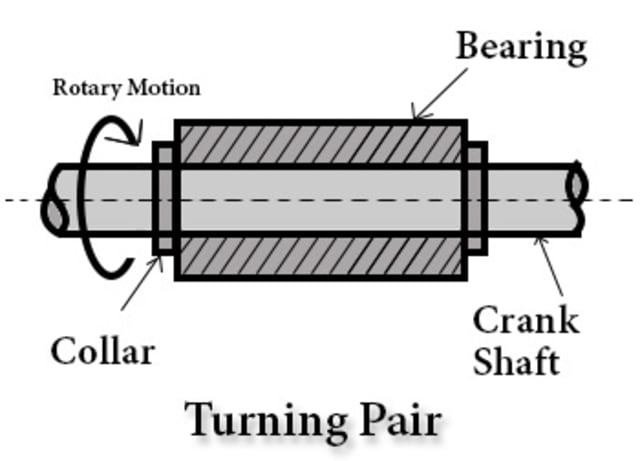
Q11: Define Turning Pair.
Ans: A turning pair is a kinematic pair in which one link rotates about a fixed axis relative to another link.
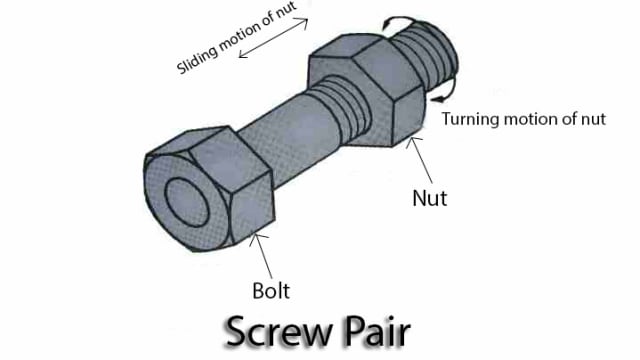
Q12: Define Screw Pair.
Ans: A screw pair is a kinematic pair in which one link has screw motion (rotation + translation) relative to another.
Q13: Define Lower Pair.
Ans: A lower pair is a kinematic pair in which two links have surface contact.
Q14: Define Higher Pair.
Ans: A higher pair is a kinematic pair in which two links have point or line contact.
Q15: State some examples of Kinematic Pairs.
Ans: Examples of kinematic pairs are:
- ➔ Piston and cylinder
- ➔ Nut and bolt
- ➔ Shaft and bearing
- ➔ Cam and follower
Q16: Define Kinematic Chain.
Ans: A kinematic chain is a combination of links connected in such a way that their relative motion is constrained.
Q17: State the types of Kinematic Chain.
Ans: The types of kinematic chain are:
- ➔ Simple chain
- ➔ Compound chain
- ➔ Complex chain
Q18: Briefly explain Kinematic Chain with Three Lower Pairs.
Ans: A kinematic chain with three lower pairs is a simple closed chain of three links connected by three lower pairs, forming a triangle-like structure with constrained motion.
Q19: Briefly explain Kinematic Chain with Four Lower Pairs.
Ans: A kinematic chain with four lower pairs consists of four links connected in a closed loop using four lower pairs, commonly used in mechanisms like four-bar linkages.
Q20: Briefly explain Un-constrained Chain.
Ans: An unconstrained chain is a kinematic chain in which relative motion between links is not restricted and free movement is possible.
Q21: Briefly explain Six Link Chain.
Ans: A six link chain is a kinematic chain consisting of six links connected in a closed or open loop, used in complex mechanisms.
Q22: Briefly explain Quadric cycle Chain.
Ans: A quadric cycle chain is a four-link kinematic chain used to produce rotary motion from oscillatory motion or vice versa.
Q23: Briefly explain Single Slider Crank Chain.
Ans: A single slider crank chain is a kinematic chain having one sliding pair and three turning pairs, used in engines to convert reciprocating motion into rotary motion.
Q24: Briefly explain Double Slider Crank Chain.
Ans: A double slider crank chain is a kinematic chain having two sliding pairs and two turning pairs, used in mechanisms like elliptical trammels.
Q25: Define Mechanism.
Ans: A mechanism is a kinematic chain in which one link is fixed and the others move relative to it to produce a desired motion.
Q26: State the types of Mechanism.
Ans: The types of mechanism are:
- ➔ Simple mechanism
- ➔ Compound mechanism
Q27: Define Simple Mechanism.
Ans: A simple mechanism is a mechanism formed by a single kinematic chain with one fixed link.
Q28: Define Compound Mechanism.
Ans: A compound mechanism is formed by combining two or more simple kinematic chains.
Q29: What are Elliptical Trammels?
Ans: Elliptical trammels is a double slider crank mechanism used to draw an ellipse by sliding two perpendicular sliders.