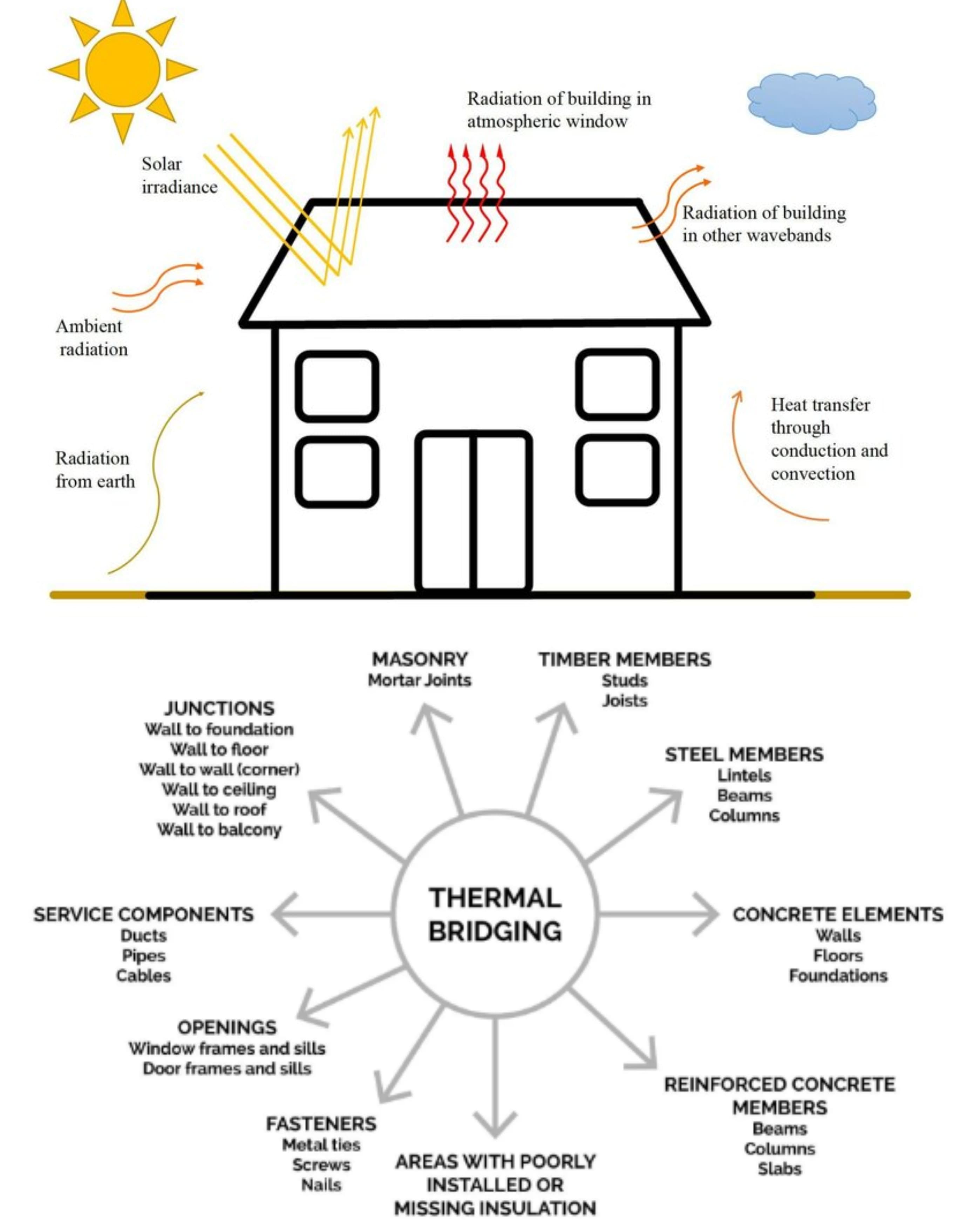
HEAT TRANSFER IN BUILDINGS
Other Chapters
PHYSICAL ENVIRONMENTCLIMATEVENTILATIONILLUMINATIONHEAT TRANSFER IN BUILDINGSWATER SUPPLY AND DRAINAGEPLUMBING AND SANITATION
- Q1: Define Heat.Ans: Heat is a form of energy that flows from a hotter object to a cooler one, causing temperature changes.
- Q2: Define Temperature.Ans: Temperature is a measure of the average kinetic energy of particles in a substance, indicating how hot or cold it is.
- Q3: Write different methods of heat transfer.Ans: The three methods of heat transfer are:
- ➔ Conduction
- ➔ Convection
- ➔ Radiation
- Q4: How does heat transfer in solids?Ans: In solids, heat transfer occurs through conduction, where heat moves from high to low temperature areas via particle collisions.
- Q5: How does heat transfer in liquids?Ans: In liquids, heat transfer occurs through convection, where heated molecules rise and cooler molecules sink, creating a current.
- Q6: How does heat transfer in gases?Ans: In gases, heat transfer also occurs through convection, but the molecules are more spread out, allowing for faster movement and heat transfer.
- Q7: Define Conduction.Ans: Conduction is the transfer of heat through direct contact between particles in a substance.
- Q8: Define Convection.Ans: Convection is the transfer of heat through the movement of fluids (liquids or gases), where hot particles rise and cooler particles sink.
- Q9: Define Radiation.Ans: Radiation is the transfer of heat in the form of electromagnetic waves, such as infrared radiation, which can travel through a vacuum.
- Q10: What is Thermal Insulation?Ans: Thermal insulation is the process of reducing the transfer of heat between objects, typically using materials that resist heat flow.
- Q11: What are three general applications of temperature range?Ans: These are:
- ➔ Home heating and cooling
- ➔ Industrial processes (e.g., cooking, metalworking)
- ➔ Electronics and machinery that require temperature control
- Q12: What is the selection criteria for insulating materials?Ans: Insulating materials are chosen based on their thermal conductivity, cost, durability, fire resistance, and ease of installation.
- Q13: Name some thermal insulating materials.Ans: Some of the thermal insulating materials are:
- ➔ Fiberglass
- ➔ Cellulose
- ➔ Mineral wool
- ➔ Polystyrene
- ➔ Polyurethane
- ➔ Aerogel
- Q14: Enlist the types of insulation.Ans: The types are:
- ➔ Thermal insulation
- ➔ Acoustic insulation
- ➔ Electrical insulation
- Q15: Enlist the forms of insulation.Ans: The forms are:
- ➔ Batts and rolls
- ➔ Rigid boards
- ➔ Loose-fill
- ➔ Spray foam
- Q16: Define Thermal Conductivity.Ans: Thermal conductivity is the ability of a material to conduct heat, usually expressed in watts per meter per degree Celsius (W/m·K).
- Q17: Define Thermal Resistance.Ans: Thermal resistance is the property of a material to resist the flow of heat, and it is the inverse of thermal conductivity.
- Q18: Define Specific Heat Capacity.Ans: Specific heat capacity is the amount of heat required to raise the temperature of one unit of mass of a substance by one degree Celsius.
- Q19: Define Density.Ans: Density is the mass of a substance per unit volume, typically measured in kilograms per cubic meter (kg/m³).
- Q20: Define Thermal Diffusivity.Ans: Thermal diffusivity is a measure of how quickly a material responds to changes in temperature, combining both its thermal conductivity and specific heat.
- Q21: Define Vapour Permeability.Ans: Vapour permeability is the ability of a material to allow water vapor to pass through it.
- Q22: What is Cellular glass available in?Ans: Cellular glass is available in rigid boards or blocks, often used as a high-performance insulation material.
- Q23: What is Cellulose available in?Ans: Cellulose is available in the form of loose-fill insulation or batts, often made from recycled paper products.
- Q24: What is Rock Mineral Wool available in?Ans: Rock mineral wool is available in batts, boards, and loose-fill forms for thermal and acoustic insulation.
- Q25: What is Phenolic foam?Ans: Phenolic foam is a rigid, closed-cell insulation material with low thermal conductivity and high fire resistance.
- Q26: What is Polyurethane?Ans: Polyurethane is a versatile insulation material, available in rigid foam boards, spray foam, or flexible forms with good thermal resistance.
- Q27: Define Aerogel.Ans: Aerogel is a highly porous, lightweight material with excellent insulating properties, often used in high-performance applications.
- Q28: What are Shading Devices?Ans: Shading devices are architectural elements designed to block or control the amount of sunlight entering a building.
- Q29: Name some Shading Devices.Ans: Some of the shading devices are:
- ➔ Blinds
- ➔ Awnings
- ➔ Shutters
- ➔ Louvers
- ➔ Overhangs
- Q30: Name some fixed exterior Shading Devices.Ans: Some of the exterior shading devices are:
- ➔ Fixed louvers
- ➔ Overhangs
- ➔ Pergolas
- ➔ Trellises
- Q31: Define Overhangs.Ans: Overhangs are horizontal extensions of a building's roof that provide shade to windows and reduce solar heat gain.
- Q32: What are Slanted louvers?Ans: Slanted louvers are angled slats that control the amount of light and air entering a space while blocking direct sunlight.
- Q33: Define Awnings.Ans: Awnings are fabric or metal coverings that extend over windows or doors to block sunlight and reduce heat gain.
- Q34: Define Canopy shade.Ans: A canopy is a roof-like structure that provides shade to outdoor areas, often made of fabric or metal.
- Q35: Define Groundcovers.Ans: Groundcovers are low-growing plants or materials used to cover soil, helping to control temperature and reduce heat absorption.
- Q36: Define Eggcrate shading.Ans: Eggcrate shading is a type of shading device with a grid-like structure that diffuses sunlight and reduces glare.
- Q37: Define Deciduous plants.Ans: Deciduous plants are trees or shrubs that lose their leaves in the fall and regrow them in the spring.
- Q38: Define Evergreen plants.Ans: Evergreen plants retain their leaves year-round, providing consistent shade and protection.
- Q39: Write the role of trees, bushes etc. to control a building’s temperature.Ans: Trees and bushes provide natural shade, reduce heat gain by blocking sunlight, and cool the air through transpiration, helping to lower indoor temperatures.
- Q40: Define Heat transfer.Ans: Heat transfer is the movement of thermal energy from a hotter object or area to a cooler one through conduction, convection, or radiation.