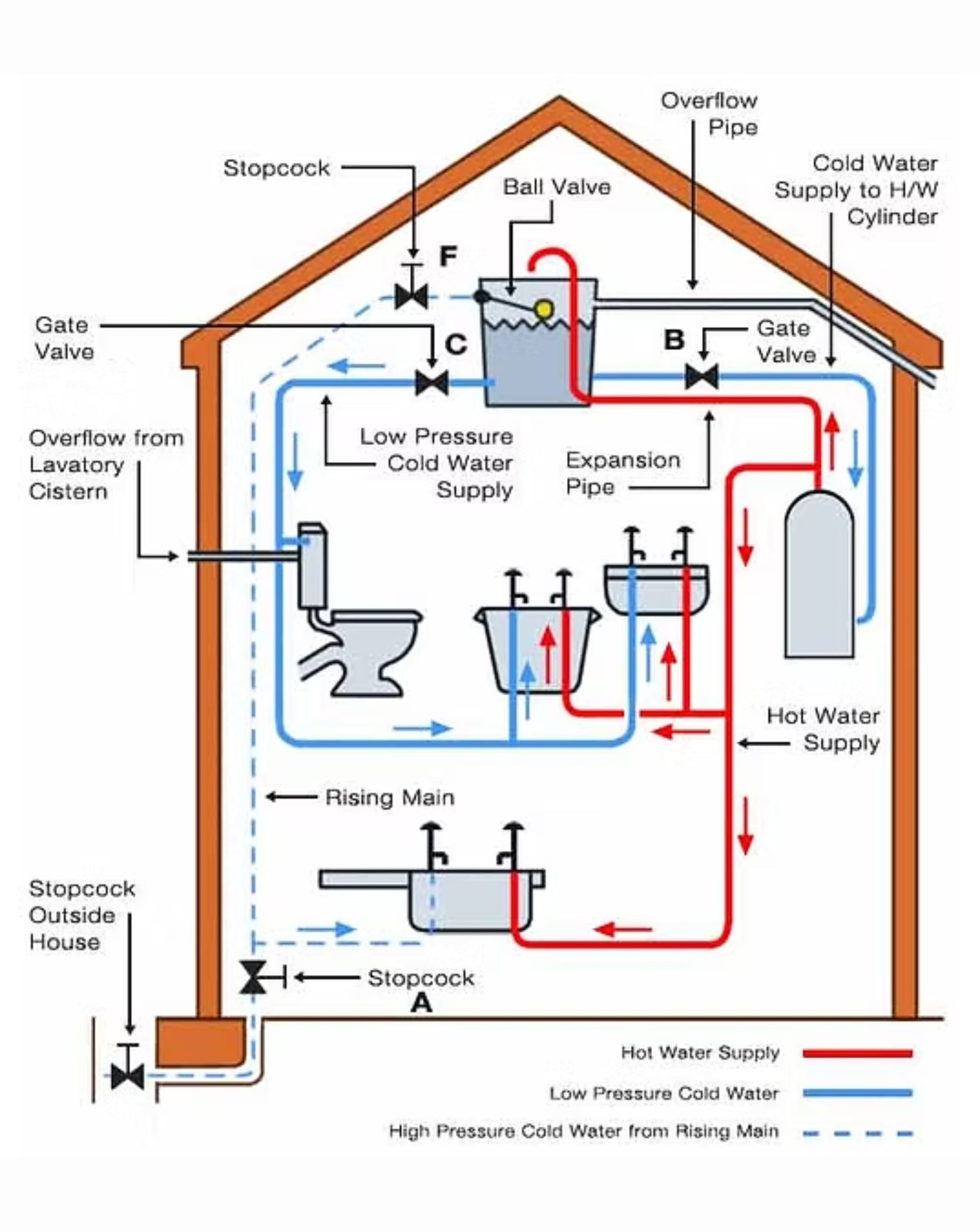
WATER SUPPLY AND DRAINAGE
Other Chapters
PHYSICAL ENVIRONMENTCLIMATEVENTILATIONILLUMINATIONHEAT TRANSFER IN BUILDINGSWATER SUPPLY AND DRAINAGEPLUMBING AND SANITATION
- Q1: Define Water Supply.Ans: Water supply is the process of providing water to meet the needs of a community, building, or system for drinking, sanitation, irrigation, and other uses.
- Q2: Why is Water Supply necessary?Ans: Water supply is necessary to ensure access to clean, safe water for drinking, hygiene, cooking, and maintaining health.
- Q3: Write the methods of domestic water supply.Ans: The methods are:
- ➔ Direct supply from a public water system.
- ➔ Borewells and tubewells.
- ➔ Rainwater harvesting.
- ➔ Storage tanks (overhead or underground).
- Q4: What are the different layouts for water supply?Ans: Common layouts include:
- ➔ Radial layout.
- ➔ Ring or circular layout.
- ➔ Grid system layout.
- Q5: Define Ring or Circular distribution method.Ans: In this method, water is distributed through a network of pipes arranged in a circular pattern, ensuring uniform pressure and easy maintenance.
- Q6: Define UGWT.Ans: A tank located underground to store water, often used for rainwater harvesting or as a backup water supply is called UGWT (Under Ground Water Tank).
- Q7: Define OHWT.Ans: A water tank placed above the ground level to provide water pressure through gravity flow is called OHWT (Over Head Water Tank).
- Q8: Define a Valve.Ans: A valve is a device used to control the flow of water or other fluids through pipes by opening, closing, or partially obstructing the passage.
- Q9: What are reservoirs?Ans: Reservoirs are large storage tanks or artificial lakes used to store water for supply and distribution.
- Q10: Name some plumbing equipment for water supply.Ans: Some of the plumbing equipment are:
- ➔ Pipes (PVC, copper, GI, etc.)
- ➔ Faucets and taps
- ➔ Valves (ball valves, gate valves)
- ➔ Pressure tanks
- ➔ Water meters
- Q11: Name different types of valves.Ans: Different types of valves are:
- ➔ Gate valve
- ➔ Globe valve
- ➔ Ball valve
- ➔ Check valve
- ➔ Butterfly valve
- Q12: What is the purpose of a valve?Ans: Valves regulate, control, or stop the flow of water within a piping system.
- Q13: Differentiate between globe and gate.Ans:
Globe valve: Used for regulating the flow of water and is better for throttling.
Gate valve: Mainly used to fully open or close the water flow and is not suitable for throttling. - Q14: Differentiate between reducer and union.Ans:
Reducer: A fitting used to connect pipes of different diameters.
Union: A fitting that allows two pipes to be easily connected and disconnected for maintenance. - Q15: Differentiate between cross and tee.Ans:
Cross: A fitting with four openings, used to connect four pipes at right angles.
Tee: A fitting with three openings, used to connect pipes in a T shape. - Q16: Enlist different pipes used in water supply.Ans: The different pipes are:
- ➔ PVC pipes
- ➔ Copper pipes
- ➔ GI (Galvanized Iron) pipes
- ➔ HDPE pipes
- ➔ CPVC pipes
- Q17: What is continuous water supply?Ans: Continuous water supply means water is provided at all times without interruptions.
- Q18: What is intermittent water supply?Ans: Intermittent water supply refers to water being supplied at certain times or intervals, with periods of no supply.
- Q19: Define drainage.Ans: Drainage refers to the system of removing excess water from an area, especially wastewater, from homes and buildings.
- Q20: Why is drainage necessary?Ans: Drainage is essential to prevent waterlogging, flooding, and to maintain hygiene by directing wastewater away from living spaces.
- Q21: Differentiate between drain and house sewer.Ans:
Drain: A pipe that carries wastewater from various sources like sinks, showers, or rainwater.
House sewer: A larger pipe that carries wastewater from the house to the main sewage system. - Q22: Enlist different pipes used in drainage systems.Ans: Different pipes are:
- ➔ PVC pipes
- ➔ RCC pipes
- ➔ Clay pipes
- ➔ CI (Cast Iron) pipes
- ➔ HDPE pipes
- Q23: Write the ways of disposal of an effluent.Ans: The ways of disposal are:
- ➔ Sewage treatment plants
- ➔ Septic tanks
- ➔ Recycling systems
- ➔ Soakage pits
- ➔ Sub-surface irrigation
- Q24: Define Septic Tank.Ans: A septic tank is an underground chamber used for the treatment and disposal of domestic wastewater by using natural processes of filtration and sedimentation.
- Q25: Define Soakage Pit.Ans: A soakage pit is a type of drainage system where wastewater is allowed to seep into the ground after filtration, helping to dispose of excess water.
- Q26: Define Manhole.Ans: A manhole is a covered opening in the ground that allows access to underground utilities like sewers or drainage systems for inspection or maintenance.
- Q27: Define Distribution box.Ans: A distribution box is a chamber used in septic systems to evenly distribute wastewater from the tank to drain fields or soakage pits.
- Q28: Define Vent Pipe/ Vent Stack.Ans: A vent pipe is used in plumbing systems to allow air into the system to prevent vacuum formation, ensuring smooth water flow and preventing odor.
- Q29: Define Rain water pipe.Ans: A rainwater pipe, often referred to as a downspout, is used to carry rainwater from the roof to the ground or drainage system.
- Q30: Write the importance of slope in drainage.Ans: The slope in drainage systems is essential to ensure the smooth flow of wastewater by gravity, preventing blockages and ensuring effective drainage.
- Q31: Write a few advantages of a soakage pit.Ans: A few advantages are:
- ➔ Reduces the risk of waterlogging.
- ➔ Helps in the filtration and natural treatment of wastewater.
- ➔ Cost-effective for small scale wastewater disposal.
- Q32: Write a few advantages of a septic tank.Ans: A few advantages are:
- ➔ Reliable and widely used in rural and suburban areas.
- ➔ Efficient in treating domestic wastewater.
- ➔ Easy to maintain with periodic cleaning.
- Q33: Write a few advantages of an OHWT.Ans: A few advantages are:
- ➔ Provides consistent water pressure.
- ➔ Stores water for future use during low supply periods.
- ➔ Easy to maintain and inspect.
- Q34: Write a few disadvantages of a septic tank.Ans: A few disadvantages are:
- ➔ Requires regular maintenance and pumping.
- ➔ Can contaminate groundwater if not properly maintained.
- ➔ Not suitable for high-density areas.
- Q35: What is an ideal slope of a drainage pipe?Ans: The ideal slope for a drainage pipe is between 1% and 2%, meaning a drop of 1 to 2 cm per meter of pipe length.
- Q36: What is the diameter kept for a soil pipe?Ans: The diameter for the soil pipe is 4 inches.
- Q37: What is the diameter kept for a waste pipe?Ans: The diameter for the soil pipe is 3 inches.