UNITS
Other Chapters
UNITSBUILDING SPECIFICATIONSBILL OF QUANTITITESMATERIAL STATEMENTMARKET RATE SCHEDULESCHEDULES OF BARSESTIMATIONRATE ANALYSIS
- Q1: Define Unit.Ans: A unit is defined as the reference standard used for measurements. For example: kg, m, ft etc.
- Q2: Define Bye Laws.Ans: Bye-laws are locally made rules that control building construction, safety, sanitation, land use, etc., within a city or town.
- Q3: Enlist different types of units.Ans: Types of units are:
- ➔ Basic Units
- ➔ Supplementary Units
- ➔ Derived Units
- Q4: Write down the basic SI units of the following:Ans:
Quantity Unit Length m (meter) Mass kg (kilogram) Time s (seconds) Current A (Ampere) Temperature K (Kelvin) - Q5: Define Metric System.Ans: A system of measurement in which the basic units are the meter, the second, and the kilogram. In this system, the ratios between units of measurement are multiples of ten.
- Q6: Define SI unit.Ans: The International System Of Units (SI) is the metric system that is used universally as a standard for measurements. Example: The SI unit of force is N (Newton).
- Q7: Differentiate between basic and derived units.Ans: A derived unit is a unit that is created by combining two or more base units. For example, the unit for speed is meters per second (m/s), which is a combination of the meter (length) and second (time) base units.
A basic unit is fundamental and cannot be expressed in terms of other units. Example N, kg, g etc. - Q8: Name the units commonly used in Civil Engineering Works.Ans:
- ➔ Meter
- ➔ Kilogram
- ➔ Cubic Meter
- ➔ Square Meter
- ➔ Litre
- Q9: Define Supplementary Units.Ans: Supplementary units are used along with base units to form derived units in the SI system. It contains radians and steradians.
- Q10: Write the difference of measuring units between English Method and P.W.D Method.Ans: The English Method uses Imperial units like feet, inches etc. while P.W.D Method uses Metric units like meters, centimeters etc.
- Q11: Write the measuring units for the following.Ans:
Item Measuring Unit Excavation m3 Bricks m3 DPC m2 Concrete Work m3 Plaster m2 Pointing m2 Steel quintals Roofing m2 Flooring m2 Piping m - Q12: Perform the following conversions.Ans:
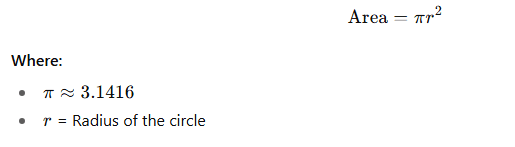
Convert Basic Scale Conversions 4000 m into cm 1 m = 100 cm 4000 × 100 = 400000 cm 120 ft into m 1 m = 3.28 ft 120 ÷ 3.28 = 36.6 m 3 Yard into ft 1 Yard = 3 ft 3 × 3 = 9 ft 5 m into Yard 1 Yard = 0.914 m 5 ÷ 0.914 = 5.46 Yard 500 ft into inch 1 ft = 12 inch 500 × 12 = 6000 inch 500 inch into ft 1 ft = 12 inch 500 ÷ 12 = 41.7 ft 800 Miles into furlong 1 Mile = 8 Furlong 800 × 8 = 6400 furlong 500 Tons into kg 1 Ton = 1000 kg 500 × 1000 = 500000 kg 8000 ft to Miles 1 Mile = 5280 ft 8000 ÷ 5280 = 1.52 Miles 12 Kanal into Marla 1 Kanal = 20 Marla 12 × 20 = 240 Marla - Q13: Write the formula of area of a circle.Ans:
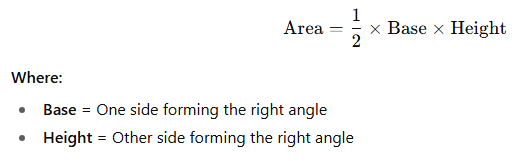
- Q14: Write the formula of area of a right angle triangle.Ans: