Q1: Define Foundry.
Ans: A foundry is a workshop or factory where metals are melted and cast into desired shapes using molds.
Q2: Define casting process.
Ans: Casting is a manufacturing process in which molten metal is poured into a mold to take the shape of the mold after solidification.
Q3: State the basic steps in the casting process.
Ans:
The basic steps in the casting process are as follows:- ➔ Pattern making
- ➔ Mold preparation
- ➔ Melting the metal
- ➔ Pouring the molten metal into the mold
- ➔ Cooling and solidification
- ➔ Removal of casting and finishing
Q4: State Molding process.
Ans: Molding is the process of preparing a hollow cavity in the shape of the desired casting, into which molten metal is poured.
Q5: Define Pattern.
Ans: A pattern is a replica of the object to be cast, used to create the mold cavity for casting.
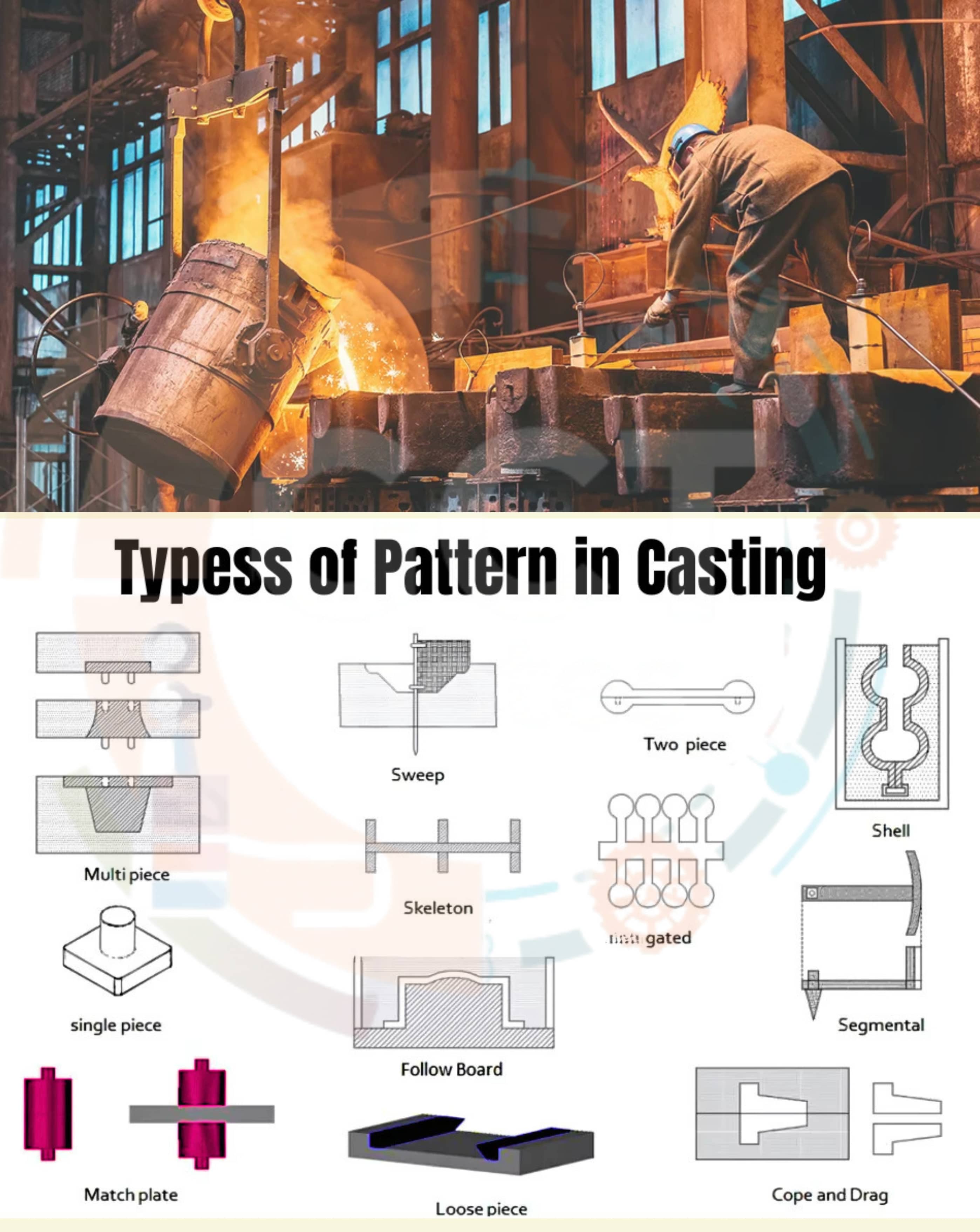
Q6: State the types of pattern.
Ans:
The types of patterns are:- ➔ Single-piece pattern
- ➔ Solid pattern
- ➔ Two-piece pattern
- ➔ Split pattern
- ➔ Loose-piece pattern
- ➔ Multi-piece pattern
- ➔ Match plate pattern
- ➔ Gated pattern
- ➔ Skeleton pattern
- ➔ Sweep pattern
- ➔ Cope and drag pattern
- ➔ Segmented pattern
Q7: State some pattern materials.
Ans:
Some common pattern materials are:- ➔ Wood
- ➔ Metal
- ➔ Plastic
- ➔ Wax
- ➔ Plaster of Paris
Q8: Define Single-piece Pattern.
Ans: A single-piece pattern is a simple pattern made of one piece, used for casting simple shapes without undercuts.
Q9: Define Solid Pattern.
Ans: A solid pattern is a single, solid piece used to make molds for simple castings with no cores.
Q10: Define Two-piece Pattern.
Ans: A two-piece pattern is divided into two parts to make molds for castings that are difficult to remove as a single piece.
Q11: Define Split Pattern.
Ans: A split pattern is a pattern divided into two or more parts to allow easy removal from the mold without damaging it.
Q12: Define Loose-piece Pattern.
Ans: A loose-piece pattern has detachable sections to form cavities for internal features like holes or recesses.
Q13: Define Multi-piece Pattern.
Ans: A multi-piece pattern consists of several parts used to make complex castings with intricate shapes.
Q14: Define Match plate Pattern.
Ans: A match plate pattern is a pattern mounted on a plate with both cope and drag sides, used for mass production in sand casting.
Q15: Define Gated Pattern.
Ans: A gated pattern is a pattern with channels or gates included, which help guide molten metal into the mold efficiently.
Q16: Define Skeleton Pattern.
Ans: A skeleton pattern is a framework-like pattern used for large castings to reduce the weight of the mold.
Q17: Define Sweep Pattern.
Ans: A sweep pattern is formed by rotating a template or sweep to shape the mold for symmetrical objects like wheels or pulleys.
Q18: Define Cope and drag Pattern.
Ans: A cope and drag pattern is divided into top (cope) and bottom (drag) sections to create molds for larger or more complex castings.
Q19: Define Segmented Pattern.
Ans: A segmented pattern is made of several sections that can be assembled to create large or irregular-shaped castings.
Q20: Which pattern material can be used again and again for casting?
Ans: Metal patterns, such as those made from steel or aluminum, can be reused multiple times because they are durable and resistant to wear.