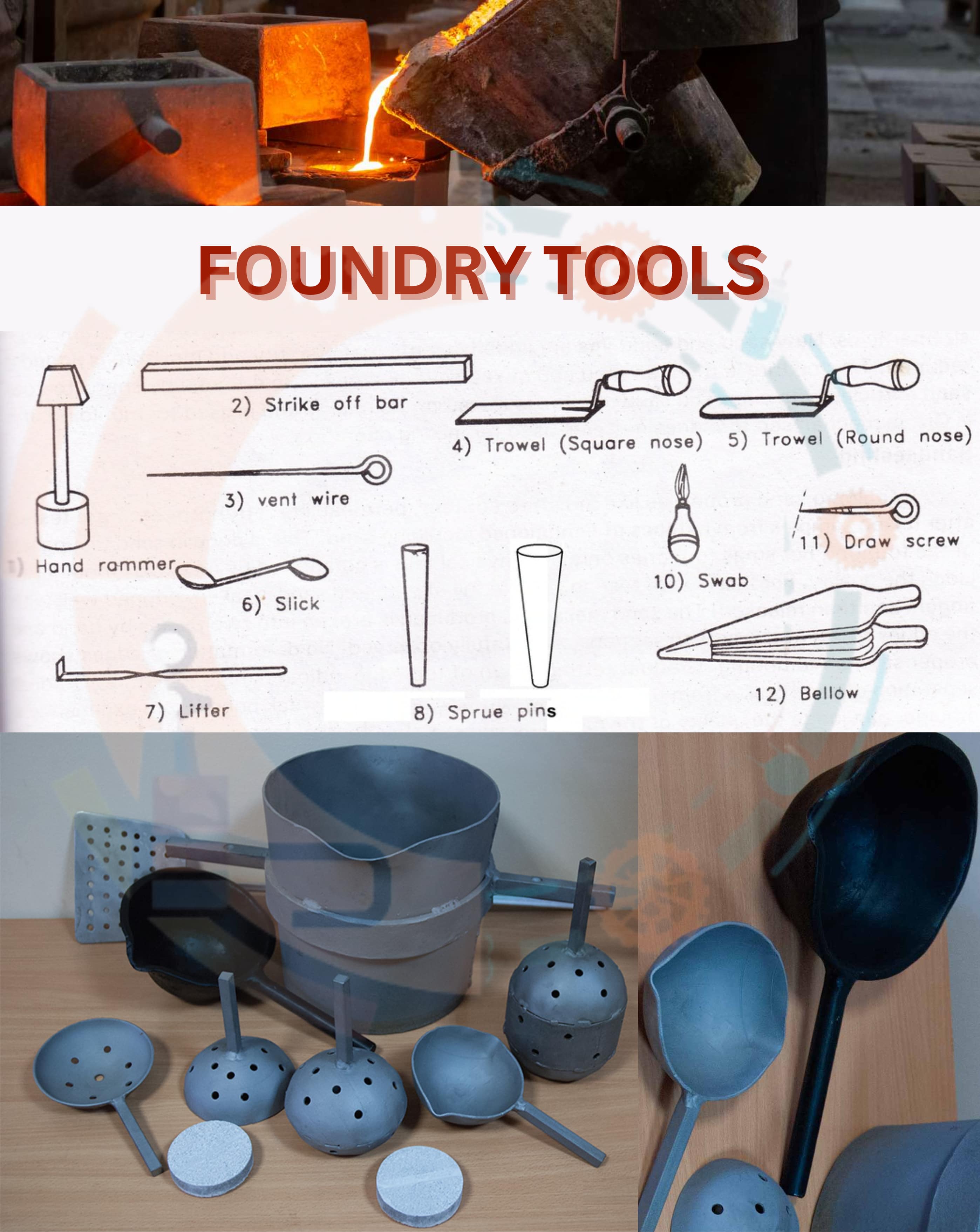
Q1: Define Mold.
Ans: A mold is a hollow cavity of the desired shape into which molten metal is poured to form a casting.
Q2: What are hand molding tools?
Ans: Hand molding tools are tools used manually to prepare molds, shape sand, and finish mold surfaces in foundry work.
Q3: Name 4 molding tools.
Ans:
Four common molding tools are:- ➔ Shovel
- ➔ Sprinkler
- ➔ Rammer
- ➔ Trowel
Q4: Define Shovel.
Ans: A shovel is a tool used for lifting and transferring molding sand during mold preparation.
Q5: Define Sprinkler.
Ans: A sprinkler is a perforated tool used to sprinkle water evenly on the sand to maintain proper moisture content.
Q6: Define Rammer.
Ans: A rammer is a tool used to compact molding sand firmly into the mold cavity.
Q7: Define Riddle.
Ans: A riddle is a sieve-like tool used to remove lumps and impurities from molding sand to make it fine and uniform.
Q8: Define Vent wire.
Ans: A vent wire is a thin wire used to create small holes in the mold for the escape of gases during casting.
Q9: Define Strike-off bar.
Ans: A strike-off bar is a straight tool used to level and remove excess sand from the top of the mold.
Q10: Define Lifters.
Ans: Lifters are small tools used to lift cores or molds from the sand without damaging them.
Q11: Define Trowel.
Ans: A trowel is a flat, hand-held tool used to smooth and shape the surface of the mold.
Q12: Define Slicks.
Ans: Slicks are tools with flat or rounded ends used for finishing and smoothing the inside of mold cavities.
Q13: Define Sprue pins.
Ans: Sprue pins are tools used to make holes in the mold for pouring molten metal into the cavity.
Q14: Define Sprue cutter.
Ans: A sprue cutter is a tool used to cut the sprue channels in the mold to control the flow of molten metal.
Q15: Define Swab.
Ans: A swab is a sponge-like tool used to moisten the mold surface or remove loose sand particles.
Q16: Define Mallet.
Ans: A mallet is a wooden or rubber hammer used to tap and compact sand without damaging the mold.
Q17: Define Spike/Screw.
Ans: A spike or screw is used to make small holes or marks in the mold to create vents or alignment points.
Q18: Define Bellow.
Ans: A bellow is a tool used to blow air into the mold to remove loose sand and dust.
Q19: Define Gate cutter.
Ans: A gate cutter is used to shape the gates in the mold through which molten metal flows into the cavity.
Q20: Define Spirit Level.
Ans: A spirit level is a tool used to check the horizontal or vertical alignment of the mold surface.
Q21: Define Molding board.
Ans: A molding board is a flat surface on which sand molds are prepared and assembled.
Q22: Define Clamps.
Ans: Clamps are devices used to hold mold parts or match plates together firmly during mold preparation.
Q23: Define Gagger.
Ans: A gagger is a tool used to pack sand around the mold cavity tightly to avoid defects in casting.
Q24: Define Shake bag or Dust bag.
Ans: A shake bag or dust bag contains fine sand used to dust the mold surface to prevent metal from sticking.
Q25: Define Molding Machine.
Ans: A molding machine is a mechanical device used to prepare sand molds with uniform compaction automatically.
Q26: Define Jolting.
Ans: Jolting is the process of compacting sand in a mold using a rapid vertical motion to achieve density.
Q27: Define Jolt machine.
Ans: A jolt machine is a machine that compacts molding sand by a jolting or vibrating action to prepare molds.
Q28: Define Squeeze machine.
Ans: A squeeze machine is a mechanical device that compresses sand under pressure to form a firm mold.
Q29: Define Jolt and Squeeze Machine.
Ans: A jolt and squeeze machine combines jolting and squeezing actions to prepare uniformly compacted sand molds.
Q30: Define Sand Mixing machine.
Ans: A sand mixing machine is used to mix sand with water and bonding materials to make it suitable for molding.
Q31: Define Sand Mullar machine.
Ans: A sand mullar machine is a heavy rotating machine used to knead and mix molding sand thoroughly.
Q32: Define Sand Blasting & Shot Blasting machine.
Ans: These machines clean, smooth, and prepare molds or castings by propelling sand or metal shots at high speed onto surfaces.
Q33: Define Furnace.
Ans: A furnace is a device used to heat metals to a molten state for casting or other metalworking processes.
Q34: Define Pit Furnace.
Ans: A pit furnace is a type of furnace built below ground level to melt metals using coal or coke as fuel.
Q35: Define Crucible Pit Furnace.
Ans: A crucible pit furnace uses crucibles placed in a pit to melt metal, suitable for small-scale casting.
Q36: Define Coke Fired Furnace.
Ans: A coke-fired furnace melts metals using coke as fuel, providing high temperatures for casting operations.
Q37: Define Oil Fired Furnace.
Ans: An oil-fired furnace melts metals using oil as fuel, providing a controlled and efficient heat source.
Q38: Define Gas Fired Furnace.
Ans: A gas-fired furnace uses gas fuel to melt metals, offering quick heating and cleaner operation.
Q39: Define Tilting Furnace.
Ans: A tilting furnace is designed to pour molten metal easily by tilting the furnace body, reducing handling risks.
Q40: Define Lift-out Furnace.
Ans: A lift-out furnace has a removable crucible or container to lift out molten metal safely for pouring.
Q41: Define Bale-out Furnace.
Ans: A bale-out furnace allows molten metal to be drained through a tap hole into molds or ladles efficiently.