Q1: Define P.C.C.
Ans: P.C.C stands for Plain Cement Concrete, which is a mixture of cement, sand, aggregate, and water without any reinforcement. It is used in flooring, foundations, and leveling surfaces.
Q2: Define R.C.C.
Ans: R.C.C stands for Reinforced Cement Concrete, which is cement concrete strengthened with steel reinforcement bars to resist tensile and compressive stresses.
Q3: What are some benefits of using steel in concrete?
Ans: Following are some advantages of using using steel in concrete:
- ➔ Steel makes concrete strong
- ➔ Steel helps concrete resist cracking
- ➔ Steel helps to carry more load
- ➔ Steel increases the life of concrete structure
Q4: Write four advantages of R.C.C.
Ans: Following are some advantages of using R.C.C:
- ➔ It is strong and durable
- ➔ It can carry heavy loads
- ➔ It is earthquake resistant
- ➔ It can be made into various shapes
Q5: Write four disadvantages of R.C.C.
Ans: Following are some disadvantages of using R.C.C:
- ➔ The initial cost of RCC is high
- ➔ It is heavy in weight
- ➔ It need more time for construction
- ➔ It requires skilled labour
Q6: Define R.B.C.
Ans: R.B.C stands for Reinforced Brick Concrete, a construction technique where bricks and concrete are used together with reinforcement, typically in slab construction for economical roofing.
Q7: Name the types of reinforcement used in concrete.
Ans: Following are the types of steel used in concrete:
➔ According to Shape:- ➔ Square Bars
- ➔ Round Bars
- ➔ Hexagonal Bars
- ➔ Octagonal Bars
➔ According to Surface:- ➔ Plain Bars
- ➔ Deformed Bars
➔ According to Strength:- ➔ 40 Grade Steel
- ➔ 60 Grade Steel
- ➔ 75 Grade Steel
- ➔ 90 Grade Steel
➔ According to Material:- ➔ Mild Steel (0.05 to 0.3% carbon)
- ➔ Medium Carbon Steel (0.3 to 0.6% carbon)
- ➔ High Carbon Steel (0.6 to 1.5% carbon)
➔ According to Use:- ➔ Ordinary Bars
- ➔ Pre-stressed Bars
Q8: Define slab.
Ans: A slab is a flat horizontal structural element, usually made of reinforced concrete, used to create floors and ceilings in buildings.
Q9: Define one-way slab.
Ans: A one-way slab is a slab supported on two opposite sides only, where the load is carried in one direction along the shorter span.It is generally used when the slab's length-to-breadth ratio is equal or greater than 2.
Q10: Define two-way slab.
Ans: A two-way slab is supported on all four sides and carries loads in both directions. It is generally used when the slab's length-to-breadth ratio is less than 2.
Q11: Differentiate bewteen One-way and Two-way slab.
Ans: | Aspects | One-way Slab | Two-way Slab |
|---|
| Also Known as | Slab Spanning in One Direction | Slab Spanning in Two Directions |
| Span | L/b ratio is greater than or equal to 2 | L/b ratio is less than 2 |
| Support of Beams | Supported by beams on two opposite sides only | Supported by beams on all four sides |
| Reinforcement | Main bars placed at shorter span & Distribution bars in longer span | Main bars provided in both directions |
| Load | Load is carried in one direction perpendicular to beams | Load is carried in both directions |
| Examples | Floors | Verandahs |
Q12: Define waffle slab.
Ans: A waffle slab is a reinforced concrete slab with a grid pattern of ribs on the underside, resembling a waffle. It is used to reduce weight and increase strength, especially for large spans.
Q13: Define ribbed slab.
Ans: A ribbed slab is a type of slab where concrete is placed only in the top slab and along narrow ribs, with voids in between. It reduces dead weight and is used for medium to large spans.
Q14: Define bubble deck slab.
Ans: A bubble deck slab is a type of slab that uses hollow plastic balls (bubbles) embedded in the concrete to reduce its self-weight by removing unused concrete from the middle zone, while maintaining structural strength and stiffness.
Q15: What is meant by main steel?
Ans: Main steel refers to the primary reinforcement bars placed in the direction of maximum bending moment to resist tensile stresses.
Q16: What are the functions of distribution steel?
Ans: Distribution steel (secondary reinforcement) is provided to distribute loads evenly, control shrinkage cracks, and support the main reinforcement in slabs.
Q17: Differentiate between clear concrete cover and effective concrete cover in RCC slab.
Ans: Clear cover is the distance between the outer surface of the concrete and the nearest surface of the reinforcement. Effective cover is the distance from the outer surface to the center of the main reinforcement bar.
Q18: Define self-weight of slab.
Ans: Self-weight of a slab is the weight of the slab itself, calculated based on its density and volume. For RCC, it is usually taken as 25 kN/m³.
Q19: Name different loads considered in the design of a slab.
Ans: The types of loads are:
- ➔ Live Load
- ➔ Dead Load
- ➔ Wind Load
- ➔ Superimposed Dead Load
- ➔ Temperature Load
- ➔ Seismic Load
- ➔ Impact Load
Q20: Define live load.
Ans: Live load is the moving load applied to a structure, such as the weight of people, furniture, or vehicles. It is the load that keeps on changing.
Q21: Differentiate between overall depth and effective depth of slab.
Ans: Overall depth is the total thickness of the slab, including cover. Effective depth is the distance from the top surface to the center of the tension reinforcement.
Q22: Define neutral axis.
Ans: The neutral axis is the imaginary axis in a structural member under bending where the fiber experiences zero stress — neither tension nor compression.
Q23: Write down the standard formula to calculate the effective depth of slab.
Ans: 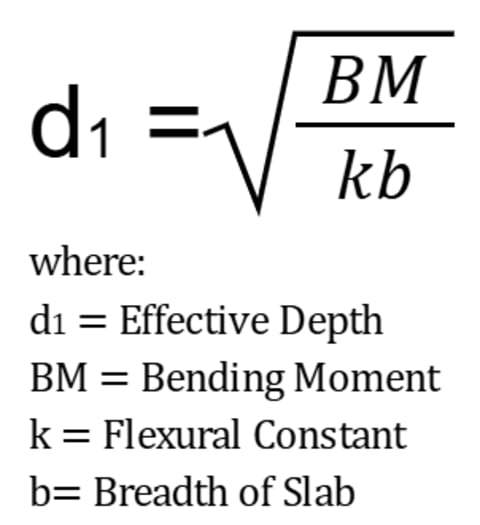
Q24: Differentiate between simply supported and cantilever slab.
Ans: | Aspects | Simply Supported Slab | Cantilever Slab |
|---|
| Support Condition | Supported at both ends | Fixed at one end, free at the other |
| Bending Moment | Bends downward (sagging) in the middle | Bends upward (hogging) at the fixed end |
| Reinforcement | Main bars placed at the bottom (mid-span) | Main bars placed at the top (fixed end) |
| Span | Shorter or moderate spans | Usually, shorter spans due to high bending at the fixed end |
| Examples | Room slabs, floor slabs between beams | Sunshades, balconies, projections without side supports |
Q25: Define Modular Ratio.
Ans: Modular Ratio (m) is the ratio of the modulus of elasticity of steel to the modulus of elasticity of concrete. It is used to analyze reinforced concrete sections as a single equivalent material.Formula:
m = Es / EcWhere:
Es = Modulus of elasticity of steel
Ec = Modulus of elasticity of concrete
Q26: What is the density of RCC in FPS system?
Ans: It is 140 to 150 lb/ft³. A commonly used average is 145 lb/ft³.
Q27: Write down the density of brickwork in FPS system.
Ans: It is 120 to 130 lb/ft³. A commonly used average is 125 lb/ft³.
Q28: How much live load is taken while designing domestic slab for house?
Ans: The live load is usually taken as 2.0 kN/m² (or 40 lb/ft²) for domestic slabs.