Q1: Define column.
Ans: A column is a vertical structural member designed to support compressive loads, transferring the weight from beams or slabs to the foundation.
Q2: What is the function of column?
Ans: the primary function of column is to transfer the load of slab and beam to the footing. A column resists compressive forces.
Q3: What is axially loaded column?
Ans: An axially loaded column is the column in which all loads(forces) are acting at the centroid of the column.
Q4: Define slender column.
Ans: A slender column is a column where the diameter is thin compared to the height and it fails by buckling.
Q5: Name the types of steel used in columns.
Ans: Following are the types of steel used in columns:
- ➔ Longitudinal Bars
- ➔ Traverse Bars
- ➔ Lateral Ties
- ➔ Helical Ties
Q6: What is meant by lateral ties?
Ans: Lateral ties are small-diameter steel bars used in reinforced concrete columns to hold the main longitudinal reinforcement in position and prevent buckling.
Q7: Define longitudinal bars.
Ans: Longitudinal bars are the main reinforcement bars placed along the length of structural members like columns and beams to resist axial and bending stresses.
Q8: Define helical ties.
Ans: Helical ties are spiral-shaped reinforcement bars wound around the longitudinal bars in circular columns to provide confinement and increase ductility.
Q9: Define pitch of lateral ties.
Ans: The pitch of lateral ties is the center-to-center distance between two consecutive lateral or transverse ties in a reinforced concrete column.
Q10: What is splice?
Ans: In RCC construction, a splice is when two pieces of steel bars (rebars) are joined together to extend their length. This is done by overlapping and welding or tying them securely so that they can carry the load properly.
Q11: What is splice length?
Ans: Splice length in RCC construction is the length of the area where two rebars overlap and are joined together. This length is important to ensure that the bars are properly connected and can transfer the load safely.
Q12: What is splicing in column?
Ans: In RCC columns, a splice is the method used to join two pieces of reinforcement bars when the column is taller than the available bar lengths. The bars are spliced together at certain points to maintain strength and support the column.
Q13: What is slenderness ratio?
Ans: Slenderness ratio is the ratio of the effective length of a column to its least radius of gyration.
Q14: Define Buckling Load.
Ans: Buckling load is the maximum weight or force a structure can carry before it starts to bend or collapse due to pressure.
Q15: Define Crushing Load.
Ans: Crushing load is the amount of weight or force that a material can handle before it gets crushed or damaged.
Q16: Define Safe Load.
Ans: Safe load is the maximum weight or force a structure or material can safely carry without breaking or being damaged.
Q17: Define short column.
Ans: A short column is one that fails mainly due to direct compression. It has a slenderness ratio less than 80 or its height is less than 10 times its least lateral dimension.
Q18: Define long column.
Ans: A long column is one that fails mainly due to bending. It has a slenderness ratio greater than 80 or its height is more than 30 times its least lateral dimension.
Q19: What is footing?
Ans: Footing is the lowest part of a structure that distributes the load from columns or walls to the ground.
Q20: What is the function of footing?
Ans: The function of footing is to safely transfer the load of the structure to the soil, preventing excessive settlement or failure.
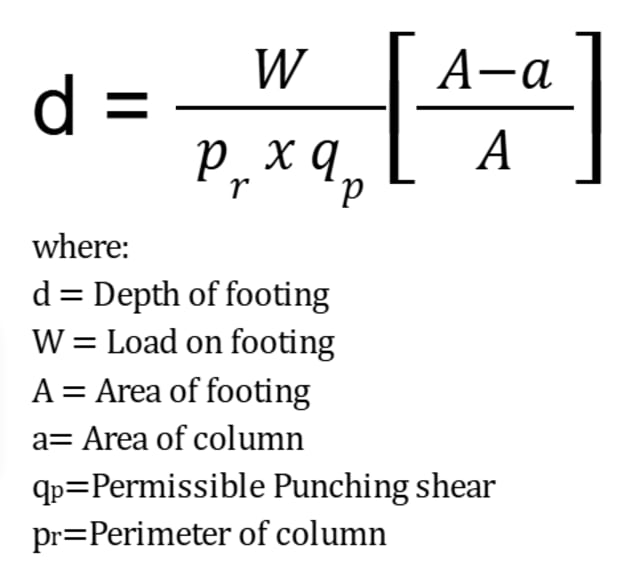
Q21: Write the formula to calculate depth of footing.
Ans: The depth of footing (D) can be calculated using the formula:
Q22: Define stirrups.
Ans: Stirrups are closed-loop steel bars used in reinforced concrete beams and columns to hold the main reinforcement in place and to resist shear and torsional forces.
Q23: What should be the bending angle of stirrups?
Ans: The bending angle of stirrup should be 1350.
Q24: Define ties.
Ans: Ties are tensile members used in reinforced concrete and steel structures to resist pulling forces and hold structural elements in position, commonly used in columns to confine reinforcement.
Q25: Define struts.
Ans: Struts are compressive members used in trusses and other structural systems to resist axial compression and transfer loads to supports.