Q1: Define Force.
Ans: A force is a push or pull applied on the body. The unit of force is N.
Q2: Name the types of force.
Ans: The types of force are as follows:
- ➔ Direct Force
- ➔ Tensile Force
- ➔ Compressive Force
- ➔ Axial Force
- ➔ Eccentric Force
- ➔ Shear Force
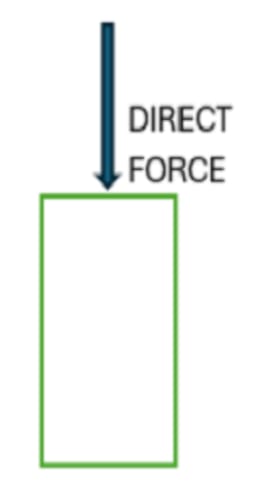
Q3: Define Direct Force.
Ans: A direct force acts normal(perpendicular i.e at 90 degrees) to the object is called Direct Force.
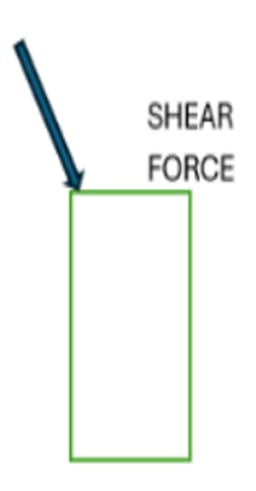
Q4: Define Shear Force.
Ans: A shear force that acts tangent(angle other than 90 degrees) to the object is called Shear Force.
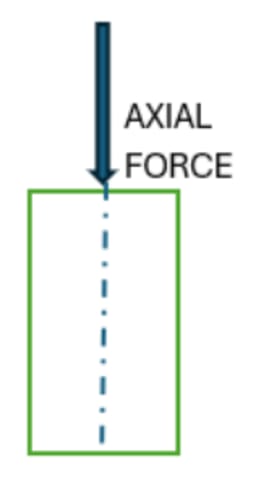
Q5: Define Axial Force.
Ans: The force acting at the centroid of an object is called axial force.
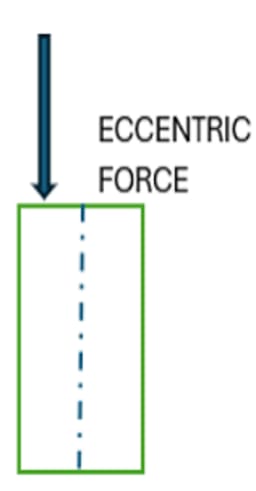
Q6: Define Eccentric Force.
Ans: The force acting away from the centroid of an object is called eccentric force.
Q7: Define Tensile Force.
Ans: A force that produces Tension (Increase in length) is called Tensile Force.
Q8: Define Compressive Force.
Ans: A force that produces Compression (Decrease in length) is called Compressive Force.
Q9: Define Tension.
Ans: Increase in length is called Tension.
Q10: Define Compression.
Ans: Decrease in length is called Compression.
Q11: Define Stress.
Ans: Stress is the internal resisting force developed inside a material when an external load is applied.
Formula:
Stress = Force / Area
Q12: Name the types of stress.
Ans: The types are:
- ➔ Direct Stress
- ➔ Tensile Stress
- ➔ Compressive Stress
- ➔ Shear Stress
Q13: Define Direct Stress.
Ans: Direct stress is the stress produced by Direct Force (when a force acts perpendicular to the cross-sectional area of a material).
Formula:
Direct Stress = Direct Force / Area
Q14: Define Shear Stress.
Ans: Shear stress is the stress produced by Shear Force (when a force acts parallel to the surface or cross-section of a material).
Formula:
Shear Stress = Shear Force / Area
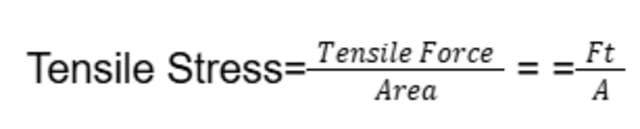
Q15: Define Tensile Stress.
Ans: Tensile stress is the stress produced when a material is pulled or stretched by an external force.
It increases the length of the material.
Q16: Define Compressive Stress.
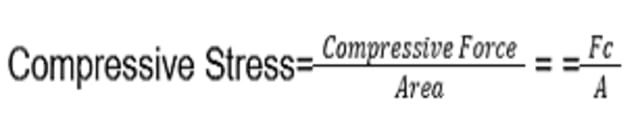
Ans: Compressive stress is the stress produced when a material is compressed or squeezed by an external force.
It decreases the length of the material.
Q17: Write down the unit of stress in:
Ans: | System | Measuring Unit |
|---|
| MKS | kg/m2 |
| CGS | g/cm2 |
| FPS | lbs/ft2 |
| SI | N/m2 |
Q18: Define Bending Stress.
Ans: The stress produced by Bending Moment is Bending Stress.
Q19: Enlist various modes through which forces affect structural members.
Ans: Some of the modes are:
- ➔ Tension
- ➔ Compression
- ➔ Shearing
- ➔ Bending
- ➔ Torsion
Q20: Differentiate between ordinary and pure bending.
Ans: A bending moment produced by forces that do not form a couple is ordinary Bending.
The bending moment produced by forces that form a couple is Pure Bending.
Q21: Define Neutral surface.
Ans: A neutral surface is the surface of a beam that does not undergo any tension or compression. At this surface, the force and its effects are zero.
Q22: What do you know about section modulus?
Ans: The ratio of Moment of Inertia and distance of extreme fibre from the centroidal axis is section modulus.
Q23: State any two postulates of bending theory.
Ans: Two points are:
- ➔ Beam is straight
- ➔ The material of beam is elastic
- ➔ Hook’s Law is applicable to the material of beam
Q24: State bending equation.
Ans: 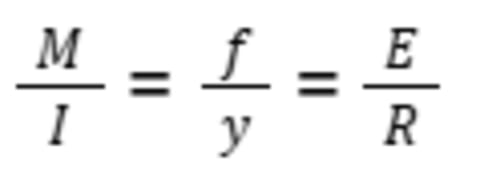
where
M = Bending Moment
I = Moment of Inertia
E = Young’s Modulus
R = Radius of Curvature