Q1: What is Conventional Machining?
Ans: Conventional Machining is the traditional method of material removal where a cutting tool physically removes material from a workpiece using mechanical force, e.g., turning, milling, drilling, and grinding.
Q2: What is Un-Conventional Machining?
Ans: Un-Conventional Machining, also called Non-Traditional Machining, removes material using non-mechanical methods such as electrical, chemical, or thermal energy instead of a cutting tool.
Q3: State some Non-Traditional Machining Processes?
Ans: Non-Traditional Machining Processes include:
- ➔ Electrical Discharge Machining (EDM)
- ➔ Electron Beam Machining (EBM)
- ➔ Electro-Chemical Machining (ECM)
- ➔ Laser Beam Machining (LBM)
- ➔ Ultrasonic Machining (USM)
Q4: What is an EDM?
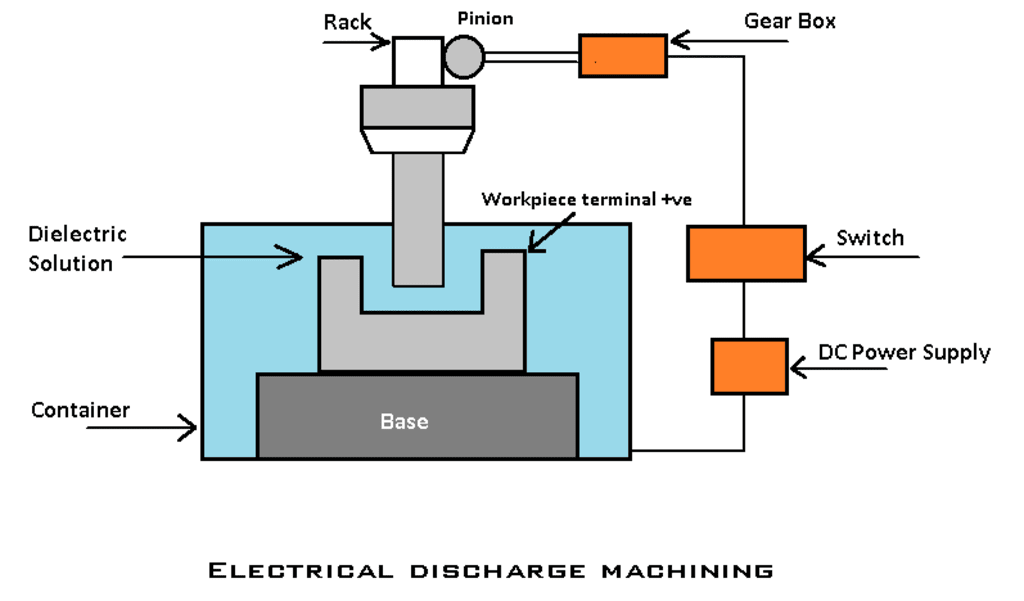
Ans: EDM (Electrical Discharge Machining) is a non-traditional machining process where material is removed from a workpiece by a series of electrical sparks between an electrode and the workpiece in the presence of a dielectric fluid.
Q5: Briefly explain the working principle of EDM.
Ans: EDM works on the principle of spark erosion. A high-frequency electric spark is generated between the tool (electrode) and the workpiece, both submerged in a dielectric fluid. The spark produces intense heat which melts and vaporizes small portions of the material, gradually shaping the workpiece.
Q6: Briefly discuss the EDM process.
Ans: EDM Process Steps:
1. The workpiece and electrode are immersed in a dielectric fluid.
2. A pulsed current is applied between them.
3. Sparks erode the workpiece material.
4. The dielectric fluid cools and flushes away debris.
5. Repeated cycles produce the desired shape.
Q7: What is Conventional EDM?
Ans: Conventional EDM uses a shaped electrode to cut cavities or profiles into a workpiece through spark erosion, typically for dies, molds, and intricate parts.
Q8: What is Wire-cut EDM?
Ans: Wire-cut EDM uses a thin wire as the electrode to cut intricate shapes and contours through a workpiece by spark erosion while the workpiece is submerged in dielectric fluid.
Q9: What are Dielectric Fluids?
Ans: Dielectric Fluids are electrically non-conductive liquids used in EDM to control sparks, cool the workpiece, and flush away eroded material. Common examples are kerosene and deionized water.
Q10: What is Flushing Ram Type EDM?
Ans: Flushing Ram Type EDM uses a ram to move the electrode toward the workpiece while a dielectric fluid is flushed through the tool to remove debris and improve spark efficiency.
Q11: What is Wire EDM Dielectric Fluid?
Ans: In Wire EDM, deionized water is used as a dielectric fluid to carry away particles, cool the workpiece, and allow controlled spark discharge between the wire and workpiece.
Q12: What is Servo Mechanism?
Ans: A Servo Mechanism in EDM automatically controls the gap between the electrode and workpiece, ensuring consistent spark generation and preventing short circuits or wire breakage.
Q13: Write any four advantages of EDM.
Ans: Advantages of EDM:
- ➔ Can cut hard materials that are difficult to machine conventionally
- ➔ Can produce intricate shapes and profiles
- ➔ High dimensional accuracy and surface finish
- ➔ No direct mechanical force on the workpiece, reducing stress
Q14: Write four characteristics of EDM Electrode.
Ans: Characteristics of EDM Electrode:
- ➔ Electrically conductive
- ➔ Shape determines the profile of the cut
- ➔ Resistant to erosion compared to the workpiece
- ➔ Can be made from copper, graphite, or brass
Q15: What is EBM?
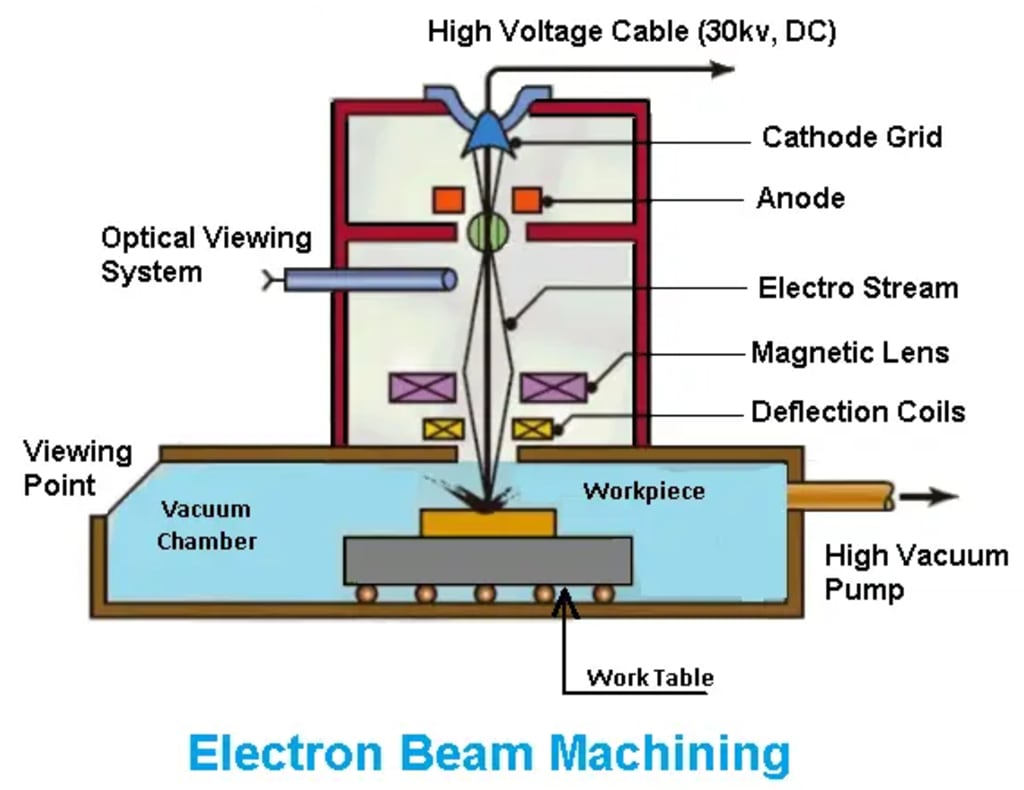
Ans: EBM (Electron Beam Machining) is a non-traditional machining process in which high-velocity electrons strike a workpiece, generating heat that melts and vaporizes material for precise cutting.
Q16: Briefly discuss the process of EBM.
Ans: EBM Process:
1. A high-velocity electron beam is focused on the workpiece.
2. Kinetic energy of electrons converts into heat.
3. Material melts and vaporizes at the impact spot.
4. The beam is controlled to produce the desired cut or hole.
Q17: Write any two uses of EBM.
Ans: Uses of EBM:
- ➔ Precision drilling in turbine blades
- ➔ Cutting of hard metals and alloys
Q18: Write any four advantages of EBM.
Ans: Advantages of EBM:
- ➔ High precision and accuracy
- ➔ Can machine very hard materials
- ➔ Small heat-affected zone
- ➔ Can cut complex shapes
Q19: Write any four characteristics of EBM.
Ans: Characteristics of EBM:
- ➔ High energy electron beam source
- ➔ Requires vacuum environment
- ➔ Can machine metals without contact
- ➔ Produces minimal mechanical stress
Q20: Briefly explain the working principle of EBM.
Ans: EBM works by accelerating electrons in a vacuum towards a workpiece. When electrons hit the surface, their kinetic energy converts to heat, melting or vaporizing the material to shape it precisely.
Q21: What is ECM?
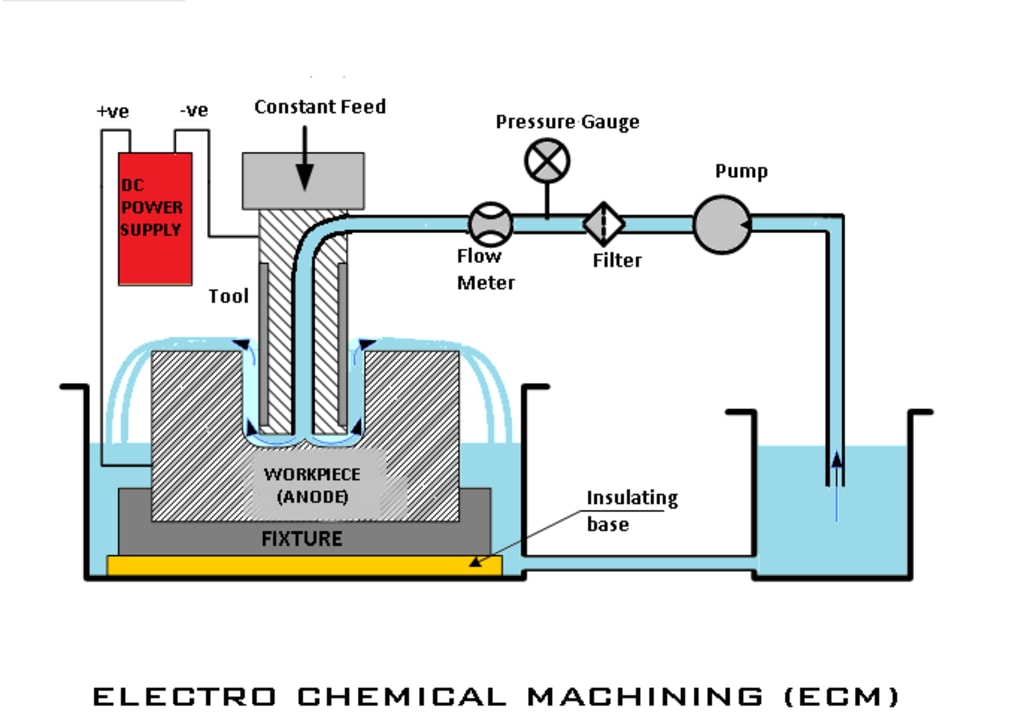
Ans: ECM (Electro-Chemical Machining) is a non-traditional machining process in which material is removed from a workpiece by anodic dissolution in an electrolytic cell, using a tool as the cathode.
Q22: Briefly discuss the process of ECM.
Ans: ECM Process:
1. The workpiece is made the anode, and the tool is the cathode.
2. Electrolyte flows between tool and workpiece.
3. When voltage is applied, material dissolves from the workpiece.
4. The tool shape determines the final workpiece shape.
5. No mechanical force is applied, ensuring stress-free machining.
Q23: Write any four advantages of ECM.
Ans: Advantages of ECM:
- ➔ Can machine hard and complex shapes
- ➔ No tool wear
- ➔ Stress-free machining without mechanical forces
- ➔ High surface finish and accuracy
Q24: Write any two uses of ECM.
Ans: Uses of ECM:
- ➔ Machining of turbine blades and dies
- ➔ Removing metal from hard alloys
Q25: Write any four characteristics of ECM.
Ans: Characteristics of ECM:
- ➔ Uses electrolytic solution as a medium
- ➔ No direct contact between tool and workpiece
- ➔ Can machine hard materials
- ➔ Tool acts as a cathode, workpiece as an anode
Q26: Briefly explain the working principle of ECM.
Ans: ECM works on the principle of electrolysis. When a DC voltage is applied across the workpiece and tool in an electrolyte, metal dissolves from the workpiece without any mechanical cutting, following the shape of the tool.
Q27: What is ELG?
Ans: ELG (Electrochemical Grinding) is a non-traditional machining process that combines mechanical grinding with electrochemical action to remove material from a workpiece.
Q28: Briefly discuss the process of ELG.
Ans: ELG Process:
1. The workpiece is connected as an anode and the conductive grinding wheel acts as a cathode.
2. Electrolyte flows between the wheel and workpiece.
3. Material is removed by electrochemical dissolution and minor mechanical abrasion.
4. This allows machining of hard and intricate shapes.
Q29: Write any four uses of ELG.
Ans: Uses of ELG:
- ➔ Grinding hard metals and alloys
- ➔ Producing precise shapes and profiles
- ➔ Sharpening hardened cutting tools
- ➔ Machining difficult-to-cut materials like carbides
Q30: Write any four advantages of ELG.
Ans: Advantages of ELG:
- ➔ Can machine hard and brittle materials
- ➔ Less mechanical stress on workpiece
- ➔ High surface finish
- ➔ Reduces wheel wear compared to conventional grinding
Q31: Write any two dis-advantages of ELG.
Ans: Disadvantages of ELG:
- ➔ Requires conductive materials
- ➔ Electrolyte handling can be messy and corrosive
Q32: Write any four characteristics of ELG.
Ans: Characteristics of ELG:
- ➔ Combines mechanical grinding and electrochemical action
- ➔ Conductive grinding wheel is used
- ➔ Material removal is precise and stress-free
- ➔ Requires electrolyte for process
Q33: Briefly explain the working principle of ELG.
Ans: ELG works by applying voltage between the conductive grinding wheel and workpiece in an electrolyte. Material is removed by electrochemical dissolution, with minor mechanical grinding for finishing.
Q34: What is USM?
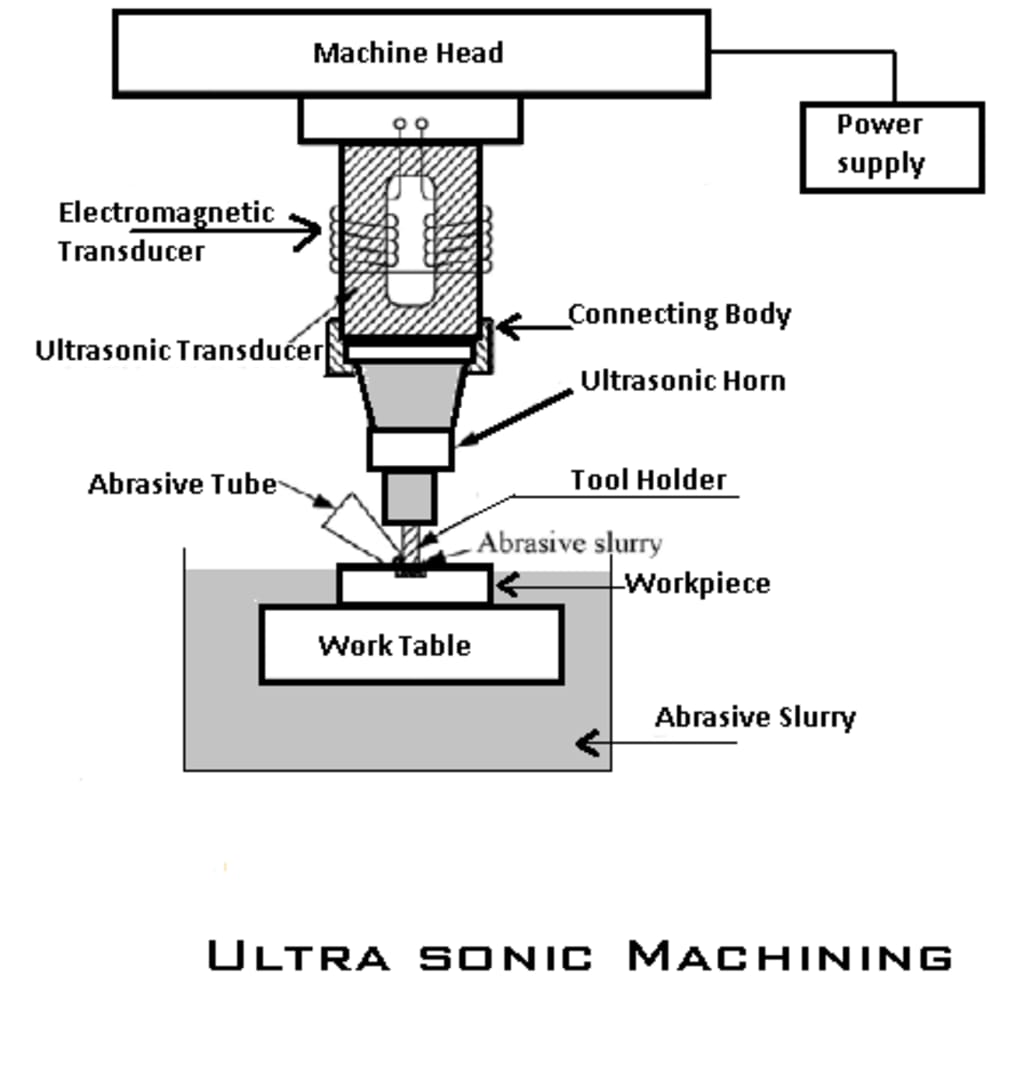
Ans: USM (Ultrasonic Machining) is a non-traditional process where high-frequency vibrations of a tool along with an abrasive slurry remove material from a workpiece without heat.
Q35: Write any four characteristics of USM.
Ans: Characteristics of USM:
- ➔ No heat is generated, so no thermal damage
- ➔ Works on brittle and hard materials
- ➔ Tool does not wear much
- ➔ Uses abrasive slurry for material removal
Q36: Write any two uses of USM.
Ans: Uses of USM:
- ➔ Drilling holes in glass, ceramics, and composites
- ➔ Shaping hard and brittle materials
Q37: Briefly explain the working principle of USM.
Ans: USM works by vibrating a tool at ultrasonic frequency while pressing it against a workpiece in an abrasive slurry. Abrasive particles impact the surface, gradually removing material.
Q38: What is Water Jet Machining (WJM)?
Ans: WJM is a non-traditional machining process in which a high-velocity stream of water, often mixed with abrasive particles, cuts material without heat.
Q39: Write any four characteristics of WJM.
Ans: Characteristics of WJM:
- ➔ Cold cutting process (no heat affected zone)
- ➔ Can cut hard and soft materials
- ➔ Uses high-pressure water with or without abrasives
- ➔ Environmentally friendly and clean
Q40: Write any two uses of WJM.
Ans: Uses of WJM:
- ➔ Cutting metal sheets, composites, and plastics
- ➔ Creating intricate shapes in fragile materials
Q41: Briefly explain the working principle of WJM.
Ans: WJM works by forcing a high-pressure stream of water or water with abrasives through a nozzle. The kinetic energy of the water erodes and removes material from the workpiece.
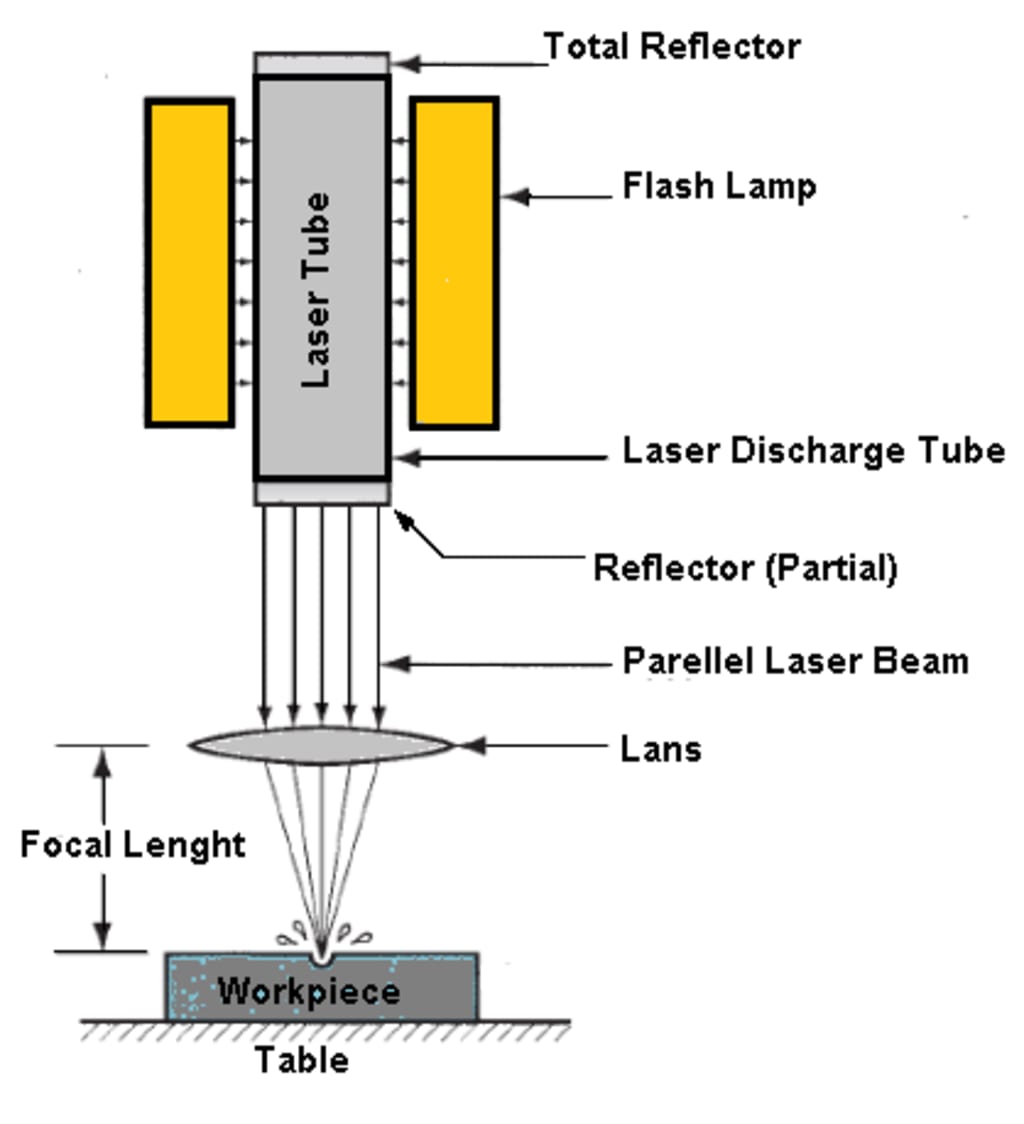
Q42: What is LBM?
Ans: LBM (Laser Beam Machining) is a non-traditional machining process that uses a concentrated laser beam to melt or vaporize material from a workpiece for precision cutting or engraving.
Q43: Write any four characteristics of LBM.
Ans: Characteristics of LBM:
- ➔ High precision and accuracy
- ➔ Works on hard and heat-resistant materials
- ➔ Non-contact process (no tool wear)
- ➔ Can cut, drill, or engrave complex shapes
Q44: Write any two uses of LBM.
Ans: Uses of LBM:
- ➔ Cutting metals, ceramics, and composites
- ➔ Engraving and marking of precision components
Q45: Write any four advantages of LBM.
Ans: Advantages of LBM:
- ➔ High accuracy and precision
- ➔ Non-contact process, no tool wear
- ➔ Can machine hard and heat-resistant materials
- ➔ Can create complex shapes and fine details
Q46: Write any four dis-advantages of LBM.
Ans: Disadvantages of LBM:
- ➔ High initial cost of equipment
- ➔ Requires skilled operators
- ➔ Can cause heat-affected zones on some materials
- ➔ Slower for large volume material removal
Q47: Name the types of lasers used in LBM.
Ans: Types of Lasers in LBM:
- ➔ CO2 Laser
- ➔ Nd:YAG Laser
- ➔ Fiber Laser
- ➔ Excimer Laser
Q48: Briefly explain the working principle of LBM.
Ans: LBM works by focusing a high-energy laser beam on the workpiece. The intense heat melts or vaporizes the material locally, allowing precise cutting, drilling, or engraving without physical contact.