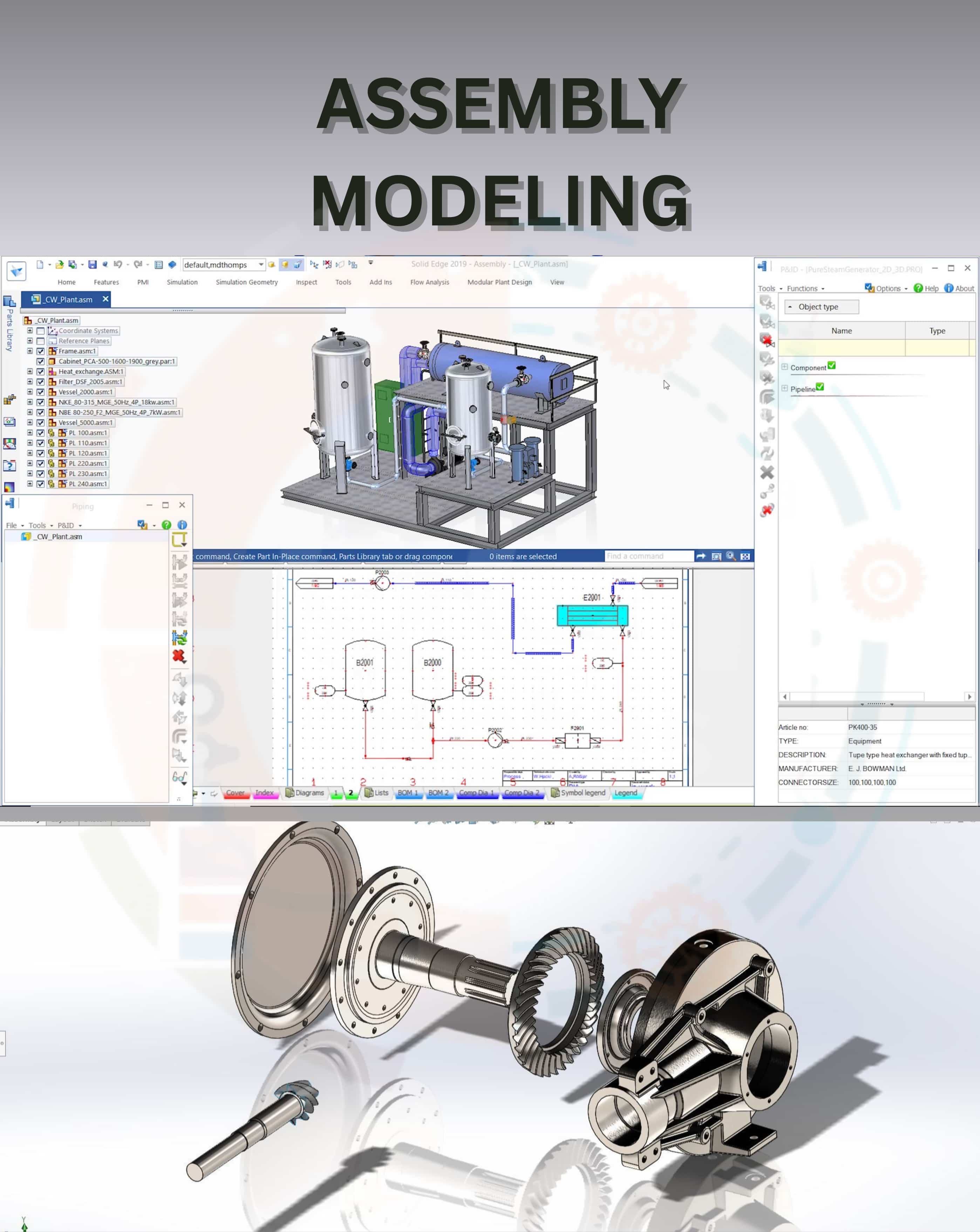
ASSEMBLY MODELING
Other Chapters
INTRODUCTION TO 2D AND 3D CAD2D SKETCHES (ASTM STANDARDS)DIMENSIONS AND CONSTRAINTS (ASTM STANDARDS)TOLERANCES (ASTM STANDARDS)SOLID MODELINGASSEMBLY MODELINGDRAWING VIEWPRESENTATION MODULESHEAR METAL COMPONENTSCAM (COMPUTER AIDED MANUFACTURING)PROCESS PLANNING
- Q1: Define Assembly.Ans: An Assembly is a collection of parts or components combined together to form a complete product in Solidworks.
- Q2: Define Assembly Modeling.Ans: Assembly Modeling is the process of bringing together multiple parts and defining their positions and relationships in a 3D space.
- Q3: Name the types of Assembly.Ans: Types of Assemblies are as follows:
- ➔ Top-down Assembly
- ➔ Bottom-up Assembly
- Q4: What is the Top-down Assembly Approach?Ans: Top-down Assembly Approach is where the design starts with the assembly and individual parts are created and controlled within it.
- Q5: What is the Bottom-up Assembly Approach?Ans: Bottom-up Assembly Approach is where individual parts are designed first, and then assembled together to form the final product.
- Q6: What are Assembly Components?Ans: Assembly Components are the individual parts or sub-assemblies that make up the complete assembly.
- Q7: Define Mate Constraints.Ans: Mate Constraints are rules applied to assembly components to define their relative positions and movement.
- Q8: Define Angle Constraints.Ans: Angle Constraints set a specific angle between two components or faces in an assembly.
- Q9: Define Tangent Constraints.Ans: Tangent Constraints ensure that a curved face of one component is always tangent to the face of another component.
- Q10: Define Insert Constraints.Ans: Insert Constraints are used to position components like pins into holes or similar features in assemblies.
- Q11: Define Translation Constraints.Ans: Translation Constraints allow components to move along a specific linear direction while restricting other movements.
- Q12: Define Rotation Constraints.Ans: Rotation Constraints allow components to rotate about a specific axis while restricting other movements.
- Q13: Define Rotation-Translation Constraints.Ans: Rotation-Translation Constraints allow a component to both rotate and translate along a specific axis, like a screw in a nut.