LAWS AND PROPERTIES OF PERFECT GASES
Other Chapters
FUNDAMENTALS OF THERMODYNAMICSLAWS AND PROPERTIES OF PERFECT GASESTHERMODYNAMIC PROCESS AND CYCLESFORMATION AND PROPERTIES OF STEAMSTEAM BOILERS AND PERFORMANCESTEAM AND GAS TURBINEINTERNAL COMBUSTION ENGINESAIR COMPRESSORS AND THEIR PERFORMANCEREFRIGERATION AND AIR CONDITIONING
- Q1: Define Ideal Gas/Perfect Gas.Ans: An ideal gas or perfect gas is a hypothetical gas that strictly follows all the gas laws at all temperatures and pressures. In this gas, the molecules are assumed to have negligible volume and no intermolecular forces of attraction or repulsion.
- Q2: What is the Characteristic Gas Equation?Ans: (The characteristic gas equation is the relation between pressure, volume, and temperature of a gas. It is expressed as:
PV = mRT
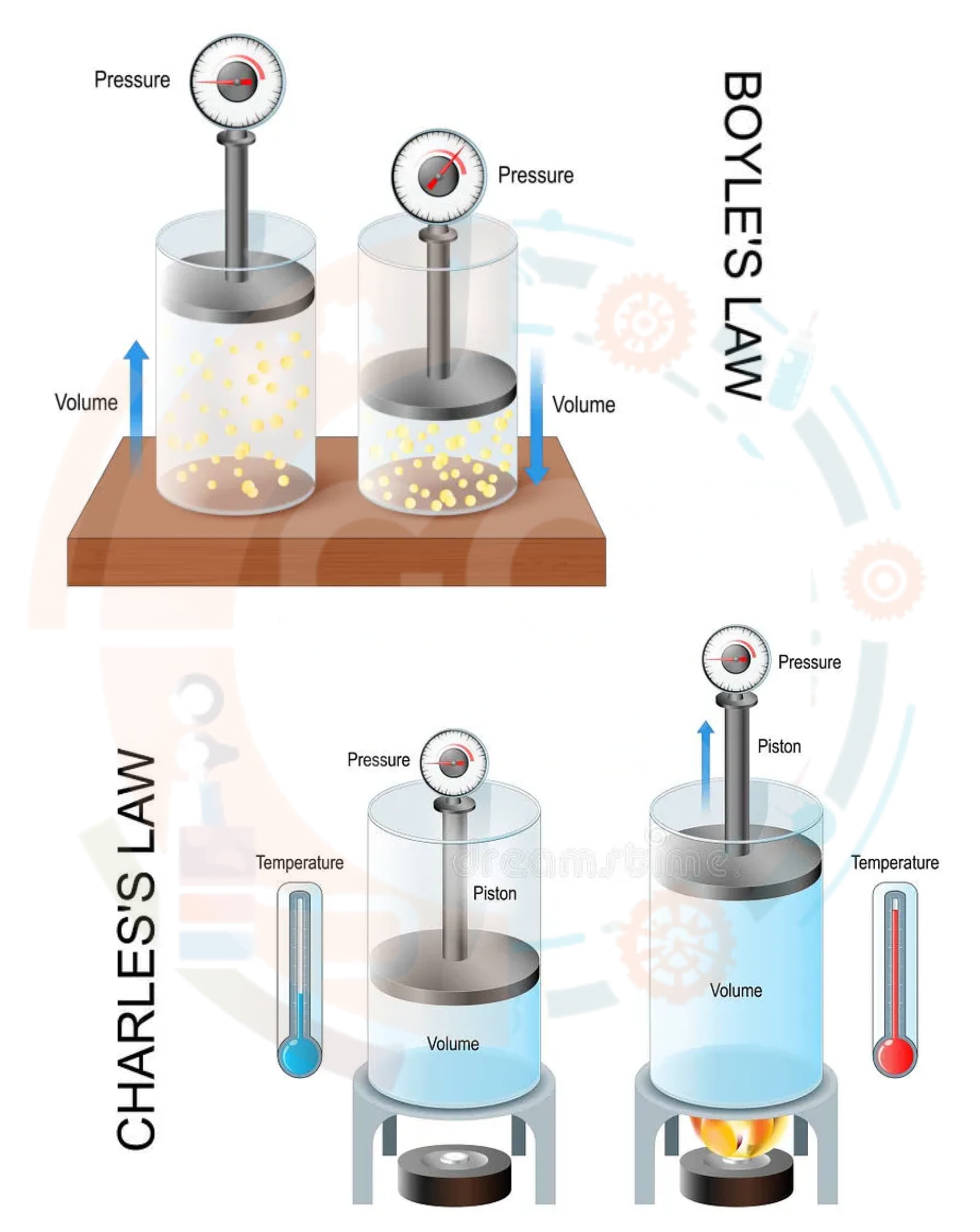
where : P is pressure V is volume m is mass R is gas constant is absolute temperature.) , - Q3: Define Boyle's Law.Ans: ( Boyle'states that for a fixed mass of gas at constant temperature, the pressure of the gas is inversely proportional to its volume. This means when volume decreases, pressure increases, provided temperature remains constant.
It is written as follows:
PV= Constant) - Q4: Define Charles’s Law.Ans: (Charles'states that for a fixed mass of gas at constant pressure, the volume of the gas is directly proportional to its absolute temperature. If the temperature increases, the volume also increases. It is written as follows:
V / T = Constant) - Q5: Define Gay-Lussac Law.Ans: Gay-Lussac Law states that for a fixed mass of gas at constant volume, the pressure of the gas is directly proportional to its absolute temperature. Thus, when temperature rises, pressure also rises.
- Q6: Define Joule’s Law.Ans: Joule’s Law states that the internal energy of an ideal gas depends only on its temperature and is independent of pressure and volume. This means a change in temperature causes a change in internal energy.
- Q7: Define Avogadro’s Law.Ans: Avogadro’s Law states that equal volumes of all gases at the same temperature and pressure contain an equal number of molecules. Therefore, volume is directly proportional to the number of moles.
- Q8: Define Dalton’s Law.Ans: Dalton’s Law states that the total pressure of a mixture of non-reacting gases is equal to the sum of the partial pressures of each individual gas in the mixture.
- Q9: Define Regnault’s Law.Ans: Regnault’s Law states that the specific heat at constant pressure for a gas is greater than the specific heat at constant volume. This is because at constant pressure, some heat is used to do external work.
- Q10: What is the General Gas Equation?Ans: The general gas equation combines Boyle’s Law, Charles’s Law, and Gay-Lussac Law.For a fixed mass of gas, it is written as follows:
P1V1/T1 = P2V2/T2 - Q11: What is the Universal Gas Equation?Ans: (The universal gas equation relates pressure, volume, and temperature in terms of moles of gas. It is expressed as:
PV = nRuT
where n is number of moles and Ru is universal gas constant.) - Q12: Define Specific Heat.Ans: Specific heat is the amount of heat required to raise the temperature of one kilogram of a substance by one degree Celsius or one Kelvin. It indicates the heat storage capacity of a substance.
- Q13: Name two specific heats of gas.Ans: The two specific heats of a gas are:
- ➔ Specific heat at constant volume (Cv)
- ➔ Specific heat at constant pressure (Cp)
- Q14: Define Molar Specific Heat.Ans: Molar specific heat is the amount of heat required to raise the temperature of one mole of a substance by one Kelvin. It is expressed in terms of heat per mole per degree temperature rise.
- Q15: Define Entropy of a gas.Ans: Entropy of a gas is a property that shows how much the energy in the gas is spread out or disordered. When the molecules move more randomly and energy becomes less available to do useful work, the entropy increases.
- Q16: Define Enthalpy of a gas.Ans: Enthalpy of a gas is the total heat content of the gas. It is the sum of internal energy and the product of pressure and volume, expressed as H = U + PV.
- Q17: What is Carnot Cycle?Ans: Carnot cycle is an ideal thermodynamic cycle consisting of two isothermal processes and two adiabatic processes. It represents the most efficient heat engine cycle operating between two temperature limits.
- Q18: What is the value of Gas Constant?Ans: The value of gas constant for air is R = 287 J/kgK.
- Q19: What is the value of Universal Gas Constant?Ans: The value of universal gas constant is R = 8314 J/kgK.