STEAM AND GAS TURBINE
Other Chapters
FUNDAMENTALS OF THERMODYNAMICSLAWS AND PROPERTIES OF PERFECT GASESTHERMODYNAMIC PROCESS AND CYCLESFORMATION AND PROPERTIES OF STEAMSTEAM BOILERS AND PERFORMANCESTEAM AND GAS TURBINEINTERNAL COMBUSTION ENGINESAIR COMPRESSORS AND THEIR PERFORMANCEREFRIGERATION AND AIR CONDITIONING
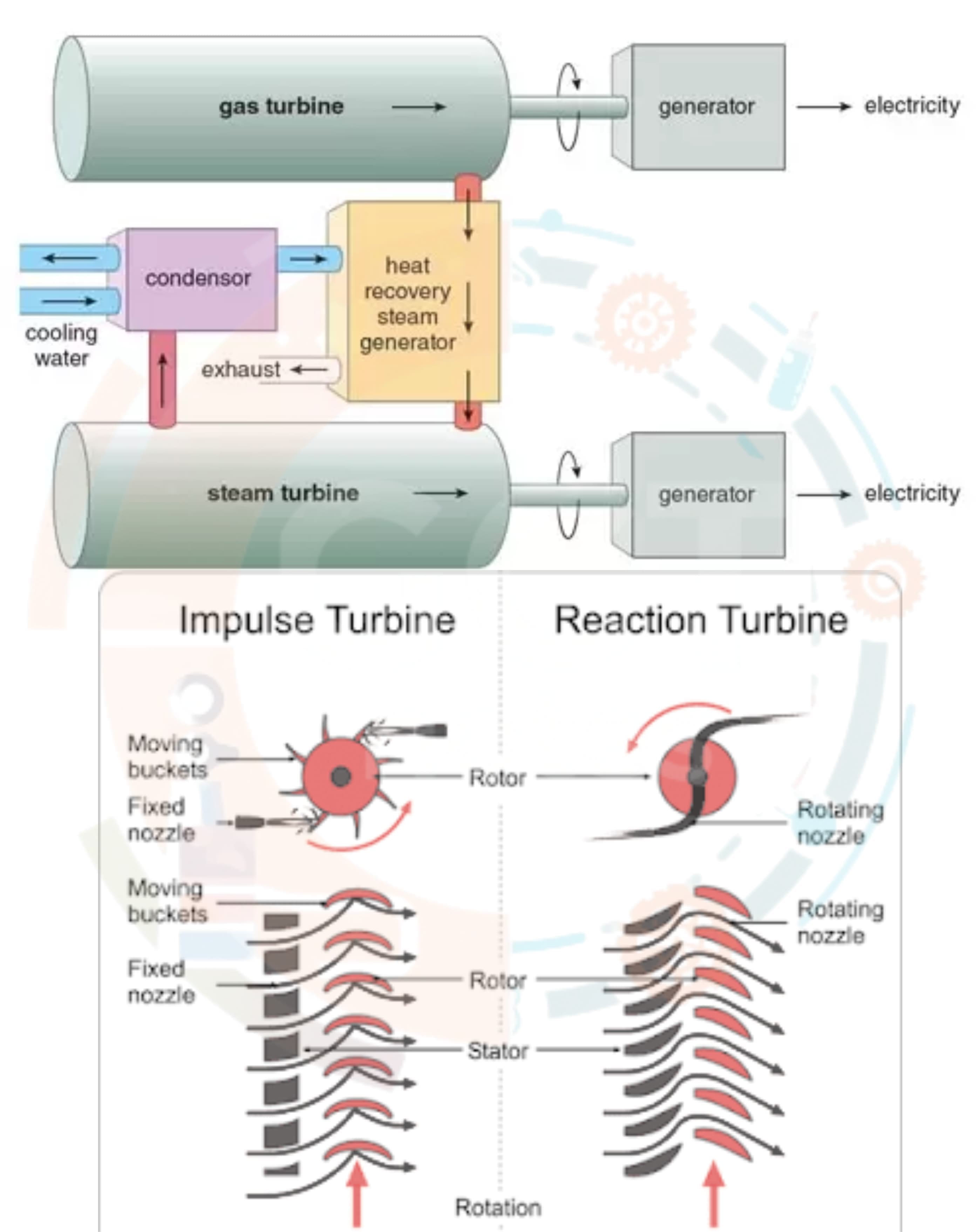
- Q1: Define Gas Turbine.Ans: A gas turbine is a rotary mechanical device that converts the energy of hot gases into mechanical energy. In a gas turbine, air is compressed, mixed with fuel, and burned in a combustion chamber. The high-temperature and high-pressure gases produced are passed over turbine blades, which rotate and produce power.
- Q2: Define Steam Turbine.Ans: A steam turbine is a machine that converts the heat energy of steam into mechanical energy. High-pressure steam strikes the blades of the turbine and makes the rotor rotate. This rotating motion is used to generate electricity or run machines.
- Q3: State the classification of Steam Turbines.Ans: The classification of steam turbines is as follows:
- ➔ Impulse Turbine
- ➔ Reaction Turbine
- ➔ Single Stage Turbine
- ➔ Multi Stage Turbine
- Q4: Briefly explain the working of De-Laval Impulse Turbine.Ans: In De-Laval impulse turbine, high-pressure steam is passed through a nozzle. The nozzle converts pressure energy into high velocity kinetic energy. The high-speed steam strikes the turbine blades (buckets) and causes the rotor to rotate. After striking the blades, the steam leaves with reduced energy.
- Q5: What is Runner and Buckets in a Steam Turbine?Ans: The runner is the rotating part of a steam turbine on which blades are mounted. Buckets are the curved blades fixed on the runner. Steam strikes these buckets and transfers its energy to rotate the runner.
- Q6: Define Casing in a Steam Turbine.Ans: The casing is the outer covering of a steam turbine. It encloses the rotor and blades, prevents steam leakage, and protects the internal parts. It also helps to guide the steam properly inside the turbine.
- Q7: State four advantages of Steam Turbine.Ans: The advantages of steam turbine are:
- ➔ High efficiency
- ➔ Smooth and continuous rotation
- ➔ Less vibration
- ➔ Requires less maintenance
- Q8: Briefly explain the working of Parson’s Reaction Turbine.Ans: In Parson’s reaction turbine, steam expands in both fixed and moving blades. The pressure of steam drops gradually while passing through the blades. The force produced by change in pressure and velocity causes the rotor to rotate. Both impulse and reaction forces help in rotation.
- Q9: Define Turbine Runner.Ans: A turbine runner is the rotating part of a turbine that carries the blades. It receives energy from steam or gas and converts it into mechanical energy by rotating.
- Q10: Define Draft Tube.Ans: A draft tube is a pipe connected to the outlet of a reaction turbine. It helps to discharge water smoothly and recover some of the kinetic energy. It also increases the efficiency of the turbine.
- Q11: Briefly explain the working of Gas Turbine.Ans: In a gas turbine, air is first compressed in a compressor. The compressed air is mixed with fuel and burned in a combustion chamber. The hot gases produced expand and pass through turbine blades. The turbine rotates and produces mechanical power.
- Q12: State the classification of Gas Turbine.Ans: The classification of Gas Turbine is as follows:
- ➔ According to Path of Working Substance:
- ➔ Closed Cycle Gas Turbine
- ➔ Open Cycle Gas Turbine
- ➔ According to Process of Heat Absorption:
- ➔ Constant Pressure Gas Turbine
- ➔ Constant Volume Gas Turbine
- ➔ According to Path of Working Substance:
- Q13: Define Jet Engine.Ans: A jet engine is a type of engine that produces thrust by expelling high-speed exhaust gases. It works on Newton’s third law of motion. It is mainly used in aircraft for propulsion.
- Q14: Define Turboprop Engines.Ans: A turboprop engine is a type of gas turbine engine that drives a propeller. Most of the power produced by the turbine is used to rotate the propeller. It is commonly used in small and medium aircraft.
- Q15: Define Auxiliary Power Unit.Ans: An Auxiliary Power Unit (APU) is a small engine used to provide power to aircraft systems. It supplies electrical power and compressed air when the main engines are not running.
- Q16: Define Turboshaft Engines.Ans: A turboshaft engine is a type of gas turbine engine designed to produce shaft power. It is mainly used in helicopters to drive the rotor blades.
- Q17: Define Turbocharger.Ans: A turbocharger is a device that increases the power of an engine by forcing more air into the combustion chamber. It uses exhaust gases to rotate a turbine connected to a compressor.
- Q18: Define Industrial Gas Turbines.Ans: Industrial gas turbines are gas turbines used for power generation in industries and power plants. They are used to drive generators, compressors, and pumps.
- Q19: What is Adiabatic Compression?Ans: Adiabatic compression is a process in which a gas is compressed without any heat exchange with the surroundings. During this process, the temperature of the gas increases.
- Q20: What is Adiabatic Expansion?Ans: Adiabatic expansion is a process in which a gas expands without exchanging heat with the surroundings. During this process, the temperature of the gas decreases.
- Q21: Define Closed Cycle Gas Turbine.Ans: In a closed cycle gas turbine, the same working fluid is used repeatedly. The gas is heated externally, expanded in the turbine, cooled, and then compressed again.
- Q22: Define Open Cycle Gas Turbine.Ans: In an open cycle gas turbine, fresh air is taken from the atmosphere and fuel is burned in it. After expansion in the turbine, the exhaust gases are released into the atmosphere.
- Q23: Define Constant Pressure Gas Turbine.Ans: A constant pressure gas turbine is one in which combustion takes place at constant pressure. It works on the Brayton cycle.
- Q24: Define Constant Volume Gas Turbine.Ans: A constant volume gas turbine is one in which combustion takes place at constant volume. The pressure increases during heat addition.
- Q25: State some uses of Gas Turbine.Ans: The uses of gas turbine are:
- ➔ Power generation in power plants
- ➔ Aircraft engines
- ➔ Marine propulsion
- ➔ Driving compressors and pumps
- Q26: What are Railway Engines?Ans: Railway engines, also called locomotives, are machines used to pull trains on railway tracks. They convert fuel energy into mechanical energy to move the train.
- Q27: What is a Super Charger?Ans: A super charger is a device used in engines to increase air pressure before it enters the combustion chamber. It is driven directly by the engine and helps to increase engine power.
- Q28: State the working principle of Steam Turbine.Ans: The working principle of a steam turbine is based on the conversion of heat energy of steam into mechanical energy. High-pressure steam expands through nozzles and strikes the turbine blades. The change in momentum of steam produces a force that rotates the turbine shaft.