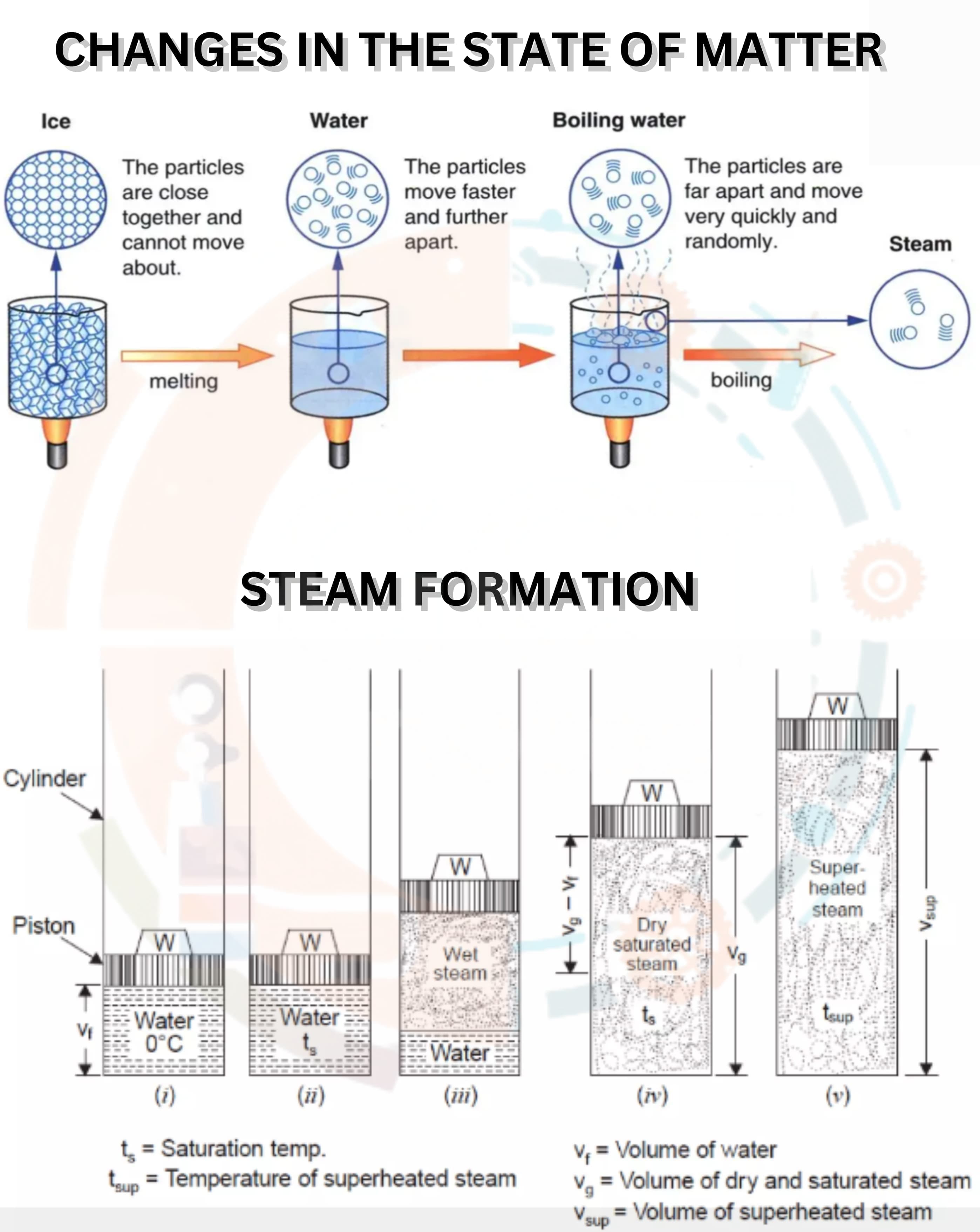
FORMATION AND PROPERTIES OF STEAM
Other Chapters
FUNDAMENTALS OF THERMODYNAMICSLAWS AND PROPERTIES OF PERFECT GASESTHERMODYNAMIC PROCESS AND CYCLESFORMATION AND PROPERTIES OF STEAMSTEAM BOILERS AND PERFORMANCESTEAM AND GAS TURBINEINTERNAL COMBUSTION ENGINESAIR COMPRESSORS AND THEIR PERFORMANCEREFRIGERATION AND AIR CONDITIONING
- Q1: Define Vapours.Ans: Vapours are the gaseous form of a substance which is normally in liquid or solid state at room temperature. Vapours are formed when a liquid changes into gas due to heating, but they can easily be converted back into liquid by cooling or increasing pressure.
- Q2: Define Dry Vapours.Ans: Dry vapours are vapours that do not contain any particles of liquid in them. They are completely in gaseous form and are free from moisture.
- Q3: Define Steam.Ans: Steam is the vapour formed when water is heated to its boiling point and changes into gaseous state. It is simply water vapour produced by boiling water.
- Q4: Define Boiling Point.Ans: Boiling point is the temperature at which a liquid starts changing into vapour at a given pressure. At this temperature, the liquid and vapour exist together.
- Q5: What is the Boiling Point of water?.Ans: The boiling point of water at normal atmospheric pressure is 100°C.
- Q6: Name the types of Steam.Ans: The types of steam are as follows:
- ➔ Wet Steam
- ➔ Dry Saturated Steam
- ➔ Superheated Steam
- Q7: Define Wet Steam.Ans: Wet steam is a mixture of water particles and steam. It contains both liquid water and water vapour together.
- Q8: Define Dry Saturated Steam.Ans: Dry saturated steam is steam that does not contain any water particles. It is obtained when all the water is completely converted into steam at boiling temperature, but it is not heated further.
- Q9: Define Superheated Steam.Ans: Superheated steam is the steam that is heated above its boiling point after becoming dry saturated steam. It does not contain moisture and has a temperature higher than the saturation temperature.
- Q10: Define Dryness Fraction.Ans: Dryness fraction is the ratio of the mass of dry steam to the total mass of wet steam (mixture of water and steam). It is represented by x and its value lies between 0 and 1.
- Q11: Define Sensible Heat of Water.Ans: Sensible heat of water is the amount of heat required to raise the temperature of water from 0°C to its boiling point at a given pressure. It is denoted by hf.
- Q12: Define Latent Heat of Vapourization.Ans: Latent heat of vapourization is the amount of heat required to convert water at boiling point into steam at the same temperature without any change in temperature. It is denoted by hfg.
- Q13: Define Enthalpy or Total Heat of Steam.Ans: Enthalpy or total heat of steam is the total amount of heat required to convert water into steam. It is the sum of sensible heat and latent heat. It is represented by h.
- Q14: Define Enthalpy of Superheated Steam.Ans: Enthalpy of superheated steam is the total heat of dry saturated steam plus the additional heat supplied to raise its temperature above saturation temperature.
- Q15: Define Steam Table.Ans: Steam table is a table that shows the properties of steam at different pressures and temperatures. It includes values like temperature, pressure, enthalpy, entropy, and specific volume.
- Q16: Write the use of Steam Table.Ans: Steam table is used to:
- ➔ Find properties of steam at different pressures and temperatures.
- ➔ Calculate enthalpy, entropy and specific volume.
- ➔ Solve problems related to boilers, turbines and steam engines.
- Q17: Write the formula of Enthalpy of Wet Steam.Ans: The formula is:
h = hf + xhfg - Q18: Write the formula of Enthalpy of Dry Steam.Ans: The formula is:
h = hg = hf + hfg - Q19: Write the formula of Enthalpy of Superheated Steam.Ans: The formula is:
hsup = hf + hfg + Cp(Tsup — T)
or
hsup = hg + Cp(Tsup — T)