THERMODYNAMIC PROCESS AND CYCLES
Other Chapters
FUNDAMENTALS OF THERMODYNAMICSLAWS AND PROPERTIES OF PERFECT GASESTHERMODYNAMIC PROCESS AND CYCLESFORMATION AND PROPERTIES OF STEAMSTEAM BOILERS AND PERFORMANCESTEAM AND GAS TURBINEINTERNAL COMBUSTION ENGINESAIR COMPRESSORS AND THEIR PERFORMANCEREFRIGERATION AND AIR CONDITIONING
- Q1: Define Thermodynamic Process.Ans: A thermodynamic process is a change in the state of a system from one equilibrium state to another. During this process, properties such as pressure, temperature, and volume change due to transfer of heat or work.
- Q2: Define Reversible Process.Ans: A reversible process is an ideal process that takes place infinitely slowly and can be reversed without leaving any change in the system and surroundings. In this process, the system remains in thermodynamic equilibrium at every stage.
- Q3: Define Irreversible Process.Ans: An irreversible process is a real process that occurs at a finite rate and cannot be reversed without causing changes in the surroundings. It involves friction, unrestrained expansion, heat transfer with finite temperature difference, and other losses.
- Q4: State the classification of Thermodynamic Process.Ans: The classification of thermodynamic processes is:
- ➔ Flow Processes
- ➔ Steady Flow Process
- ➔ Non-Steady Flow Process
- ➔ Non-Flow Processes
- ➔ Non-Flow Reversible Process
- ➔ Non-Flow Irreversible Process
- Q5: Define Flow Processes.Ans: A flow process is a thermodynamic process in which mass crosses the boundary of the system. It commonly occurs in open systems such as turbines, compressors, and boilers.
- Q6: Define Steady Flow Processes.Ans: A steady flow process is a flow process in which the properties of the system do not change with time at any point. The mass flow rate and energy transfer remain constant during the process.
- Q7: Define Non-Steady Flow Processes.Ans: A non-steady flow process is a process in which the properties within the system change with time. The mass and energy content of the system vary during the operation.
- Q8: Define Non-Flow Processes.Ans: A non-flow process is a thermodynamic process in which there is no mass transfer across the system boundary. It usually occurs in closed systems where only heat and work interactions take place.
- Q9: Define Non-Flow Reversible Processes.Ans: A non-flow reversible process is a process occurring in a closed system that can be reversed without any loss or change in surroundings. The system remains in equilibrium throughout the process.
- Q10: Define Non-Flow Irreversible Processes.Ans: A non-flow irreversible process is a process in a closed system that cannot be reversed without affecting the surroundings. It involves internal friction, rapid expansion, or heat transfer with finite temperature difference.
- Q11: Define Constant Pressure Process.Ans: A constant pressure process is a thermodynamic process in which the pressure of the system remains constant throughout the change of state. During this process, volume and temperature may vary.
- Q12: Define Constant Volume Process.Ans: A constant volume process is a process in which the volume of the system remains fixed while pressure and temperature change. No boundary work is done in this process because there is no change in volume.
- Q13: How is change in Enthalpy represented in the Constant Pressure Process?Ans: ( In a constant pressure process, the change in enthalpy is represented as follows:
dH = H2 - H1 = mCP(T2 - T1).
It shows that the change in enthalpy is directly proportional to the mass, specific heat at constant pressure, and temperature difference. ) - Q14: Define Constant Temperature Process.Ans: A constant temperature process, also called an isothermal process, is a process in which the temperature of the system remains constant throughout. Heat transfer takes place to maintain constant temperature during expansion or compression.
- Q15: Define Adiabatic Process or Isentropic Process.Ans: An adiabatic process is a process in which no heat is transferred between the system and surroundings. If the process is reversible and adiabatic, it is called an isentropic process because entropy remains constant.
- Q16: Define Polytropic Process.Ans: A polytropic process is a thermodynamic process that follows the relation PVⁿ = constant. It represents many practical processes depending on the value of the polytropic index.
- Q17: Define Polytropic Index.Ans: The polytropic index is the exponent 'n' in the equation PVⁿ = constant. Its value determines the nature of the process, such as isothermal, adiabatic, or constant pressure process.
- Q18: Define Thermodynamic Cycle.Ans: A thermodynamic cycle is a series of thermodynamic processes that return the system to its initial state. At the end of the cycle, there is no change in internal energy of the system.
- Q19: State the types of Thermodynamic Cycle.Ans: The types of thermodynamic cycles are:
- ➔ Reversible Thermodynamic Cycle
- ➔ Irreversible Thermodynamic Cycle
- Q20: Define Reversible Thermodynamic Cycle.Ans: A reversible thermodynamic cycle is a cycle in which all processes are reversible. It can be reversed without leaving any effect on the system and surroundings.
- Q21: Define Irreversible Thermodynamic Cycle.Ans: An irreversible thermodynamic cycle is a cycle that consists of one or more irreversible processes. It cannot be completely reversed due to friction and other losses.
- Q22: Name any 2 assumptions made in Thermodynamic Cycle.Ans: Two assumptions made in thermodynamic cycles are:
- ➔ The working fluid behaves as an ideal gas.
- ➔ All processes are internally reversible.
- Q23: Briefly explain the working of an Ideal Engine.Ans: An ideal engine operates on a thermodynamic cycle where heat is supplied from a high-temperature source and part of it is converted into work. The remaining heat is rejected to a low-temperature sink, and the cycle repeats continuously.
- Q24: Define Isothermal Expansion.Ans: Isothermal expansion is a process in which a gas expands at constant temperature. Heat is supplied to the system to maintain constant temperature while volume increases and pressure decreases.
- Q25: Define Isothermal Compression.Ans: Isothermal compression is a process in which a gas is compressed at constant temperature. Heat is removed from the system to maintain constant temperature while volume decreases and pressure increases.
- Q26: Define Reversible Adiabatic or Isentropic Expansion.Ans: Reversible adiabatic or isentropic expansion is a process in which the gas expands without heat transfer and without entropy change. The temperature and pressure decrease during the expansion.
- Q27: Define Reversible Adiabatic Compression.Ans: Reversible adiabatic compression is a process in which the gas is compressed without heat transfer and without entropy change. The temperature and pressure increase during compression.
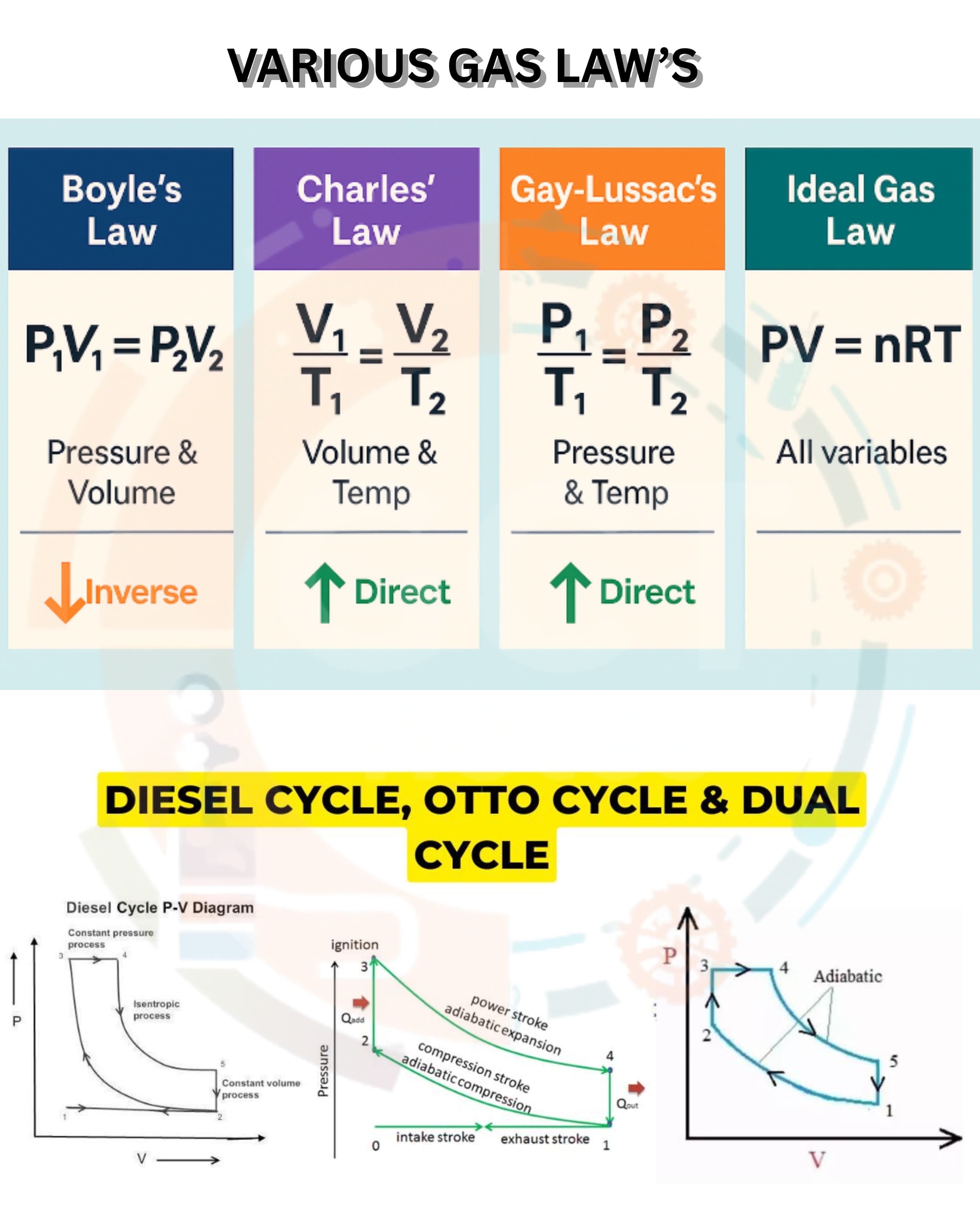
- Q28: What is the OTTO Cycle?Ans: The Otto cycle is an ideal thermodynamic cycle used to describe the working of petrol engines. It consists of two adiabatic processes and two constant volume processes.
- Q29: What is the Diesel Cycle?Ans: The Diesel cycle is an ideal cycle that represents the working of diesel engines. It consists of two adiabatic processes, one constant pressure process, and one constant volume process.
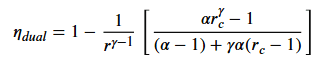
- Q30: What is the Dual Combustion Cycle?Ans: The dual combustion cycle is an ideal cycle that combines features of both Otto and Diesel cycles. Heat is added partly at constant volume and partly at constant pressure.
- Q31: Write the formula for Reversible Adiabatic Process.Ans: Its formula is as follows:

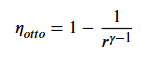
- Q32: Write the formula for effeciency of OTTO Cycle.Ans: Its formula is as follows:
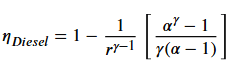
- Q33: Write the formula for effeciency of Diesel Cycle.Ans: Its formula is as follows:
- Q34: Write the formula for effeciency of Dual Combustion Cycle.Ans: Its formula is as follows: