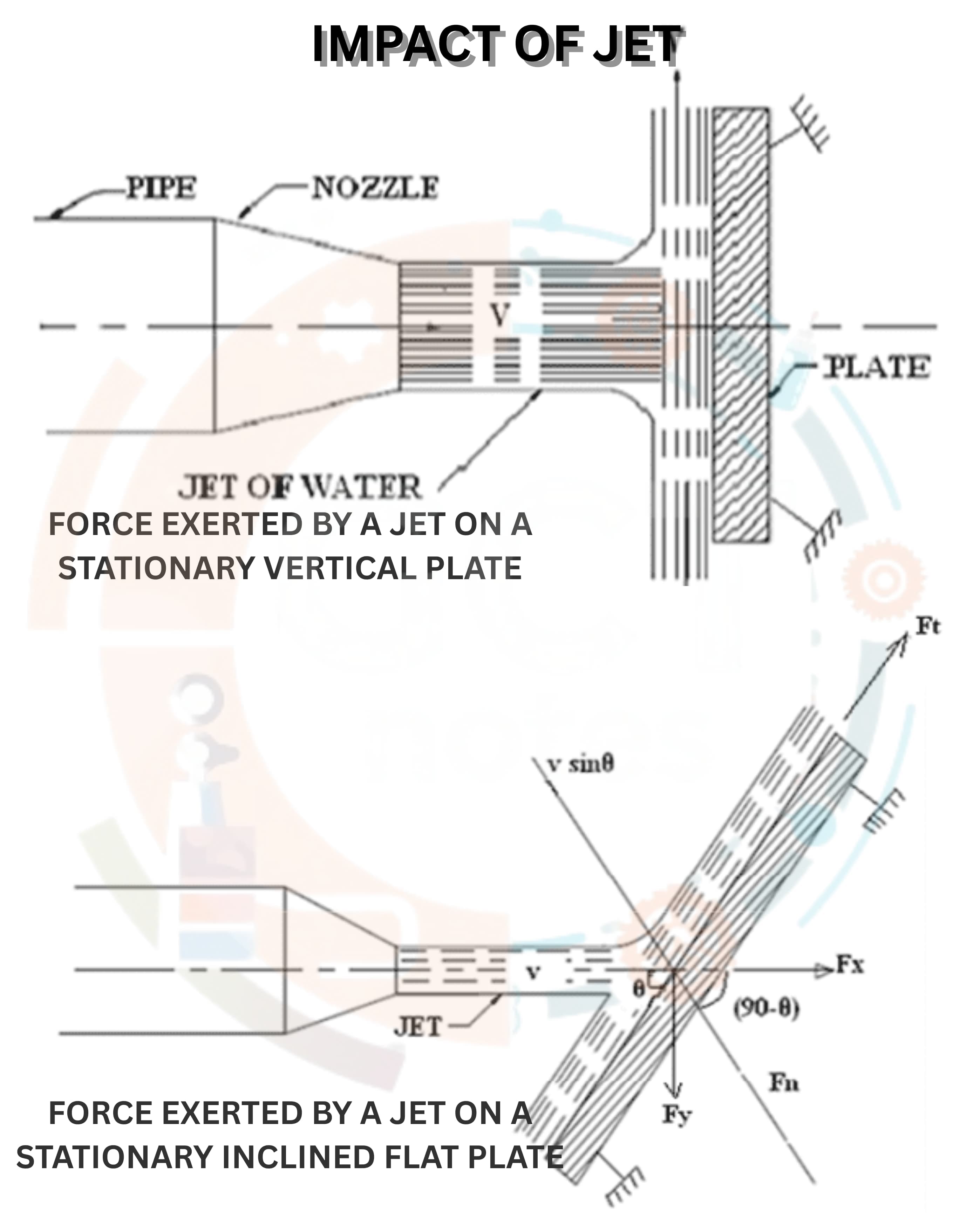
IMPACT OF JET
Other Chapters
INTRODUCTION TO HYDRAULICSHYDRO KINEMATICSFLOW THROUGH PIPESIMPACT OF JETWATER TURBINESPUMPSHYDRAULIC VALVES AND SEALSHYDRAULIC SIMPLE MACHINESHYDRAULIC ACTUATORSHYDRAULIC CIRCUITS AND ACCESSORIESPNEUMATIC SIMPLE MACHINES
- Q1: Define Jet of water.Ans: A jet of water is a stream of water flowing with high velocity from a nozzle or an orifice into the atmosphere. It has high speed and kinetic energy.
- Q2: What energy is possessed in a Jet?Ans: A jet of water possesses kinetic energy because it is moving with high velocity.
Kinetic Energy per unit weight = V2 / 2g - Q3: Define Impact of Jet.Ans: Impact of jet is the force produced when a moving jet of water strikes a surface like a plate or vane. This force is produced due to change in velocity and direction of the jet.
- Q4: On which principle does impact of jet work?Ans: Impact of jet works on the principle of Newton’s Second Law of Motion. The force exerted by the jet is equal to the rate of change of momentum of water.
Force (F) = Rate of change of momentum - Q5: Write the expression for force when jet strikes a stationary curved vane.Ans: When a jet strikes a stationary curved vane,
Force (F) = ρ A V (V − V cos θ)
Where ρ = density, A = area of jet, V = velocity of jet, θ = angle of deflection. - Q6: Write the effects of Jet colliding with plate.Ans: When a jet collides with a plate:
- ➔ The velocity of jet changes.
- ➔ The direction of jet changes.
- ➔ A force is exerted on the plate.
- ➔ Some kinetic energy is converted into pressure energy.
- Q7: How much force is executed by a Jet colliding with a Fixed Plate?Ans: When a jet strikes a fixed vertical plate normally, the velocity in the direction of flow becomes zero.
Force (F) = ρ A V2
Where ρ = density, A = area of jet, V = velocity of jet. - Q8: How much force is executed by a Jet colliding with a Diagonal Plate?Ans: When a jet strikes a fixed plate inclined at an angle θ, only the component of velocity in the direction of flow is considered.
Force (F) = w A V2 / g - Q9: How much force is executed by a Jet colliding with a Moving Plate?Ans: When a jet strikes a plate moving with velocity u in the same direction,
Force (F) = w A (V − u)2 / g
Where V = velocity of jet, u = velocity of plate. - Q10: While colliding with a Diagonal Plate, how much force a Jet executes in the direction of Flow?Ans: The force exerted by the jet in the direction of flow when striking a diagonal plate is:
F = w A V2 sin2θ / 2g
Where θ = angle of inclination of plate. - Q11: What happens to velocity when jet strikes a smooth curved vane?Ans: When a jet strikes a smooth curved vane, only the direction of velocity changes. The magnitude of velocity remains almost the same if friction is neglected.
- Q12: Define Momentum of a Jet.Ans: Momentum of a jet is the product of mass and velocity of flowing water.
Momentum = m × V - Q13: Write formula for mass flow rate of jet.Ans: Mass flow rate is the mass of water flowing per second.
Formula: ṁ = ρ A V
Where ρ = density, A = area of jet, V = velocity. - Q14: Define Work done by a Jet on a Plate.Ans: Work done by a jet is the product of force exerted by the jet and distance moved by the plate.
Work Done = Force × Distance - Q15: Write expression for power developed by a moving plate struck by jet.Ans: Power developed is the work done per second.
Power = Force × Velocity of plate
Power = ρ A (V − u)2 × u
Where V = velocity of jet, u = velocity of plate. - Q16: At what condition is maximum efficiency obtained for a moving plate?Ans: Maximum efficiency is obtained when the velocity of plate is half the velocity of jet.
u = V / 2 - Q17: Write maximum efficiency of jet striking a moving plate.Ans: The maximum efficiency of a jet striking a flat moving plate is:
ηmax = 50%
It occurs when u = V / 2.