Q1: Define Machine Design.
Ans: Machine design is the process of planning and creating the parts of a machine so that it can perform a specific function safely and efficiently.
It involves selecting suitable materials, dimensions, and shapes for machine components.
Q2: State the classification Machine Design.
Ans:
Following are the types of Machine Designing:- ➔ Adaptive Design
- ➔ Development Design
- ➔ New Design
Q3: Name the factors considered in Machine Design.
Ans:
The following factors are considered in machine design:- ➔ Strength of material
- ➔ Safety of the machine
- ➔ Cost of production
- ➔ Efficiency of the machine
- ➔ Durability and reliability
- ➔ Ease of maintenance
Q4: Define Constant Velocity of machine.
Ans: Constant velocity means that a machine or moving body travels equal distances in equal intervals of time in a fixed direction.
In this condition, both the speed and direction remain constant.
Q5: State the properties of materials to be selected for machine design.
Ans:
The following properties should be considered while selecting materials for machine design:- ➔ Strength
- ➔ Hardness
- ➔ Toughness
- ➔ Ductility
- ➔ Durability
- ➔ Resistance to wear and corrosion
Q6: State the general procedure in Machine Design.
Ans:
The procedure is as follows:- ➔ Identify the need
- ➔ Synthesis
- ➔ Analysis of Forces
- ➔ Material selection
- ➔ Design of elements
- ➔ Modifications
- ➔ Detailed Drawings
- ➔ Production
- ➔ Quality Check
Q7: What are Basic Units?
Ans: Basic units are the fundamental units used to measure basic physical quantities.
These units cannot be derived from other units and form the foundation of measurement systems.
Q8: Name any four Basic Units.
Ans:
Four basic units are as follows:- ➔ Meter (m) for length
- ➔ Kilogram (kg) for mass
- ➔ Second (s) for time
- ➔ Ampere (A) for electric current
Q9: What are Derived Units?
Ans: Derived units are the units obtained by combining two or more basic units through multiplication or division.
These units are used to measure derived physical quantities.
Q10: Name any four Derived units.
Ans:
Four derived units are as follows:- ➔ Newton (N) for force
- ➔ Joule (J) for work or energy
- ➔ Watt (W) for power
- ➔ Pascal (Pa) for pressure
Q11: Name the Systems of Units.
Ans:
The three main Systems of Units are as follows:- ➔ F.P.S (Foot Pound Seconds)
- ➔ M.K.S (Meter Kilogram Seconds)
- ➔ S.I Units (System of International Units)
Q12: Describe F.P.S System of Units.
Ans: F.P.S system stands for Foot — Pound — Second system.
In this system, foot is used as the unit of length, pound as the unit of force or weight, and second as the unit of time.
Q13: Describe M.K.S System of Units.
Ans: M.K.S system stands for Meter — Kilogram — Second system.
In this system, meter is the unit of length, kilogram is the unit of mass, and second is the unit of time.
Q14: Describe the System of International Units.
Ans: The System of International Units (SI) is the modern and globally accepted system of measurement.
It is based on seven basic units such as meter, kilogram, second, ampere, kelvin, mole, and candela.
Q15: Define Load.
Ans: Load is the external force or weight applied on a machine part or structure.
It causes stress, strain, or deformation in the material.
Q16: State the types of Loads.
Ans:
The types of loads are as follows:- ➔ Dead Load
- ➔ Live Load
- ➔ Shock Load
- ➔ Impact Load
Q17: Define Dead Load.
Ans: Dead load is the permanent or constant load acting on a structure or machine part.
It includes the weight of the structure itself and fixed components.
Q18: Define Live Load.
Ans: Live load is the variable or moving load acting on a structure or machine.
It changes with time and includes loads such as people, vehicles, or movable equipment.
Q19: Define Shock Load.
Ans: Shock load is a sudden load applied to a machine or structure.
It occurs due to sudden starting, stopping, or quick changes in motion.
Q20: Define Impact Load.
Ans: Impact load is the load produced when one object suddenly strikes another object.
It acts for a very short time but produces a large force.
Q21: Define Stress.
Ans: Stress is the internal resisting force developed inside a material when an external load is applied.
Formula:
Stress = Force / Area
Q22: Name the types of stress.
Ans:
The types are:- ➔ Direct Stress
- ➔ Tensile Stress
- ➔ Compressive Stress
- ➔ Shear Stress
Q23: Define Direct Stress.
Ans: Direct stress is the stress produced when a force acts perpendicular to the cross-sectional area of a material.
It acts directly along the axis of the material.
Q24: Define Shear Stress.
Ans: Shear stress is the stress produced when a force acts parallel to the surface or cross-section of a material.
Formula:
Shear Stress = Shear Force / Area
Q25: Define Tensile Stress.
Ans: Tensile stress is the stress produced when a material is pulled or stretched by an external force.
It increases the length of the material.
Q26: Define Compressive Stress.
Ans: Compressive stress is the stress produced when a material is compressed or squeezed by an external force.
It decreases the length of the material.
Q27: Define Strain.
Ans:
The ratio of change in dimension to original dimension is strain. It has no unit.
Q28: Why does strain has no unit?
Ans:
It is because both change in length and length have the same units which cancel out each other. 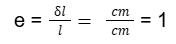
Q29: Name the types of strain
Ans:
The types are:- ➔ Direct Strain
- ➔ Tensile Strain
- ➔ Compressive Strain
- ➔ Shear Strain
- ➔ Volumetric Strain
- ➔ Linear Strain
- ➔ Lateral Strain
Q30: Define Direct Strain.
Ans: Direct strain is the strain produced when a material experiences direct stress.
It causes a change in length of the material along the direction of the applied force.
Q31: Define Shear Strain.
Ans: Shear strain is the strain produced when shear stress acts on a material.
It causes a change in the shape of the material without significantly changing its volume.
Q32: Define Tensile Strain.
Ans: Tensile strain is the strain produced when a material is stretched due to a tensile force.
It results in an increase in the length of the material.
Q33: Define Compressive Strain.
Ans: Compressive strain is the strain produced when a material is compressed due to a compressive force.
It results in a decrease in the length of the material.
Q34: Define Linear Strain.
Ans: Linear strain is the ratio of change in length of a material to its original length when a force is applied.
Formula:
Linear Strain = Change in Length / Original Length
Q35: Define Lateral Strain.
Ans: Lateral strain is the strain produced in the direction perpendicular to the applied force.
It occurs when a material changes its width or diameter due to tensile or compressive stress.
Q36: Define volumetric strain.
Ans:
If a force is applied on the body and the volume of the body changes i.e. the length, height or width changes then such a strain is volumetric strain.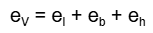
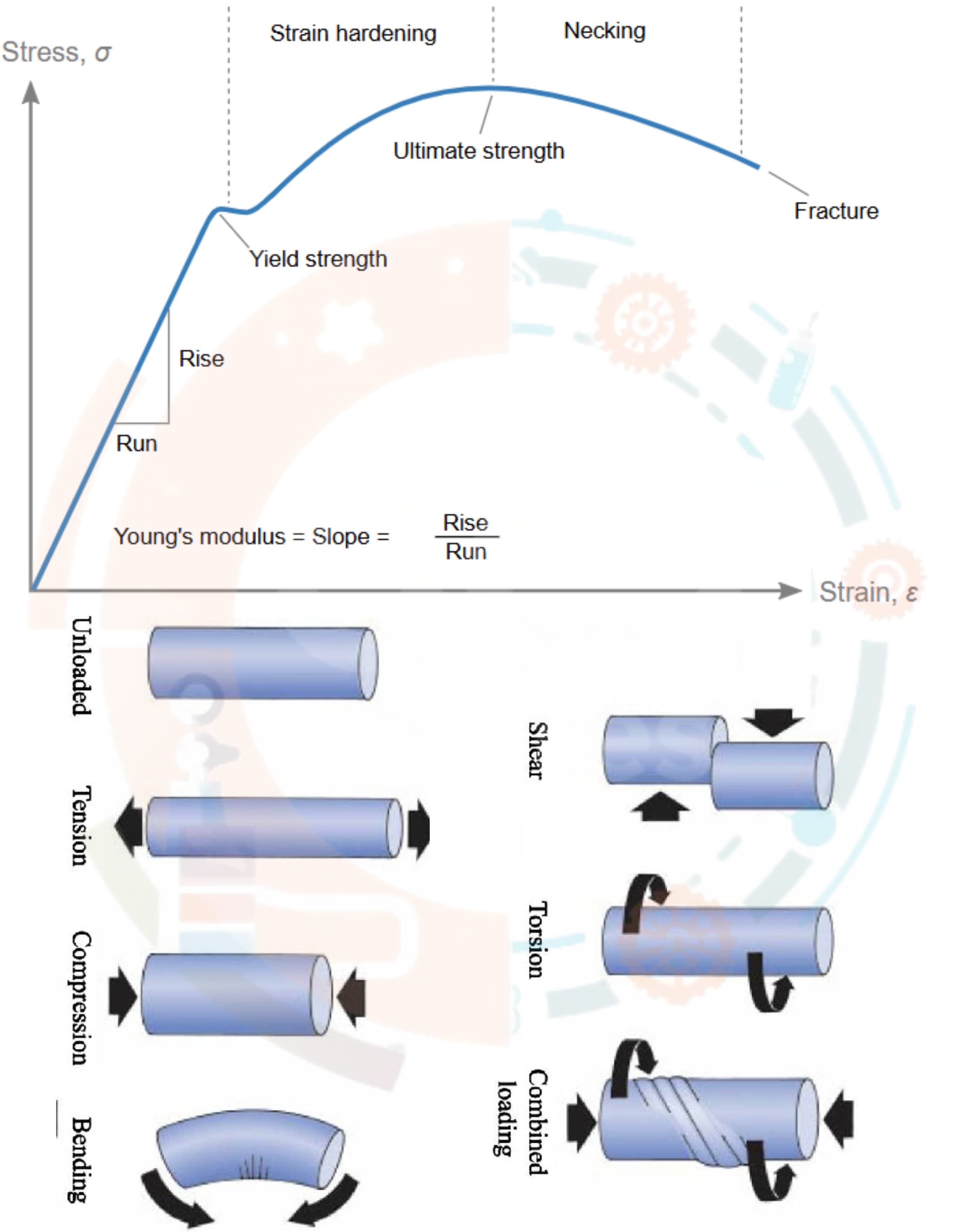
Q37: Define Young’s Modulus or Modulus of Elasticity.
Ans: Young's Modulus or Modulus of Elasticity is the ratio of tensile stress to tensile strain within the elastic limit of a material.
It measures the stiffness of a material.
Formula:
Young's Modulus = Stress / Strain
Q38: State the value of E for the followings.
Ans:
| Material | Modulus of Elasticity (E) — KN/mm2 |
|---|
| Steel and Nickle | 200 to 220 |
| Wrought Iron | 190 to 200 |
| Cast Iron | 100 to 160 |
| Copper | 90 to 110 |
| Brass | 80 to 90 |
| Aluminium | 60 to 80 |
| Timber | 10 |
Q39: Define Shear Modulus or Modulus of Rigidity.
Ans: Shear Modulus or Modulus of Rigidity is the ratio of shear stress to shear strain within the elastic limit of a material.
It measures the rigidity of a material when a shear force is applied.
Formula:
Shear Modulus = Shear Stress / Shear Strain
Q40: State the value of shear modulus for the followings.
Ans:
| Material | Shear Modulus (G) — KN/mm2 |
|---|
| Steel and Nickle | 80 to 100 |
| Wrought Iron | 80 to 90 |
| Cast Iron | 40 to 50 |
| Copper | 44 to 48 |
| Brass | 35 to 45 |
| Aluminium | 25 to 28 |
| Timber | 0.6 to 1.2 |
Q41: State Hook's Law.
Ans:
Hook's Law states that:
“Within elastic limits, stress is directly proportional to strain”
Q42: Define Stress Strain Diagram.
Ans: A stress strain diagram is a graphical representation that shows the relationship between stress and strain of a material when a load is applied.
It helps to study the mechanical properties of the material such as elasticity, yield point, and breaking point.
Q43: Define Elastic Limit.
Ans: Elastic limit is the maximum stress that a material can withstand without permanent deformation.
If the load is removed within this limit, the material returns to its original shape.
Q44: Define Plastic Limit.
Ans: Plastic limit is the stage beyond the elastic limit where permanent deformation occurs in the material.
After this point, the material does not return to its original shape when the load is removed.
Q45: Define Proportional Limit.
Ans: Proportional limit is the maximum stress up to which stress is directly proportional to strain.
In this region, the material obeys Hooke's Law.
Q46: Define Yield Point.
Ans: Yield point is the point on the stress strain diagram at which the material begins to deform permanently without an increase in load.
Q47: Define Ultimate Stress.
Ans: Ultimate stress is the maximum stress that a material can withstand before failure begins.
It is the highest point on the stress strain diagram.
Q48: Define Breaking Stress.
Ans: Breaking stress is the stress at which the material finally breaks or fractures.
Q49: Define Working Stress.
Ans: Working stress is the maximum stress that is allowed to act on a material during normal working conditions.
It is kept lower than the ultimate stress to ensure safety.
Q50: Define Percentage Elongation.
Ans: Percentage elongation is the increase in length of a material expressed as a percentage of its original length after the application of load.
Formula:
Percentage Elongation = (Increase in Length / Original Length) × 100
Q51: Define Factor of Safety.
Ans: Factor of Safety is the ratio of the maximum stress a material can withstand to the allowable working stress.
It ensures that the machine or structure operates safely.
Formula:
Factor of Safety = Ultimate Stress / Working Stress
Q52: Name the factors to be considered while selecting the Factor of Safety.
Ans:
The following factors should be considered while selecting the factor of safety:- ➔ Type of material used
- ➔ Nature of load (static or dynamic)
- ➔ Working conditions
- ➔ Accuracy of design calculations
- ➔ Reliability and importance of the machine
Q53: Define Thermal Stresses.
Ans: Thermal stress is the stress developed in a material due to changes in temperature when the material is not allowed to expand or contract freely.
Q54: Define Bulk Modulus.
Ans: Bulk modulus is the ratio of normal stress to volumetric strain within the elastic limit of a material.
It measures the resistance of a material to uniform compression.
Formula:
Bulk Modulus = Normal Stress / Volumetric Strain
Q55: Define Poisson’s Ratio.
Ans: Poisson's ratio is the ratio of lateral strain to linear strain in a material when it is subjected to stress.
Formula:
Poisson's Ratio = Lateral Strain / Linear Strain
Q56: Define Toughness.
Ans: Toughness is the ability of a material to absorb energy and deform without breaking.
It represents the total energy a material can absorb before fracture.
Q57: Define Resilience.
Ans: Resilience is the ability of a material to absorb energy when it is elastically deformed and release that energy when the load is removed.