Q1: What are Screwed Joints?
Ans: Screwed joints are temporary fasteners used to join two or more machine parts with the help of screws, bolts, and nuts.
These joints can be easily assembled and disassembled without damaging the parts.
Q2: Name the parts of Screwed Joints?
Ans:
Screwed joints consist of two main parts:Q3: What is a Single Start Thread?
Ans: A single start thread is a screw thread that has only one continuous helical groove around the cylinder.
In this type, the lead is equal to the pitch.
Q4: What is a Multi-Start Thread?
Ans: A multi-start thread is a screw thread that has two or more helical grooves running around the cylinder.
In this type, the lead is greater than the pitch.
Q5: State four advantages of Screwed Joints.
Ans:
The advantages of screwed joints are as follows:- ➔ Easy to assemble and dismantle
- ➔ Simple construction
- ➔ Reusable joints
- ➔ Suitable for temporary fastening
Q6: State four disadvantages of Screwed Joints.
Ans:
The disadvantages of screwed joints are as follows:- ➔ Joints may loosen due to vibration
- ➔ Require regular maintenance
- ➔ Stress concentration occurs at threads
- ➔ Not suitable for permanent joints
Q7: State some important terms used in Screwed Threads.
Ans:
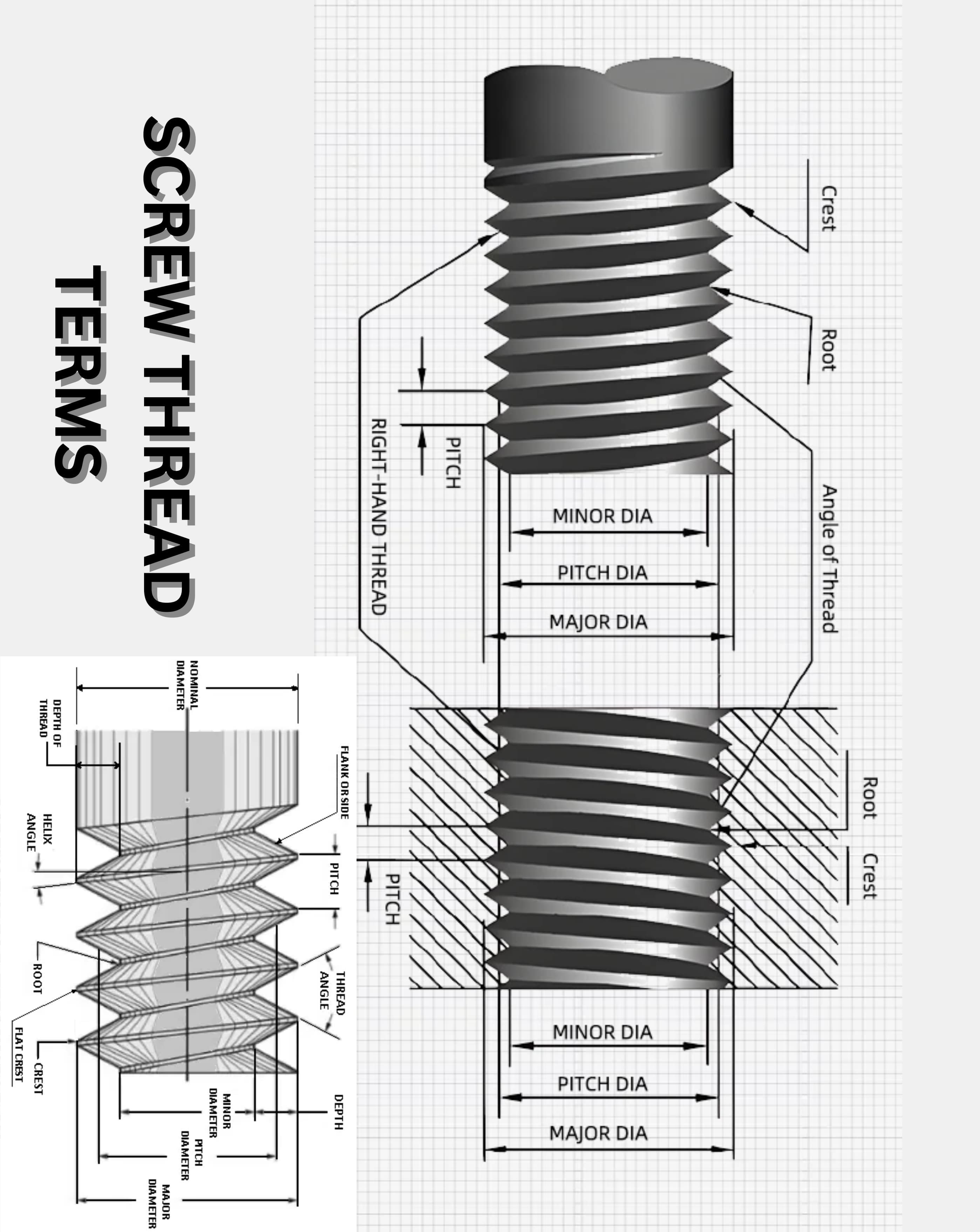
Some important terms used in screwed threads are as follows:- ➔ Major or Nominal Diameter
- ➔ Minor or Core Diameter
- ➔ Pitch Diameter
- ➔ Pitch
- ➔ Lead
- ➔ Crest
- ➔ Root
Q8: State some technical terms used in Screwed threads.
Ans:
The technical terms used in screwed threads are as follows:- ➔ Major Diameter
- ➔ Minor Diameter
- ➔ Pitch Diameter
- ➔ Pitch
- ➔ Lead
- ➔ Crest
- ➔ Root
Q9: Define Minor or Core Diameter.
Ans: Minor or core diameter is the smallest diameter of the screw thread measured at the bottom of the threads.
Q10: Define Major or Nominal Diameter.
Ans: Major or nominal diameter is the largest diameter of a screw thread measured at the crest of the threads.
Q11: Define Pitch Diameter.
Ans: Pitch diameter is the imaginary diameter of a screw thread at which the width of the thread and the width of the space between threads are equal.
Q12: Define Pitch in Screw Joints.
Ans: Pitch is the distance between two corresponding points on adjacent threads measured parallel to the axis of the screw.
Q13: Define Lead.
Ans: Lead is the distance a screw advances in one complete revolution.
For a single start thread, lead is equal to pitch.
Q14: Define Thread.
Ans: A thread is a helical ridge formed on the outer or inner surface of a cylinder used for fastening or power transmission.
Q15: Name the forms of Thread.
Ans:
The forms of threads are as follows:- ➔ B.S.W Thread
- ➔ American National Standard Thread
- ➔ ACME Thread
- ➔ Square Thread
- ➔ Unified Standard Thread
- ➔ Knuckle Thread
- ➔ Buttress Thread
Q16: Define B.S.W Thread.
Ans: B.S.W thread (British Standard Whitworth thread) is a thread form with a 55° thread angle and rounded crests and roots.
It was widely used in British engineering standards.
Q17: Define American National Standard Thread.
Ans: American National Standard thread is a screw thread with a 60° thread angle used widely in American engineering standards.
Q18: Define ACME Thread.
Ans: ACME thread is a modified trapezoidal thread form used for power transmission in machines such as screw jacks and lead screws.
Q19: Define Square Thread.
Ans: Square thread is a thread form with square-shaped ridges used mainly for power transmission because of its high efficiency.
Q20: Define Unified Standard Thread.
Ans: Unified Standard Thread is an internationally accepted screw thread system with a 60° thread angle used in the United States, Canada, and the United Kingdom.
Q21: Define Knuckle Thread.
Ans: Knuckle thread is a thread form having rounded crests and roots used where rough handling or frequent assembly is expected.
Q22: Define Buttress Thread.
Ans: Buttress thread is a thread form designed to withstand heavy loads in one direction.
It has one perpendicular face and one slanted face.
Q23: Define the Angle of Thread.
Ans: The angle of thread is the included angle between the two sides of a thread measured in an axial plane.
Q24: Define Crest.
Ans: Crest is the top surface of the thread which joins the two sides of the thread.
Q25: Define Root.
Ans: Root is the bottom surface of the thread between two adjacent threads.
Q26: What is the standard dimension of Screw Thread?
Ans: The standard dimensions of screw threads are specified by international standards such as ISO or national standards.
These include standard values for major diameter, minor diameter, pitch, and thread angle.
Q27: State the stresses in Screwed Fastening due to Static Loading.
Ans:
The stresses in screwed fastening due to static loading are as follows:- ➔ Tensile stress due to axial load
- ➔ Shear stress due to transverse load
- ➔ Crushing stress between threads
- ➔ Bending stress due to eccentric loading