Q1: Define Fasteners.
Ans: Fasteners are mechanical components used to join or hold two or more parts together.
They help in assembling machine parts either permanently or temporarily.
Q2: State the types of Fasteners.
Ans:
The types of fasteners are as follows:- ➔ Temporary Fasteners
- ➔ Permanent Fasteners
Q3: Define Temporary Fasteners.
Ans: Temporary fasteners are those fasteners that can be easily removed without damaging the joined parts.
Examples include bolts, nuts, and screws.
Q4: Define Permanent Fasteners.
Ans: Permanent fasteners are those fasteners that cannot be removed without damaging the joined parts.
Examples include welding, riveting, and soldering.
Q5: Define Welding.
Ans: Welding is a process of joining two or more metal parts by heating them to a suitable temperature with or without applying pressure and filler material.
Q6: State the types of Welding
Ans:
The types of Welding is as follows:- ➔ Fusion Welding
- ➔ Thermite Welding
- ➔ Electric Arc Welding
- ➔ Gas Welding
- ➔ Oxy-Acetelyne Welding
- ➔ Oxy Hydrogen Welding
- ➔ Non-Fusion Welding
- ➔ Forge Welding
- ➔ Spot Welding
- ➔ Seam Welding
- ➔ Flash Welding
- ➔ Projection Welding
- ➔ Upset Welding
Q7: Define Fusion Welding.
Ans: Fusion welding is a welding process in which the base metals are melted and fused together with or without filler material to form a strong joint.
Q8: State the types of Fusion Welding.
Ans:
The types of fusion welding are as follows:- ➔ Electric Arc Welding
- ➔ Thermite Welding
- ➔ Gas Welding
Q9: Define Electric Arc Welding.
Ans: Electric arc welding is a welding process in which heat is produced by an electric arc between the electrode and the workpiece to melt and join the metals.
Q10: Define Thermite Welding.
Ans: Thermite welding is a welding process in which heat is produced by a chemical reaction between aluminum powder and iron oxide to melt and join metal parts.
Q11: Define Gas Welding.
Ans: Gas welding is a welding process in which heat is produced by burning fuel gas with oxygen to melt and join the metal parts.
Q12: Define Oxy-Acetelyne Welding.
Ans: Oxy-acetylene welding is a gas welding process in which acetylene gas burns with oxygen to produce a high temperature flame used for welding metals.
Q13: Define Oxy-Hydrogen Welding.
Ans: Oxy-hydrogen welding is a welding process in which hydrogen gas burns with oxygen to produce heat for joining metal parts.
Q14: Define TIG Welding.
Ans: TIG welding (Tungsten Inert Gas welding) is a welding process in which a non-consumable tungsten electrode is used to produce the weld while an inert gas protects the weld area from contamination.
Q15: Define Non-Fusion Welding.
Ans: Non-fusion welding is a welding process in which the metals are joined without melting them.
The joint is formed mainly by applying pressure and heat.
Q16: Define Forge Welding.
Ans: Forge welding is a process in which metal parts are heated to a high temperature and then hammered or pressed together to form a joint.
Q17: Define Seam Welding.
Ans: Seam welding is a resistance welding process in which continuous welds are made along a seam using rotating wheel electrodes.
Q18: Define Spot Welding.
Ans: Spot welding is a resistance welding process in which two metal sheets are joined at specific points by applying heat and pressure.
Q19: Define Upset Welding.
Ans: Upset welding is a resistance welding process in which the metal parts are heated by electric current and then pressed together to form a weld.
Q20: Define Flash Welding.
Ans: Flash welding is a resistance welding process in which heat is produced by electrical resistance between two metal surfaces before they are pressed together to form a joint.
Q21: Define Projection Welding.
Ans: Projection welding is a resistance welding process in which small projections on the metal surfaces concentrate the heat and pressure to form the weld.
Q22: State four advantages of Welding.
Ans:
The advantages of welding are as follows:- ➔ Produces strong and permanent joints
- ➔ Saves weight of the structure
- ➔ Provides smooth and neat joints
- ➔ Can join complex shapes easily
Q23: State four disadvantages of Welding.
Ans:
The disadvantages of welding are as follows:- ➔ Welded joints cannot be easily dismantled
- ➔ Skilled labor is required
- ➔ Heat may cause distortion in metal
- ➔ Inspection of welds can be difficult
Q24: State the types of Welds.
Ans:
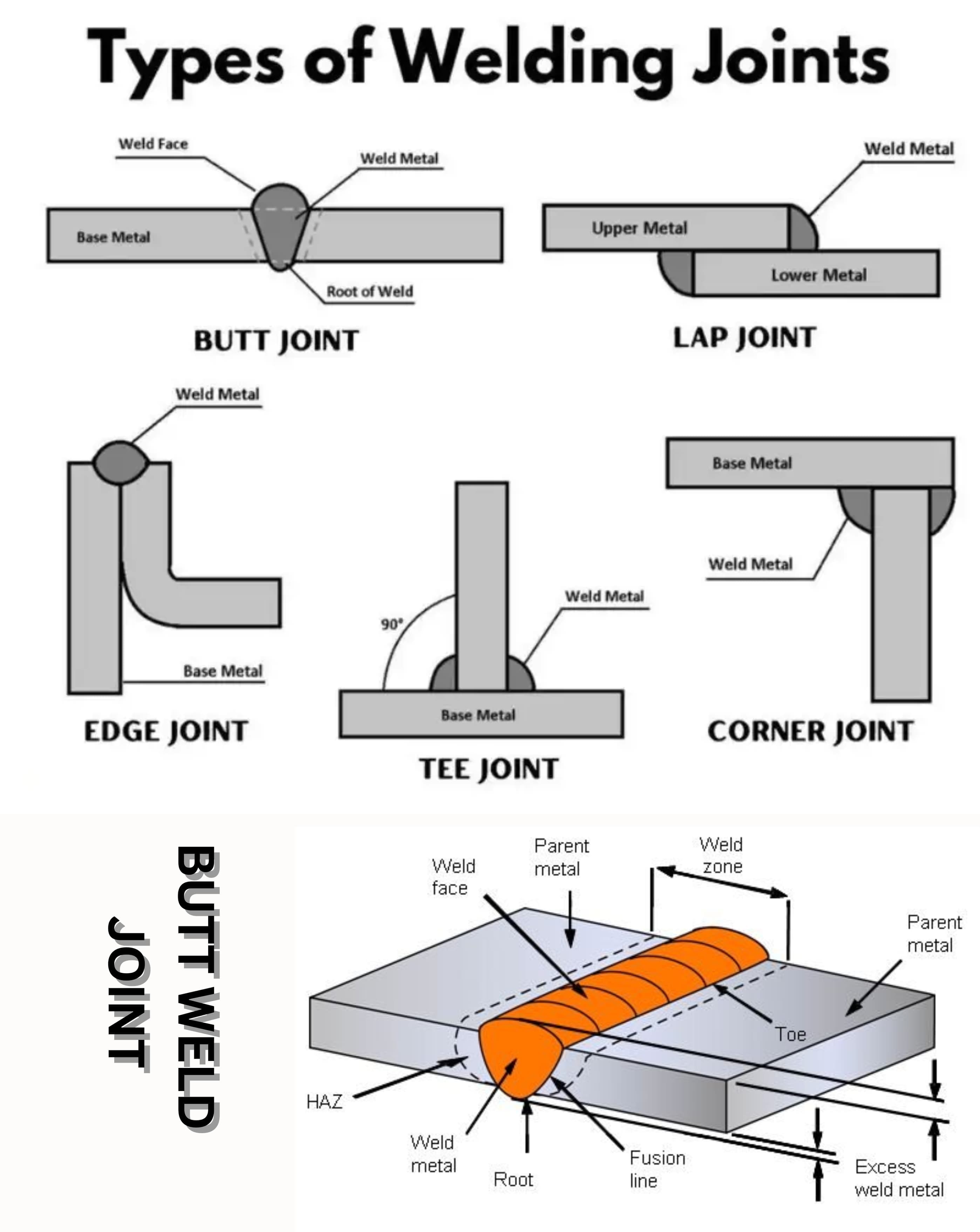
The types of welds are as follows:- ➔ Lap Weld
- ➔ Fillet Weld
- ➔ Butt Weld
- ➔ T Weld
- ➔ Edge Weld
- ➔ Corner Weld
Q25: Define Lap Weld.
Ans: Lap weld is a type of weld in which two metal plates overlap each other and are welded along the edges of the overlap.
Q26: Define Fillet Weld.
Ans: Fillet weld is a triangular shaped weld used to join two metal surfaces at right angles or in lap joints.
Q27: State the types of Fillet Weld.
Ans:
The types of fillet weld are as follows:- ➔ Single Fillet Weld
- ➔ Double Fillet Weld
Q28: Define Butt Weld.
Ans: Butt weld is a type of weld where two metal plates are placed in the same plane and joined at their edges.
Q29: State the types of Butt Weld.
Ans:
The types of butt weld are as follows:- ➔ Single V Butt Weld
- ➔ Double V Butt Weld
- ➔ Single U Butt Weld
- ➔ Double U Butt Weld
Q30: Define T Weld.
Ans: T weld is a weld used to join two metal plates at right angles forming a T-shaped joint.
Q31: Define Edge Weld.
Ans: Edge weld is a weld made along the edges of two or more metal plates placed side by side.
Q32: Define Corner Weld.
Ans: Corner weld is a weld used to join two metal plates at a corner forming an L-shaped joint.
Q33: Define Rivets.
Ans: Rivets are permanent mechanical fasteners used to join metal plates or machine parts together.
They consist of a cylindrical shaft with a head on one end.
Q34: State four advantages of Riveting.
Ans:
The advantages of riveting are as follows:- ➔ Simple and reliable joining method
- ➔ Suitable for heavy structures
- ➔ Can join thick metal plates
- ➔ No heat distortion like welding
Q35: State four disadvantages of Riveting.
Ans:
The disadvantages of riveting are as follows:- ➔ Requires drilling holes in plates
- ➔ Increases weight of the structure
- ➔ Time-consuming process
- ➔ Not suitable for airtight joints
Q36: Define Fatigue Loading.
Ans: Fatigue loading is the repeated or fluctuating load applied to a material over time which may cause failure even if the stress is below the maximum strength.
Q37: Define Static Loading.
Ans: Static loading is a constant load applied slowly to a machine or structure and remains unchanged with time.