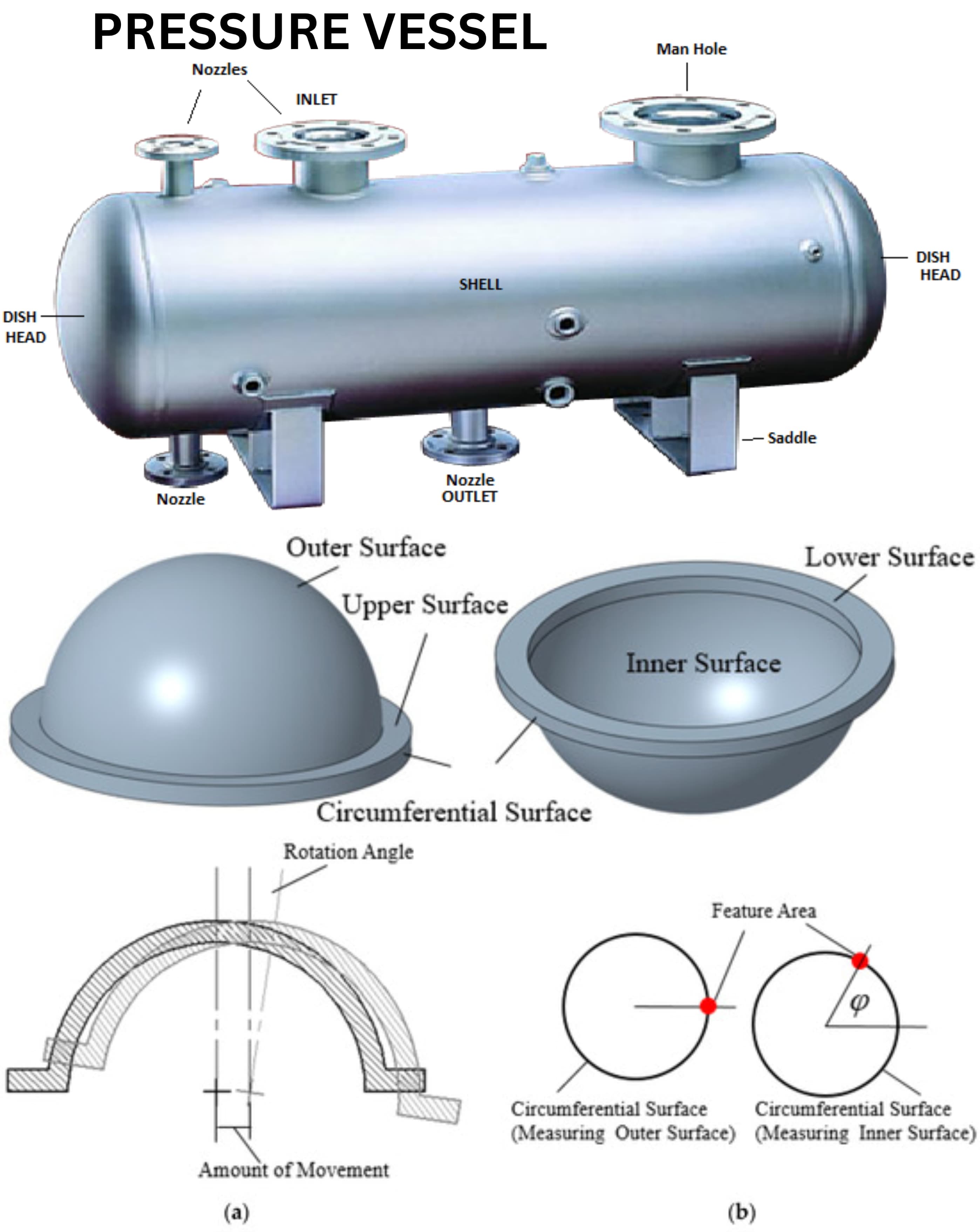
PRESSURE VESSELS
Other Chapters
DESIGN METHODOLOGYSIMPLE STRESSES IN MACHINE PARTSPRESSURE VESSELSWELDED JOINTSSCREWED JOINTSDESIGN OF KEYS
- Q1: Define Pressure Vessel.Ans: A pressure vessel is a closed container used to store gases or liquids at a pressure different from the surrounding atmospheric pressure.
It is designed to safely withstand internal or external pressure. - Q2: State the classification of Pressure Vessels.Ans: The classification of Pressure Vessels is made in two ways:
- ➔ According to Wall Thickness
- ➔ According to End Construction
- Q3: Define Thin Pressure Vessel.Ans: A thin pressure vessel is a vessel in which the wall thickness is very small(less than 1/10 of the internal diameter) compared to its diameter.
- Q4: Define Thick Pressure Vessel.Ans: A thick pressure vessel is a vessel in which the wall thickness is large(greater than 1/10 of the internal diameter) compared to its internal diameter.
- Q5: State the formula of Thick Pressure Vessel.Ans: The stresses in a thick pressure vessel are calculated using Lame’s equations.
Formula:
σt = A + B / r2
σr = A - B / r2
Where:
σt = Tangential stress
σr = Radial stress
r = Radius of the vessel - Q6: State the classification of pressure Vessels according to End Construction.Ans: The classification of Pressure Vessels is as follows:
- ➔ Open End Pressure Vessel
- ➔ Closed End Pressure Vessel
- Q7: What is an Open End Pressure Vessel?Ans: An open end pressure vessel is a vessel that has no closed ends.
The pressure acts only on the cylindrical wall and no longitudinal stress is developed. - Q8: What is a Closed End Pressure Vessel?Ans: A closed end pressure vessel is a vessel that has both ends closed.
In this vessel, internal pressure produces both circumferential stress and longitudinal stress. - Q9: What is Hoop or Circumferential Stress?Ans: Hoop or circumferential stress is the stress acting along the circumference of the pressure vessel due to internal pressure.
It tends to split the vessel along its length. - Q10: What is Longitudinal Stress?Ans: Longitudinal stress is the stress acting along the length of the pressure vessel due to internal pressure.
It tends to split the vessel across its cross-section. - Q11: What is Tangential Stress?Ans: Tangential stress is the stress acting along the tangent of the circular section of a pressure vessel.
It is the same as circumferential or hoop stress in cylindrical vessels. - Q12: What is Radial Stress?Ans: Radial stress is the stress acting in the radial direction of a pressure vessel.
It acts from the inner surface towards the outer surface of the vessel wall. - Q13: What is Lame’s Equation?Ans: Lame’s equation is used to calculate tangential stress and radial stress in thick pressure vessels.
It helps determine the stress distribution across the thickness of the vessel wall. - Q14: State the formula of Thin Spherical Shell.Ans: The stress in a thin spherical shell due to internal pressure is given by the following Formula:
σ = (p × d) / 4t
Where:
p = Internal pressure
d = Diameter of the shell
t = Thickness of the shell - Q15: State the formula of Longitudinal Stress.Ans: The formula for longitudinal stress in a thin cylindrical pressure vessel is:
σl = (p × d) / 4t
Where:
σl = Longitudinal stress
p = Internal pressure
d = Diameter of the vessel
t = Thickness of the vessel wall