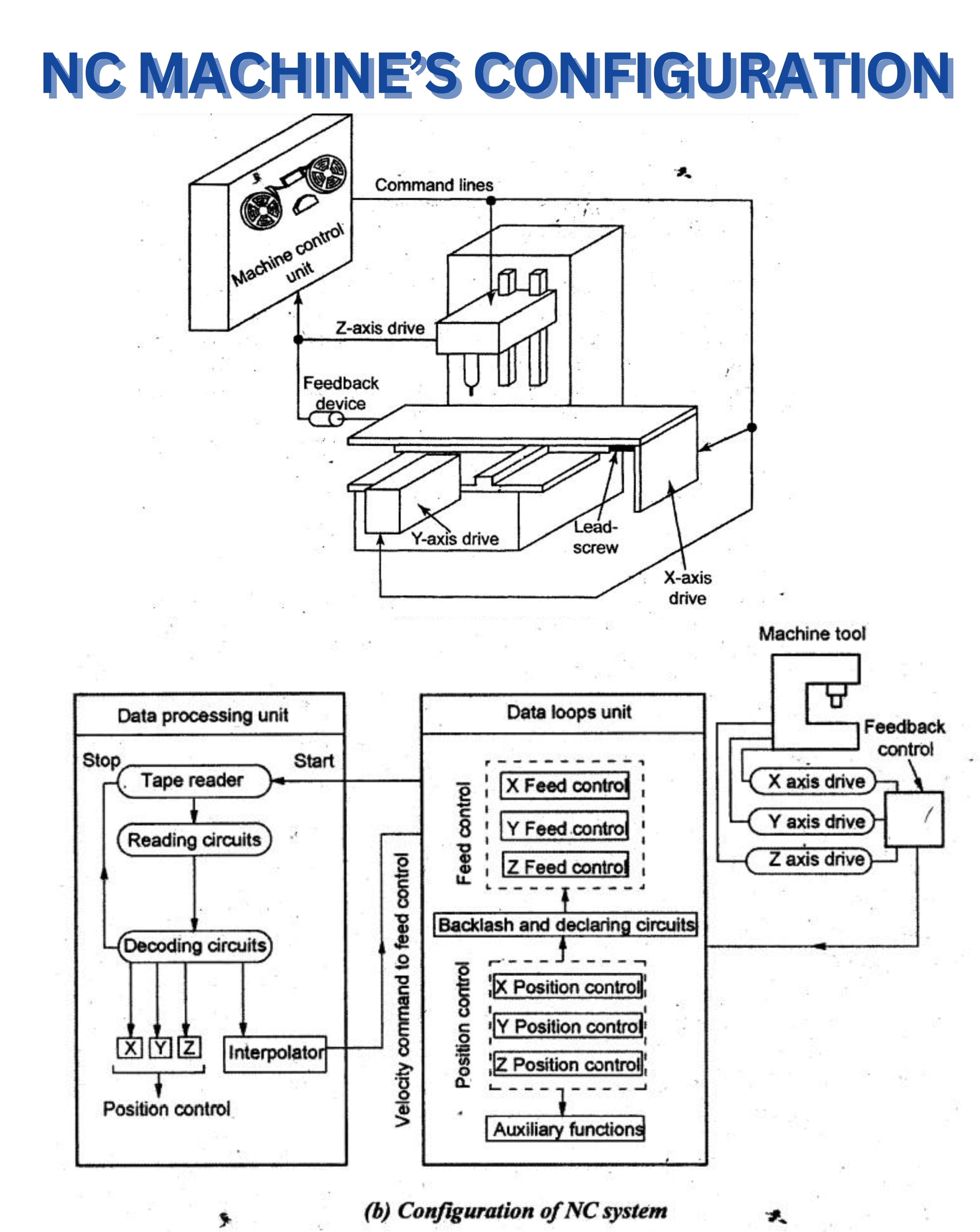
CONFIGURATION AND CONTROL METHOD OF NC MACHINE TOOLS
Other Chapters
INTRODUCTION TO NUMERICAL CONTROLNC MACHINE TOOL CHARACTERISTICSTYPES OF MACHINE TOOLSCONFIGURATION AND CONTROL METHOD OF NC MACHINE TOOLSACCESSORIES TOOLS AND CUTTING FLUIDTURNING CENTER PROGRAMMACHINING CENTER PROGRAMAUTOMATED MANUFACTURING SYSTEMCONDITION FOR CUTTINGCUTTING TOOLS AND CHIPSSELECTING A TYPE OF TOOL MATERIAL
- Q1: What is Positioning Control?Ans: Positioning control is a control system in which the tool moves from one point to another without controlling the path in between.
- Q2: What is Profile Control?Ans: Profile control is a control system in which the tool movement is controlled continuously along a defined path.
- Q3: What is Point to Point Control?Ans: Point to point control allows the machine tool to move directly between specified points without considering the path followed.
- Q4: What is Linear or Straight Cut Control?Ans: Linear or straight cut control is a system in which the tool moves along a straight line between two points at a controlled feed rate.
- Q5: What is Positioning Reference Point System?Ans: It is a coordinate system in which all positions are measured from a fixed reference point on the machine.
- Q6: What is an Incremental System?Ans: In an incremental system, the position of the tool is measured with respect to the previous position.
- Q7: What is an Absolute System?Ans: In an absolute system, the position of the tool is measured from a fixed origin point.
- Q8: Define Servo Mechanism.Ans: A servo mechanism is an automatic control system that uses feedback to control the position, speed, or motion of a machine component.
- Q9: Name the parts of Servo Mechanism.Ans: Following are the parts of Servo Mechanism:
- ➔ Servo motor
- ➔ Feedback device
- ➔ Controller
- ➔ Power amplifier
- Q10: Name the types of Servo Mechanism.Ans: Following are the types of Servo Mechanism:
- ➔ Electrical servo mechanism
- ➔ Hydraulic servo mechanism
- ➔ Pneumatic servo mechanism
- Q11: Write the working principle of Servo Mechanism.Ans: The working principle of Servo Mechanism is as follows:
- ➔ Input signal is given to the controller
- ➔ Controller compares input with feedback
- ➔ Error signal is generated
- ➔ Motor corrects the position until error becomes zero
- Q12: Name four advantages of Servo Mechanism.Ans: Some of the advantages of Servo Mechanism are as follows:
- ➔ High accuracy
- ➔ Fast response
- ➔ Automatic error correction
- ➔ Smooth operation
- Q13: Define Feedback Control System.Ans: A feedback control system is a system in which the output is continuously monitored and compared with the input.
- Q14: Name the types of Feedback Control System.Ans: Following are the types of Feedback Control System:
- ➔ Open loop system
- ➔ Closed loop system
- Q15: Define Open Loop System.Ans: An open loop system is a control system in which there is no feedback from output to input.
- Q16: Define Closed Loop System.Ans: A closed loop system is a control system that uses feedback to compare actual output with desired output.
- Q17: Define Semi Closed Loop System.Ans: A semi closed loop system measures feedback from the motor or drive but not directly from the machine table.
- Q18: Define Hybrid System.Ans: A hybrid system combines features of both open loop and closed loop control systems.
- Q19: Define Ball Screw.Ans: A ball screw is a mechanical device that converts rotary motion into linear motion with high efficiency.
- Q20: Name the parts of Ball Screw.Ans: The parts of Ball Screw are as follows:
- ➔ Screw shaft
- ➔ Ball nut
- ➔ Balls
- ➔ Return mechanism
- Q21: What is a Ball Screw Lead?Ans: Ball screw lead is the linear distance travelled by the nut for one complete rotation of the screw.
- Q22: Define Linear Motors.Ans: Linear motors are electric motors that produce linear motion directly without using mechanical transmission.
- Q23: State the working principle of Linear Motors.Ans: Linear motors work on the principle of electromagnetic force between the stator and the mover.
- Q24: Name the parts of Linear Motors.Ans: The parts of Linear Motors are as follows:
- ➔ Stator
- ➔ Mover
- ➔ Power supply
- ➔ Control unit
- Q25: Name four uses of Linear Motors.Ans: The uses of Linear Motors are as follows:
- ➔ CNC machines
- ➔ Automation systems
- ➔ Precision positioning
- ➔ High-speed machining
- Q26: What is a Low Acceleration Linear Motor?Ans: A low acceleration linear motor is designed for smooth motion and moderate speed applications.
- Q27: What is a High Acceleration Linear Motor?Ans: A high acceleration linear motor is designed for rapid motion and quick response applications.
- Q28: What are Linear Motion Guides?Ans: Linear motion guides are mechanical elements that support and guide linear movement with minimum friction.
- Q29: Name the types of Linear Motion Guides?Ans: Following are the types of Linear Motion Guides:
- ➔ Rolling guides
- ➔ Sliding guides
- ➔ Hydrostatic guides
- ➔ Magnetic levitation guides
- Q30: What is a Rolling Guide?Ans: A rolling guide uses rolling elements like balls or rollers to reduce friction.
- Q31: What is a Sliding Guide?Ans: A sliding guide allows motion by sliding surfaces in contact with each other.
- Q32: What is a Hydro Static Guide?Ans: A hydrostatic guide uses pressurized fluid to support and guide motion without contact.
- Q33: What is CMM?Ans: CMM stands for Coordinate Measuring Machine, used to measure the physical dimensions of objects.
- Q34: What is a Magnetic Levitation Guide?Ans: A magnetic levitation guide supports motion using magnetic forces without physical contact.
- Q35: Define Tool pre-setter.Ans: A tool pre-setter is a device used to measure and set tool dimensions before machining.
- Q36: What type of motion is obtained from Linear motors?Ans: Linear motors produce direct linear motion.
- Q37: What kind of path control does a CNC Drilling Machine work?Ans: A CNC drilling machine works on point to point path control.
- Q38: What kind of path control does a NC Tapping Machine work?Ans: An NC tapping machine works on point to point path control.
- Q39: How does a Ball Screw work?Ans: A ball screw works by using rolling balls between the screw and nut to convert rotary motion into linear motion.
- Q40: How are the dimensions given in Absolute programming?Ans: In absolute programming, dimensions are given from a fixed reference point.
- Q41: How are the dimensions given in Incremental programming?Ans: In incremental programming, dimensions are given from the previous position.
- Q42: Why is absolute programming preferred?Ans: Absolute programming is preferred because it reduces cumulative errors and is easier to understand.
- Q43: What is the speed of a Linear Motor?Ans: Linear motors can operate at very high speeds, often 4 meters per second.