
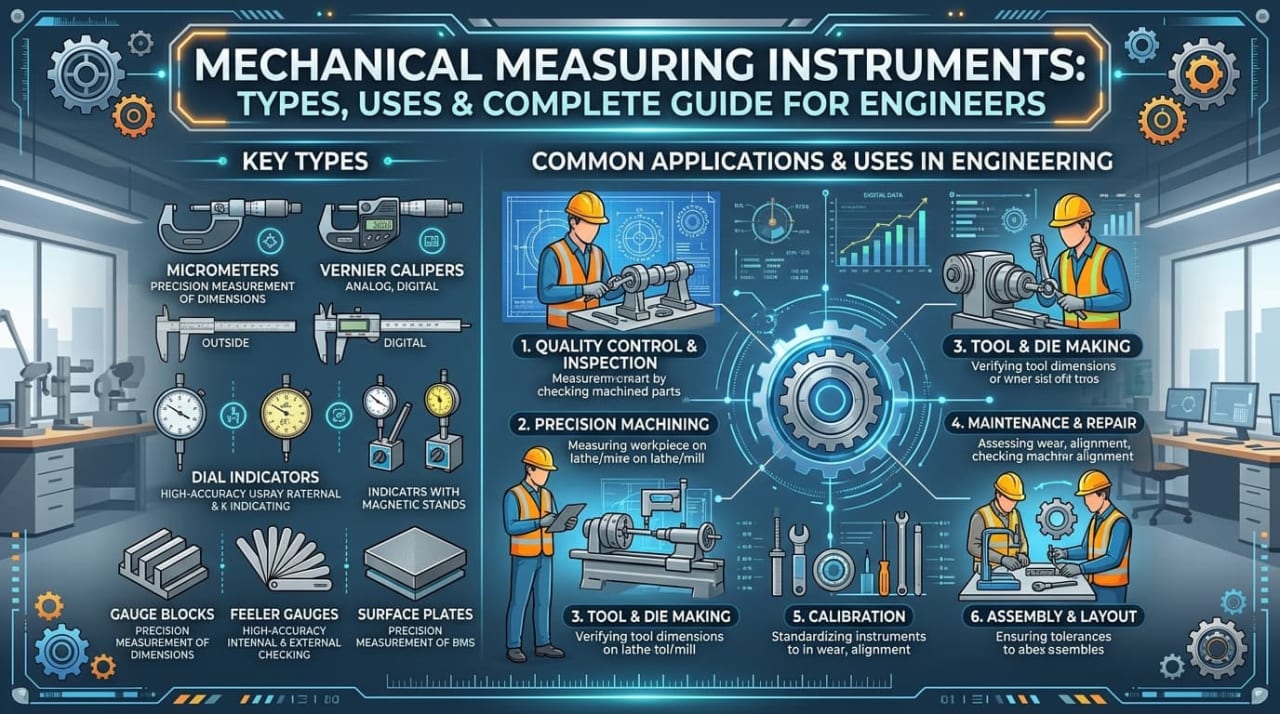
Mechanical Measuring Instruments: Types, Uses & Complete Guide for Engineers
A complete guide to mechanical measuring instruments — vernier calipers, micrometers, dial indicators, height gauges, and slip gauges — covering types, accuracy, calibration, and real workshop applications.
By Mr. Najaf Qazalbash16 min read
Introduction to Mechanical Measuring Instruments
Mechanical measuring instruments are the tools that turn an engineering drawing into a real, working part. Every dimension, angle, and tolerance on a blueprint has to be checked against the actual component, and that verification job belongs entirely to measuring instruments. From a simple steel rule to a calibrated slip gauge, these instruments quietly decide whether a machine runs smoothly or fails in the field.
In this guide, we break down every major category of mechanical measuring instrument used in engineering and manufacturing today, along with working principles, accuracy levels, and best-use scenarios. Whether you are a DAE or BSc mechanical student, a workshop technician, or a quality inspector, this article will help you decide which mechanical measuring instruments suit your work and how to use them correctly. Most of these tools share bench space with the broader set of mechanical workshop tools and uses found on any production floor or training lab.
Why mechanical measuring instruments matter in engineering
- Confirm that machined parts match the design drawing
- Catch dimensional errors before assembly or installation
- Support consistent quality across production batches
- Build the foundation for safe, reliable machine operation
- Strengthen a technician's or engineer's professional credibility
Definition and Importance of Mechanical Measuring Instruments
A mechanical measuring instrument is a device used to measure physical dimensions or geometric characteristics — length, diameter, depth, angle, or surface deviation — using mechanical scales, verniers, dials, or reference standards. These instruments help engineers and technicians verify whether a manufactured part meets its specified design requirements before it ever reaches assembly.
Accurate measurement is critical in industries where even a small dimensional error can lead to equipment failure, reduced efficiency, or a genuine safety hazard. That is exactly why mechanical measuring instruments occupy a permanent spot on every inspection bench, not just in specialised metrology labs.
Benefits of using mechanical measuring instruments
- Ensures dimensional accuracy across every machined component
- Improves overall product quality and reduces rework
- Minimises manufacturing defects and material waste
- Supports structured quality control and inspection processes
- Enhances workshop efficiency by catching errors early
- Helps maintain compliance with engineering and industry standards
While many modern metrology instruments now include digital readouts, the core measuring principle — comparing a workpiece against a known, traceable standard — remains unchanged. Across the full range of mechanical engineering measurement tools available today, purely mechanical scales are simply easier to maintain, less sensitive to battery life or electrical noise, and often more durable on a busy shop floor than electronic alternatives.
Types of Mechanical Measuring Instruments
Mechanical measuring instruments are generally grouped by what they measure rather than by how they look on a workbench. Four broad categories cover almost every workshop measuring instrument you will encounter:
Linear Measuring Instruments
- Steel rules & vernier calipers
- Micrometer screw scales
- Height & depth gauges
Precision: Medium–High · Best for: Length, diameter & depth checks
Angular Measuring Instruments
- Bevel protractors
- Combination squares
- Sine bars & angle gauges
Precision: Medium · Best for: Angle & slope verification
Precision Measuring Instruments
- Dial indicators
- Slip gauges (gauge blocks)
- Digital & micrometer calipers
Precision: Very High · Best for: Tight-tolerance inspection
Specialized & Reference Instruments
- Feeler gauges
- Reference slip-gauge sets
- Custom inspection fixtures
Precision: High (reference-grade) · Best for: Clearance checks & calibration
Linear Measuring Instruments
Linear measurement instruments measure length, width, thickness, depth, and diameter — the most frequently needed dimensions on any drawing. They form the backbone of dimensional measurement in a typical mechanical workshop.
- Steel rule
- Vernier caliper
- Micrometer
- Height gauge
- Depth gauge
Tip: Start with the cheapest tool that meets your tolerance. A steel rule is fine for rough layout work, but switch to a vernier caliper or micrometer the moment a drawing calls for a tolerance tighter than half a millimetre.
Angular Measuring Instruments
Angular measurement instruments measure angles and angular relationships between surfaces — essential whenever a part has a tapered face, a chamfer, or a tool needs setting at a precise cutting angle.
- Bevel protractor
- Combination square
- Sine bar
- Angle gauge
Tip: Always reference an angular measurement from a clean, flat surface. A burr or chip caught under the blade of a protractor or sine bar will throw the reading off by far more than the instrument's rated accuracy.
Precision Measuring Instruments
Precision measuring instruments provide highly accurate readings for critical, tight-tolerance applications where a standard caliper simply is not good enough.
- Dial indicator
- Slip gauges
- Micrometers
- Digital calipers
Tip: Precision instruments are only as good as their last calibration. Keep a calibration log for every dial indicator and slip-gauge set, and never assume a drawer-stored tool is still within tolerance.
Common Mechanical Measuring Instruments and Their Uses
Beyond the broad categories above, a handful of specific instruments show up on almost every inspection bench. For a broader look at every tool used for measurement and instrumentation in the field, see our companion guide on measuring instruments in mechanical engineering.
Vernier Caliper
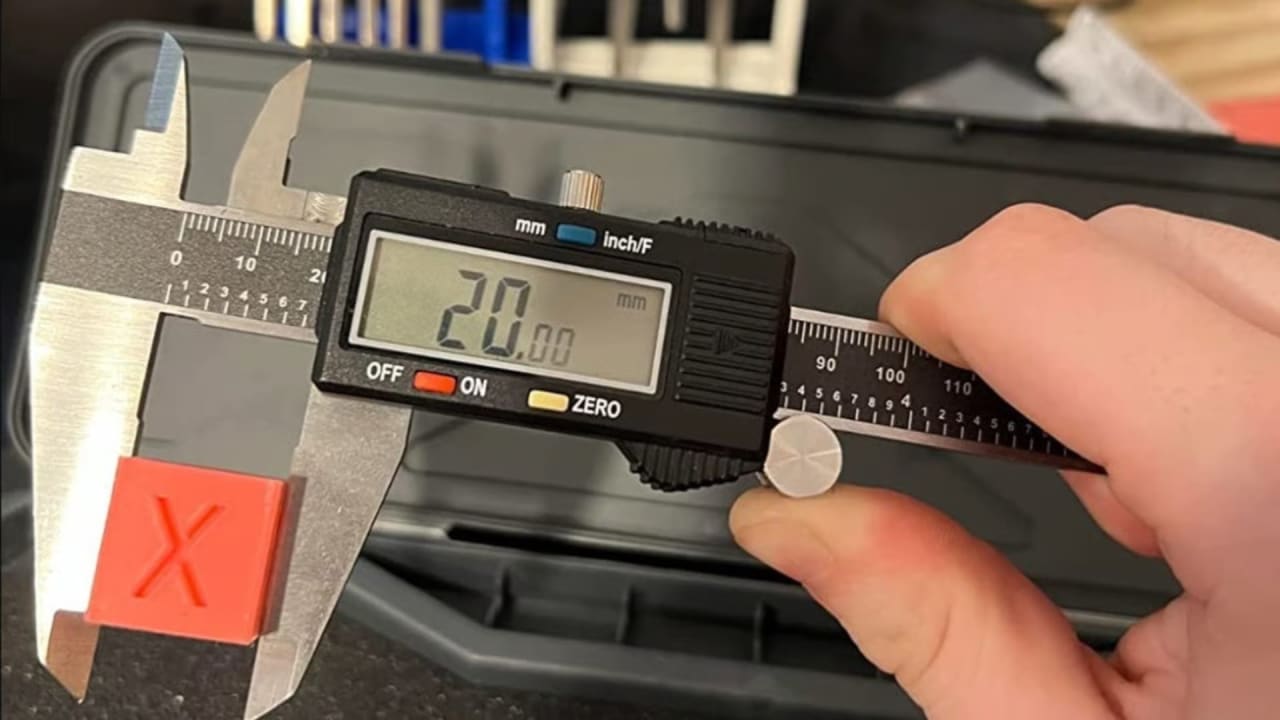
The vernier caliper is usually the first precision measuring tool every mechanical student picks up, and it remains one of the most versatile mechanical measuring instruments in any workshop. A single vernier caliper can measure external dimensions, internal dimensions, depth, and step measurements, all on one calibrated scale.
- External diameters and thicknesses
- Internal bore diameters
- Depth of holes and slots
- Step and shoulder measurements
Tip: Check the jaws for zero error before measuring, and let the workpiece settle into the jaws without forcing it — even a well-made vernier caliper reads incorrectly under inconsistent pressure.
Micrometer
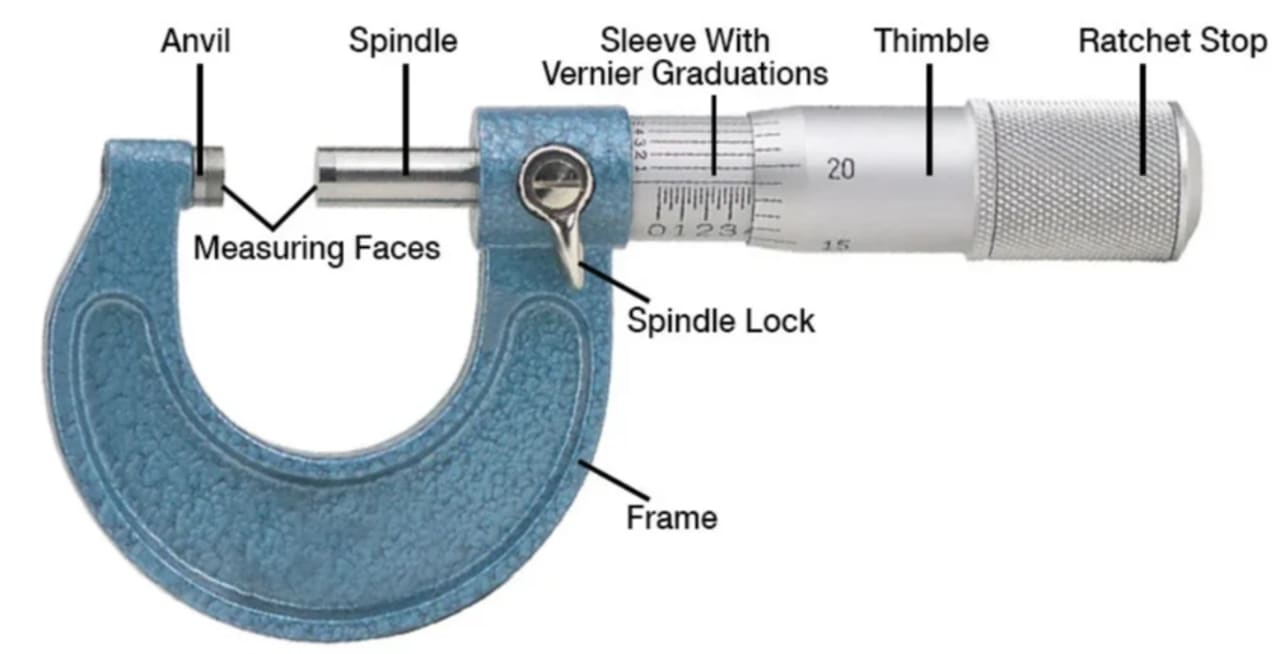
Where a vernier caliper covers a wide range with moderate precision, a micrometer narrows the focus and delivers far tighter accuracy on small dimensions. Outside micrometers, inside micrometers, and depth micrometers each handle a different measuring job, but all rely on the same precise screw-thread mechanism.
- Outside micrometer — shaft and rod diameters
- Inside micrometer — bore and internal width
- Depth micrometer — recess and step depth
Tip: Use the ratchet stop, not the thimble, for the final turns. This keeps measuring force consistent and protects both the instrument and your reading from operator-induced error.
Dial Indicator
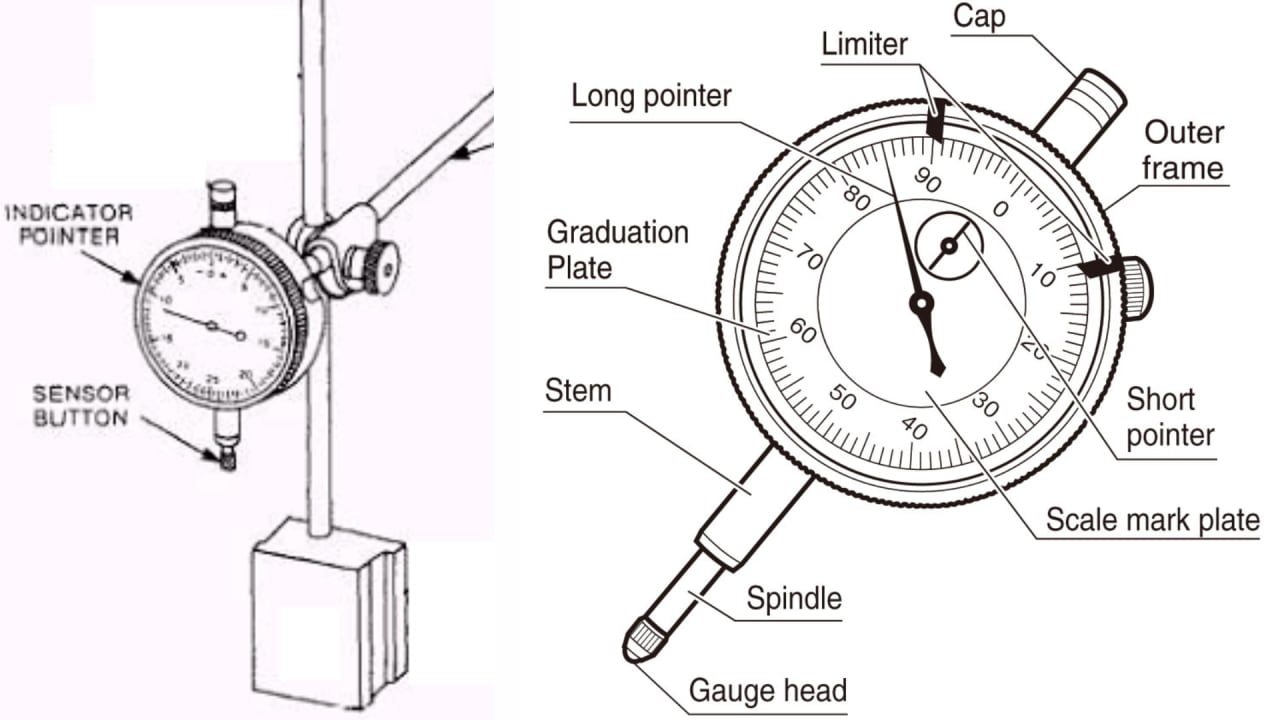
A dial indicator does not measure absolute size; instead it tracks small deviations and displacements as a plunger or lever moves against a surface. This makes it indispensable wherever alignment, runout, or flatness needs to be confirmed rather than simply measured once.
- Shaft and spindle runout checks
- Machine table and fixture alignment
- Surface flatness inspection
- Setup verification on lathes and mills
Tip: Mount the dial indicator rigidly and check that the plunger travels freely through its full range before taking a reading — a sticking plunger gives a false sense of precision.
Height Gauge
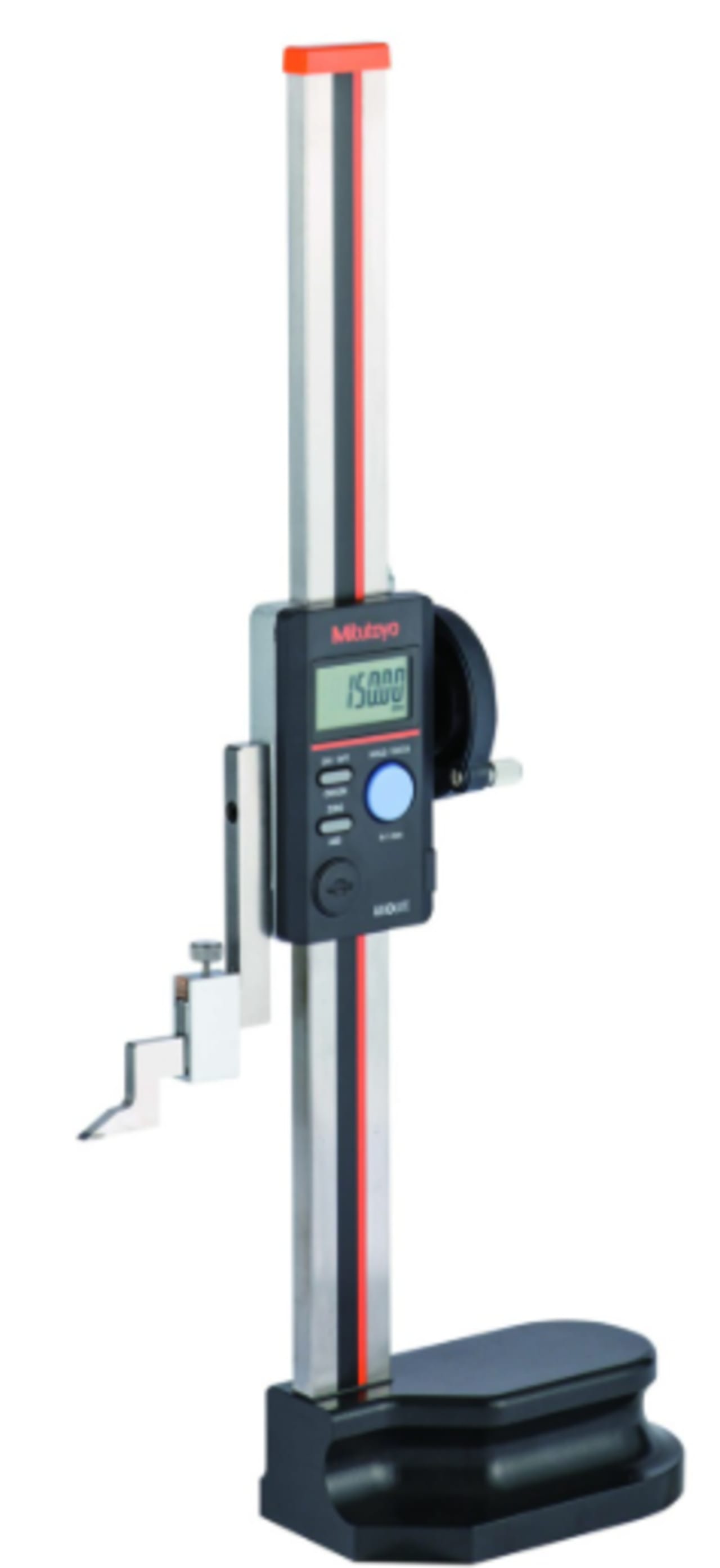
A height gauge combines the scale precision of a vernier or digital readout with a scriber or probe, letting you measure vertical dimensions directly off a surface plate. It is as much a marking tool as a measuring one, which is why inspection and layout departments rely on it so heavily.
- Vertical height inspection
- Precision marking and layout work
- Step-height verification on fixtures and jigs
Depth Gauge
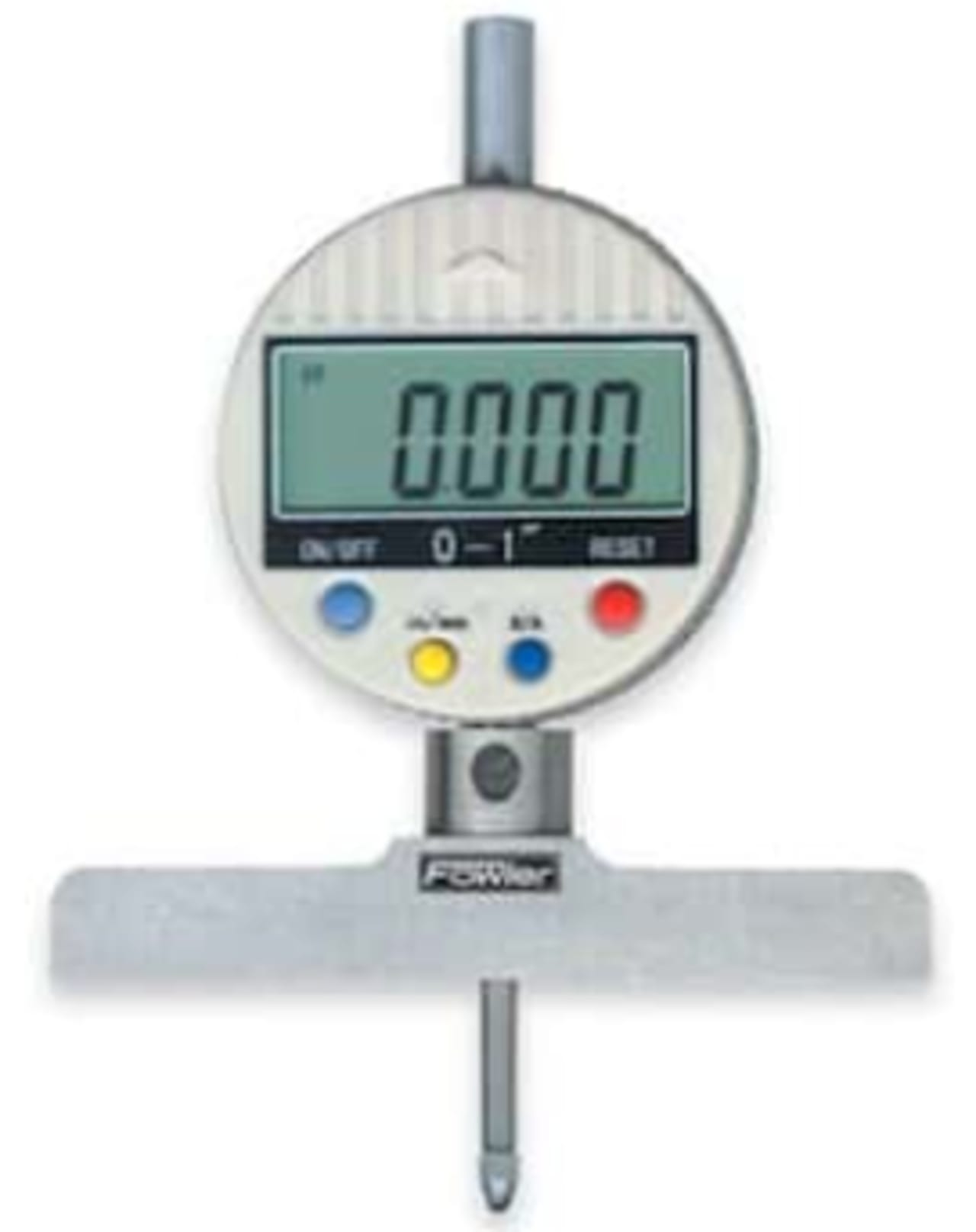
Depth gauges are built specifically to reach into holes, slots, and recesses that a caliper jaw simply cannot access. The reading comes from a sliding rod referenced against a flat base, giving a clean depth measurement without disturbing the surrounding surface.
- Bore and hole depth measurement
- Slot and groove depth checks
- Machined cavity and recess inspection
Bevel Protractor
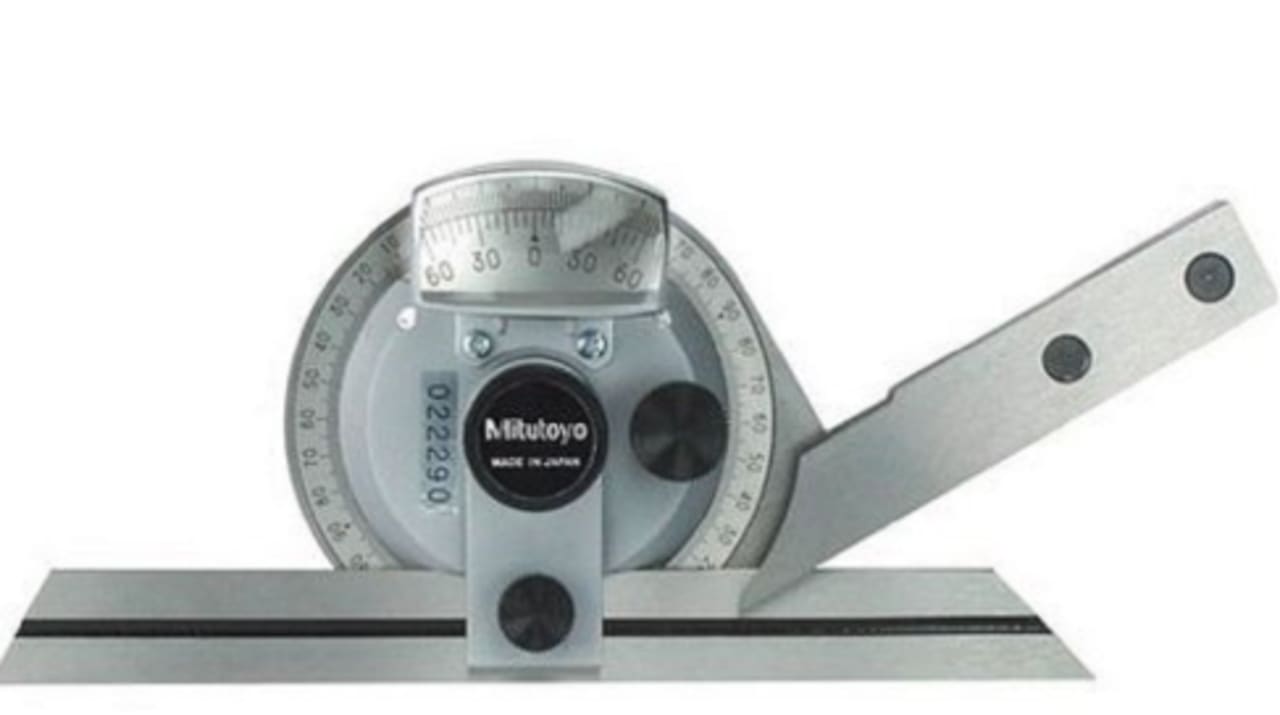
Among angular measuring instruments, the bevel protractor is the most widely used for everyday machining work. Its adjustable blade rotates against a graduated dial, letting a technician set or check an angle directly on the job rather than relying on a fixed template.
- Setting cutting-tool angles
- Inspecting angled machined faces
- Checking work-holding and fixture angles
Tip: Lock the blade firmly before reading the scale, and view the graduations straight-on to avoid parallax error — even a slight viewing angle can shift the reading by a degree or more.
Slip Gauges
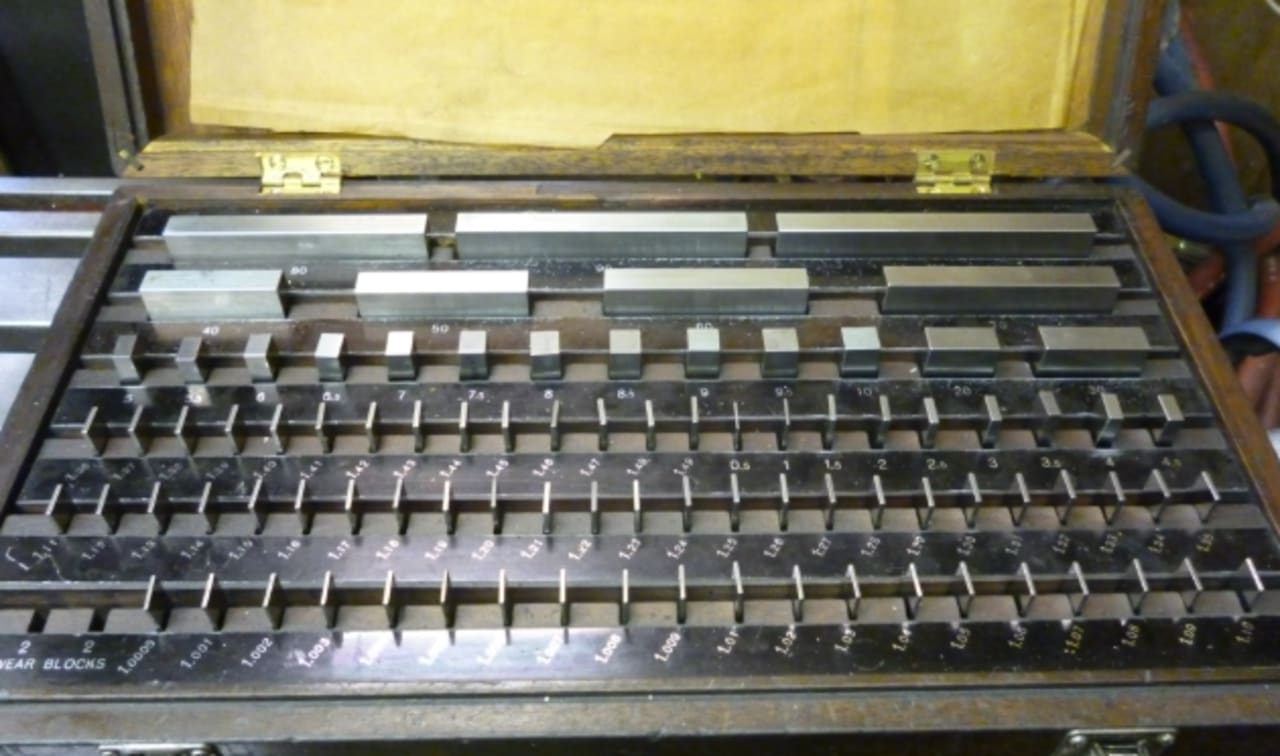
Slip gauges, also called gauge blocks, are reference standards rather than everyday measuring tools. Each block is ground and lapped to an exact thickness, and a set of blocks is wrung together to build up almost any length with extraordinary accuracy. They are the backbone of any serious set of calibration tools in a metrology lab.
- Calibrating other measuring instruments
- Setting up precision fixtures and gauges
- Acting as length standards for quality audits
Feeler Gauge
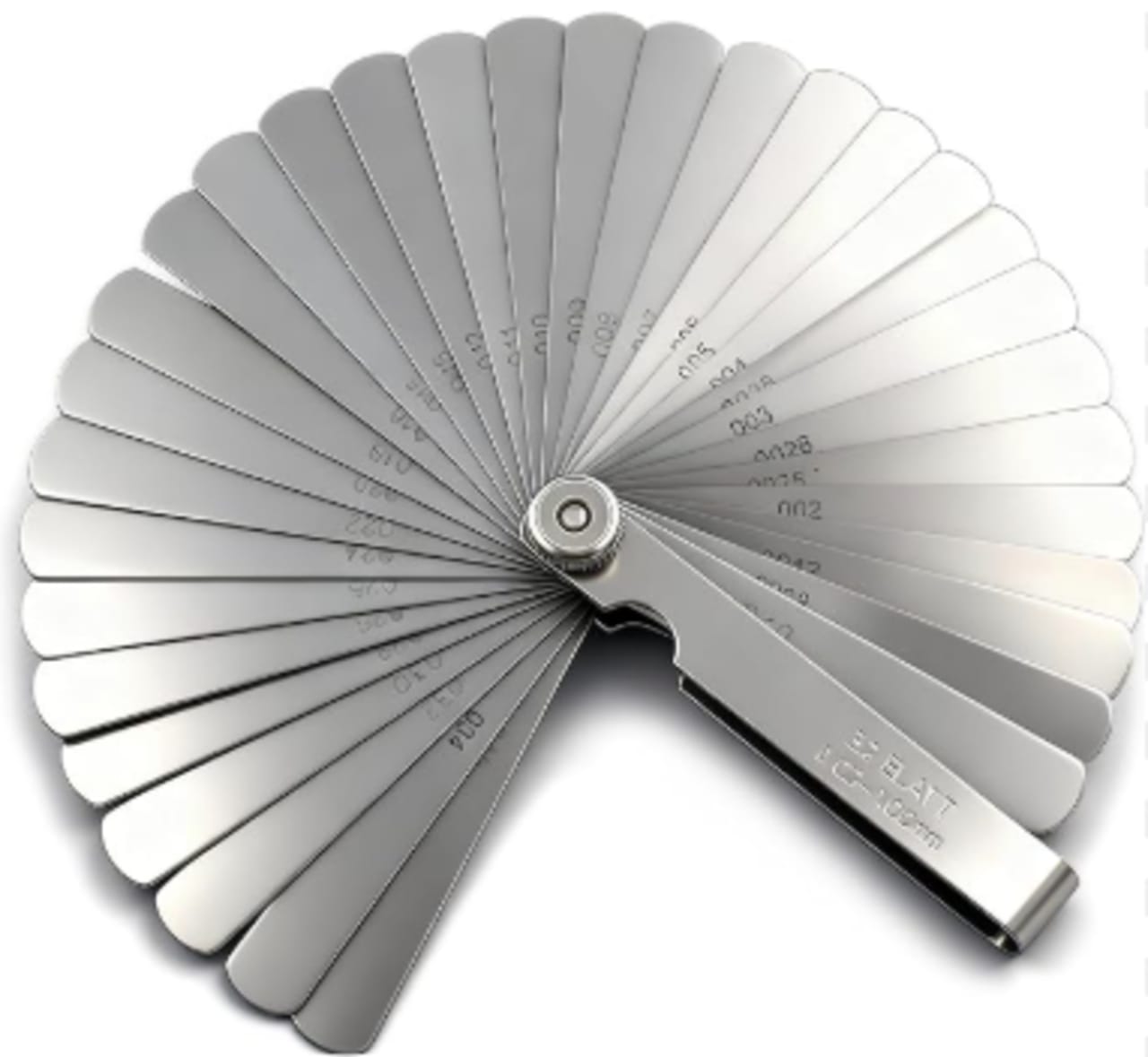
A feeler gauge is a simple set of thin steel blades of known, incremental thickness, used to check small gaps and clearances by feel rather than by scale reading. Despite its simplicity, it remains one of the most-used mechanical measuring instruments in routine maintenance work.
- Valve clearance checks on engines
- Bearing and gear clearance inspection
- Setting gaps in machine assemblies
Measurement Accuracy and Calibration
Accuracy is the entire point of using mechanical measuring instruments. An instrument that cannot be trusted is worse than no instrument at all, because it gives false confidence in a part that may already be out of tolerance.
Typical precision level by instrument (relative)
Steel Rule30%
Vernier Caliper65%
Micrometer85%
Dial Indicator90%
Slip Gauges (Gauge Blocks)99%
Factors affecting measurement accuracy
- Instrument condition
- User skill
- Environmental temperature
- Calibration status
- Measurement technique
Why calibration matters
Calibration ensures that measuring instruments provide reliable and repeatable results against a known, traceable standard.
- Improved consistency between operators and shifts
- Reduced measurement errors over an instrument's life
- Compliance with industry and customer quality standards
- Better, more defensible product quality records
Workshops that need defensible, traceable results typically calibrate against standards referenced in frameworks such as ISO 17025 or ASME B89.1.13, so that every micrometer, dial indicator, and gauge block in use can be traced back to a certified reference standard.
Technicians who have built up the skills required for a mechanical technician typically receive dedicated training in calibration procedures and traceable measurement practice as part of their craft.
Advantages and Limitations of Mechanical Measuring Instruments
Advantages
- High accuracy
- Improved productivity
- Better quality control
- Reduced waste
- Enhanced reliability
- Cost-effective inspection
Limitations
- Require regular calibration
- Sensitive to mishandling
- Accuracy depends on operator skill
- Some instruments have limited measurement ranges
Applications of Mechanical Measuring Instruments in Engineering & Manufacturing
Mechanical measuring instruments are widely used as industrial measuring devices across almost every sector that builds or maintains machinery:
Manufacturing Industry
- Component inspection
- In-process quality control
- Final assembly verification
Automotive Industry
- Engine component measurement
- Assembly verification
- Maintenance inspections
Aerospace Industry
- Precision component verification
- Tolerance checking
- Safety-critical inspections
Mechanical Workshops
- Accurate machining setup
- Assembly checks
- Routine maintenance inspection
Before measuring on a running machine or a freshly-cut workpiece, review the safety rules in a mechanical workshop to avoid injury from sharp edges, swarf, or moving parts.
Best Practices for Using Mechanical Measuring Instruments
Following a consistent routine matters as much as owning a good-quality instrument. These habits separate reliable measurement accuracy from guesswork:
Measurement Best Practices
- Clean the instrument before use
- Verify calibration status
- Handle instruments carefully
- Avoid excessive force during measurement
- Store instruments properly after use
- Follow manufacturer guidelines
Common Mistakes to Avoid
- Measuring dirty or burred surfaces
- Using damaged instruments
- Ignoring calibration schedules
- Reading scales at an angle
- Applying excessive pressure
Maintenance and Storage Guidelines
Proper maintenance extends the working life and accuracy of every mechanical measuring instrument on the bench.
Maintenance Tips
- Clean after every use
- Protect from moisture
- Lubricate moving parts when necessary
- Inspect regularly for wear and damage
Storage Recommendations
- Use protective cases
- Store in dry environments
- Avoid direct sunlight
- Keep instruments organised
Mechanical Measuring Instruments Comparison Table
A side-by-side look at accuracy, primary measurement, and typical application for each instrument covered above:
| Instrument | Typical Accuracy | What It Measures | Common Application | Relative Cost |
|---|---|---|---|---|
| Vernier Caliper | ≈ 0.02 mm | External, internal & depth dimensions | Machine shops, labs | Low |
| Micrometer | ≈ 0.01 mm | Small diameters & thickness | Precision machining | Low-Medium |
| Dial Indicator | ≈ 0.01 mm | Deviation, runout, flatness | Alignment & QC | Medium |
| Height Gauge | ≈ 0.02 mm | Vertical height & marking | Layout & inspection | Medium |
| Depth Gauge | 0.02-0.05 mm | Hole, slot & recess depth | Bore inspection | Low |
| Bevel Protractor | ≈ 5 arc-minutes | Angles between surfaces | Tool setting, machining | Low |
| Slip Gauges | ± 0.0001 mm (grade-dependent) | Reference length standards | Calibration, setup | High |
| Feeler Gauge | 0.01-0.05 mm steps | Gaps & clearances | Valve / bearing clearance | Low |
Frequently Asked Questions
- What are mechanical measuring instruments?
- Mechanical measuring instruments are tools used to measure dimensions, angles, distances, and tolerances on engineering components. They rely on mechanical scales, verniers, dials, or reference standards — rather than purely electronic sensing — to verify that a part matches its design drawing.
- Which is the most commonly used mechanical measuring instrument?
- The vernier caliper is the most widely used mechanical measuring instrument in workshops and labs because a single tool can measure external, internal, depth, and step dimensions with reasonable precision.
- Why is calibration important for mechanical measuring instruments?
- Calibration confirms that an instrument's scale still matches a known reference standard. Without regular calibration, mechanical measuring instruments can drift out of tolerance and produce results that look correct but are not, which leads to rejected parts or assembly failures.
- What is the difference between a vernier caliper and a micrometer?
- A vernier caliper measures a wide range of external, internal, and depth dimensions with moderate precision, typically down to 0.02 mm. A micrometer covers a smaller measuring range but delivers much finer precision, typically down to 0.01 mm or better, making it the better choice for tight-tolerance work.
- Where are mechanical measuring instruments used?
- They are used across manufacturing, automotive, aerospace, maintenance, quality control, and general mechanical engineering — anywhere a physical dimension needs to be checked against a design specification.
- What is the least count of common measuring instruments?
- A standard vernier caliper has a least count of around 0.02 mm, an outside micrometer around 0.01 mm, and grade-0 slip gauges can hold tolerances within a few hundredths of a micron, making them suitable as calibration references.
- How do you maintain mechanical measuring instruments for long-term accuracy?
- Clean instruments before and after every use, store them in dry, padded cases away from direct sunlight and vibration, avoid applying excessive measuring force, and send them for periodic calibration against certified reference standards.
Conclusion — Mastering Mechanical Measuring Instruments
Mechanical measuring instruments play a critical role in modern engineering, manufacturing, and quality assurance. From vernier calipers and micrometers to dial indicators and slip gauges, these precision measuring tools ensure dimensional accuracy and product reliability at every stage of production.
By understanding the types, applications, calibration needs, and maintenance requirements of mechanical measuring instruments, engineers and technicians can achieve consistent measurement accuracy and improve overall operational efficiency.
Whether you are learning workshop practices, exploring metrology instruments in greater depth, or building the skills of a working mechanical technician, mastering mechanical measuring instruments is an essential step toward professional success.
Explore more engineering guides in our articles section.
Written by
Mr. Najaf Qazalbash
Mr. Najaf Qazalbash is a Mechanical Engineer with over 14 years of experience in the idustry. He is committed to machine manufacturing, repair as well as mentoring students in developing strong foundations and professional skills that prepare them for market.