
What is PCATP? Complete Guide for Architecture Students in Pakistan (2026)
Everything engineering students in Pakistan need to know about PCATP: registration categories, accreditation, the registration process, PEC vs PCATP, and what it means for DAE and architecture pathways.
By Mr. Azaan Ajum Khan13 min read
Introduction — Why Every Architecture Student Hears 'PCATP'
PCATP is the word every architecture student in Pakistan eventually hears — usually right after someone bursts a popular myth: finishing a five-year B.Arch degree does not, by itself, make you an architect. Without PCATP registration, even a brilliant design portfolio cannot legally be called the work of an "Architect" in Pakistan.
Understanding PCATP early changes real decisions: which B.Arch programme you choose, how you plan your mandatory practical year, and how quickly you can move from graduate to a fully Licensed Architect. This guide breaks down exactly what PCATP regulates, its registration tiers, the accreditation you must verify before enrolling, and how it differs from PEC — the body many students confuse it with.
Whether you're finishing a DAE Architecture diploma and deciding whether to continue into B.Arch, already studying architecture, or simply trying to make sense of a registration form your university handed you, this guide covers everything you need before your first PCATP application in 2026.

What is PCATP (Pakistan Council of Architects and Town Planners)?
PCATP stands for the Pakistan Council of Architects and Town Planners. It is the federal statutory body that regulates the architecture and town planning professions in Pakistan, established under the Pakistan Council of Architects and Town Planners Ordinance, 1983, and headquartered in Islamabad.
PCATP's authority covers two connected professions: Architecture and Town Planning. It accredits the university programmes that teach them, registers the individual professionals who practise them, and sets the code of conduct both must follow. Put simply: if you want to legally call yourself an Architect in Pakistan, you must be registered with PCATP — a design portfolio and a degree certificate are not, on their own, enough.
PCATP works alongside Pakistan's Ministry of Housing and Works and the Higher Education Commission (HEC) to maintain these standards. Its registration applies specifically to B.Arch-qualified architects — not to Architectural Engineering graduates, who are regulated by PEC instead, or to DAE Architecture diploma holders, who must complete a recognised B.Arch before they can register at all.
Why this matters: studying an unaccredited B.Arch programme can create real difficulty later. PCATP registration depends on your specific degree being recognised under the Council's Ordinance, not simply on graduating from a well-known university. Always confirm accreditation status before — not after — you commit.
If you're currently completing a DAE diploma and deciding whether to continue into B.Arch, our DAE Architecture in Pakistan guide explains how the diploma route compares in scope, cost, and timeline.
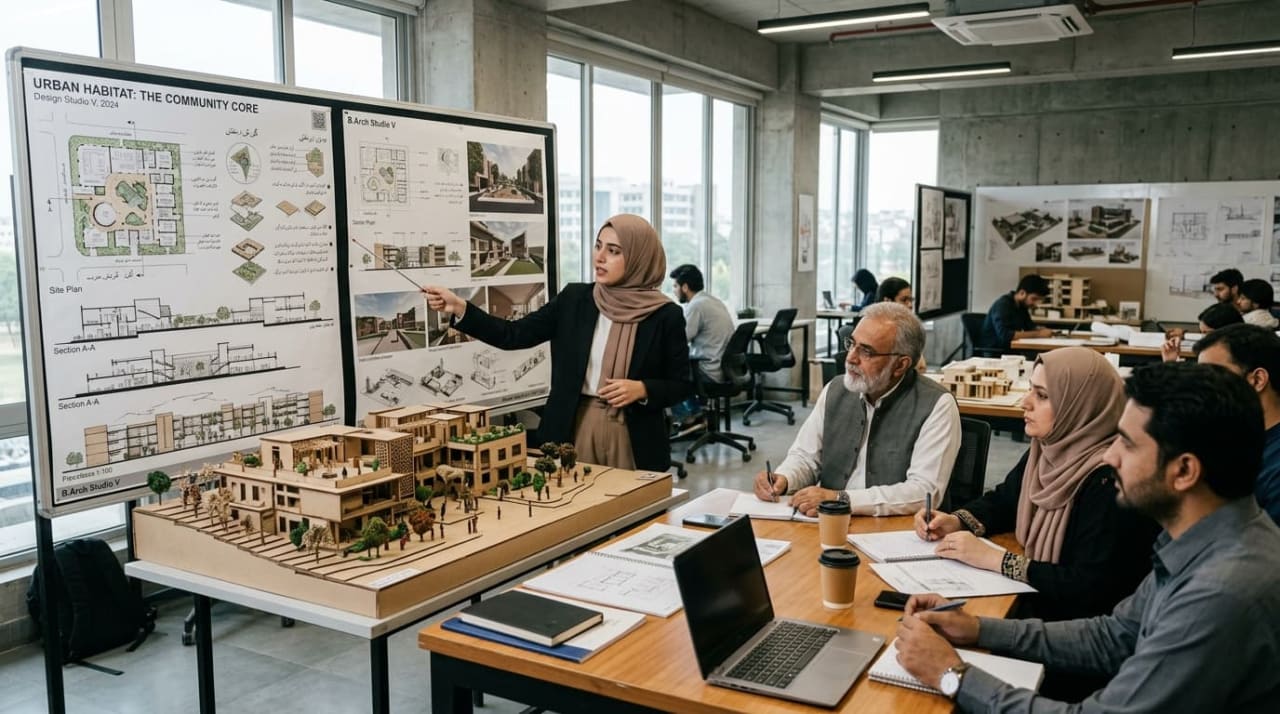
Key Functions & Role of PCATP
PCATP sits at the centre of Pakistan's architecture ecosystem — connecting universities, individual architects, firms, and government bodies under one regulatory umbrella.
Accreditation
Evaluates and accredits B.Arch and town-planning degree programmes against national education standards.
Registration & Licensing
Registers graduate Architects (RA) and oversees their progression to PCATP Licensed Architect status.
Standards & Ethics
Sets the code of professional conduct, runs the Architects Licensing Examination (ALE), and protects public interest in the built environment.
| Detail | Information |
|---|---|
| Full Name | Pakistan Council of Architects and Town Planners (PCATP) |
| Established | 1983, under the Pakistan Council of Architects and Town Planners Ordinance |
| Headquarters | Islamabad |
| Regulates | Architecture and Town Planning education, registration, and practice |
| Affiliated With | Ministry of Housing and Works; Higher Education Commission (HEC) |
| Core Registration Categories | Registered Architect (RA), PCATP Licensed Architect, Registered Town Planner, Architectural Firm |
| Recognised Primary Degree | Bachelor of Architecture (B.Arch) — a 5-year professional degree |
PCATP Registration Categories Explained
PCATP registration isn't a single certificate — it's a tiered system that follows your career from fresh graduate to a fully Licensed Architect. Here's how the main tiers fit together.
Entry-Level — After Graduation
Registered Architect (RA)
Granted after applying to PCATP following graduation from a recognised B.Arch programme. Lets you work under or alongside licensed architects, but not yet practise independently.
Registered Town Planner
The parallel entry tier for graduates of PCATP-recognised town planning programmes.
Becoming a Licensed Architect
PCATP Licensed Architect
Requires at least one year of supervised practical experience at a PCATP-registered firm, the required CPD credit points, and passing the Architects Licensing Examination (ALE).
Supervising Architect Eligibility
An architect must hold a minimum of five years' experience after their own registration before they can supervise a graduate's mandatory practical year.
Firm & Specialist Registration
Architectural Firm Registration
Lets architectural practices legally offer professional services and employ Registered or Licensed Architects under the firm's name.
Foreign Qualification Evaluation
Architects with foreign degrees apply for recognition through PCATP's accreditation and evaluation process before registering locally.
Coming from a DAE diploma? DAE Architecture holders cannot register with PCATP directly — a recognised B.Arch degree is required first. See our complete DAE Architecture guide for how the diploma connects to further study.
Skills Every Future Architect Needs
A PCATP-accredited B.Arch builds your design and technical foundation, but registration boards and employers consistently look for a specific set of practical competencies alongside it.
Creative & Conceptual Design Thinking
Translate a brief into a coherent spatial concept — the core skill every design studio and licensing review ultimately tests.
Sketching & Manual Drawing
Quick hand sketches remain the fastest way to develop and communicate ideas before software ever opens.
AutoCAD, Revit & BIM Proficiency
Industry-standard 2D drafting and 3D Building Information Modelling skills employers expect from day one.
Model-Making & Prototyping
Physical and digital massing models help test proportion, light, and form long before construction drawings exist.
Presentation & Client Communication
Defend design decisions clearly to juries, clients, and approval authorities — a skill tested throughout the licensing journey.
Building Codes & Construction Knowledge
Understand materials, structural basics, and the codes that govern safe, buildable design — essential for the ALE and real projects alike.
PCATP-Accredited B.Arch Programmes & How to Verify Yours
A range of public and private universities across Pakistan offer PCATP-accredited B.Arch programmes. Below are examples of well-established institutions commonly associated with architecture education — but accreditation is granted per programme, not just per university, and status can change.
National College of Arts (NCA), Lahore
Premier / Public
NUST School of Art, Design & Architecture, Islamabad
Public Sector
UET Lahore — Department of Architecture
Multi-Discipline
Dawood University of Engineering & Technology, Karachi
Public
Beaconhouse National University (BNU), Lahore
Private
Indus Valley School of Art & Architecture, Karachi
Private
Always verify directly: before admission, check the specific B.Arch programme — not just the university name — against PCATP's official accredited list. If you completed a DAE in architecture at a Government College of Technology (GCT) or similar polytechnic, remember this diploma alone does not qualify you for PCATP registration; you'll still need a recognised B.Arch degree afterward.
How to Register With PCATP: Step-by-Step
The registration process is straightforward once you know the order of operations. Here's the typical path from graduation to PCATP Licensed Architect status in 2026.
Confirm Your B.Arch Programme Is PCATP-Accredited
Verify your specific programme — not just your university — is recognised under PCATP's Ordinance before you graduate.
Graduate & Apply for Registered Architect (RA) Status
Submit your degree certificate, transcript, CNIC, photographs, and the prescribed registration fee. Processing typically takes a few weeks.
Complete One Year of Supervised Practical Experience
Work under an architect with at least 5 years' post-registration experience at a PCATP-registered firm or office.
Accumulate the Required CPD Credit Points
Continuing Professional Development points must be earned before you can sit the licensing examination.
Pass the ALE & Become a Licensed Architect
Clear the Architects Licensing Examination (ALE) to be issued your licence to independently practise architecture.

Career Opportunities for PCATP-Registered Architects
PCATP registration opens doors across nearly every sector that designs, plans, or shapes the built environment in Pakistan — and increasingly, beyond its borders.
Private Architecture Practice & Firms
Design, documentation, and client-facing roles at PCATP-registered architectural firms of every size.
Government Planning & Development Authorities
Urban development authorities such as CDA, LDA, and KDA rely on registered architects and town planners for master planning.
Construction & Real Estate Development
In-house design and approvals roles with developers building residential, commercial, and mixed-use projects.
Interior Design & Visualisation Studios
3D visualisation, rendering, and interior architecture roles for residential and commercial clients.
Academia & Architectural Research
Teaching, studio critique, and research roles at PCATP-accredited universities and design schools.
International & Remote Design Work
Gulf-market projects and remote BIM/visualisation freelancing are increasingly accessible to Pakistani architects.
Curious how this compares to a more technical, engineering-led path? See our jobs for associate engineers in architecture guide for entry-level roles on the engineering side.
Experience, CPD & Licensing Requirements
Registration isn't a one-time achievement. Graduate Architects move through a defined sequence of supervised experience, CPD credit points, and a licensing exam before they can practise independently.
Experience required to reach each milestone
Registered Architect (RA) — fresh graduateImmediate, on graduation + registration
PCATP Licensed Architect1 year supervised experience + ALE + CPD
Eligible to Supervise Graduate ArchitectsMin. 5 years post-registration experience
Figures reflect PCATP's published bye-laws on registration, the mandatory practical year, and supervising architect eligibility. Exact CPD point requirements and fees can change — always confirm current figures directly with PCATP.
Start your CPD and portfolio early: studio juries, workshops, and software certifications all build toward your professional record. Architects who document their design work and software skills from their very first semester move through the licensing year with far less last-minute scrambling. Strengthen your software foundation now with our AutoCAD beginner guide.
PCATP vs PEC — Which One Do You Need?
Many students choosing between architecture and engineering ask whether they need PCATP or PEC. The honest answer is that it depends entirely on the profession you want to practise — not on which body sounds more relevant to construction.
For Architects
PCATP (Pakistan Council of Architects and Town Planners)
Regulates: Architecture & town planning practice
Registers: Architects & Town Planners
Relevant Degree: B.Arch — 5-year professional architecture degree
Outcome: Licensed, practising Architect
Best for: Students pursuing B.Arch and design-led architecture careers
For Engineers
PEC (Pakistan Engineering Council)
Regulates: Engineering education & professional practice
Registers: Engineers (RE/PE), Technologists, Firms
Relevant Degrees: BSc Civil / Mechanical / Electrical / Architectural / Chemical Engineering, and other accredited programmes
Outcome: Licensed, practising Engineer
Best for: Students pursuing any accredited engineering degree, including Architectural Engineering
Bottom line: if your goal is to design buildings as a licensed Architect, your path runs through B.Arch and PCATP. If your goal is to engineer structures, systems, or architectural-engineering projects instead, your path runs through an accredited engineering degree and PEC. BSc Architectural Engineering graduates in particular register through PEC, not PCATP. Compare both routes fully in our B.Arch vs BSc Architectural Engineering guide or read our dedicated What is PEC? guide if engineering registration is what you are actually trying to understand.
Future of Architecture Regulation in Pakistan
PCATP's role keeps evolving alongside Pakistan's urban growth, climate concerns, and design technology. These five trends will shape architecture registration over the next few years.
Digital Modernisation of PCATP Registration
Online application processing and digital record-keeping are gradually streamlining the path from graduation to Registered Architect status.
Sustainable & Climate-Responsive Design Standards
Green building codes, passive design, and climate resilience are increasingly factored into accreditation and professional practice expectations.
BIM & Parametric Design Becoming Standard
Revit, BIM workflows, and parametric tools are becoming default expectations in studios and firms, not optional extras.
Urban Growth Driving Demand for Town Planners
Pakistan's housing shortfall and rapid urban expansion are increasing demand for registered Town Planners alongside Architects.
Stronger International Architecture Links
Growing engagement with international architecture and planning bodies is widening recognition options for Pakistani architects seeking work or further registration abroad.
Frequently Asked Questions (FAQs)
- What does PEC stand for?
- PEC stands for the Pakistan Engineering Council, the statutory body that regulates engineering education and professional practice in Pakistan.
- Is PEC registration mandatory for engineers in Pakistan?
- For most professional engineering roles — especially anything involving signing designs, government contracts, or consulting — yes, PEC registration is required. Some entry-level technical roles can be performed before full registration, but long-term career growth depends on it.
- Can DAE holders register with PEC?
- A DAE diploma alone is not equivalent to a PEC-recognised engineering degree. DAE holders typically register under PEC's Engineering Technologist category after gaining relevant practical experience, or continue to a PEC-accredited bachelor's engineering programme to register as a Registered Engineer.
- How long does PEC registration take?
- Timelines vary by category and how complete your documentation is. Recent graduating batches processed through PEC's integrated university portal under the Pathway to Practice initiative are generally registered faster than applicants submitting manually.
- What is the difference between a Registered Engineer and a Professional Engineer?
- A Registered Engineer (RE) is the first registration tier, granted on graduation from a PEC-accredited programme. A Professional Engineer (PE) is a more advanced tier requiring several years of relevant post-RE experience, passing PEC's Engineering Practice Examination (EPE), and meeting required CPD credit points.
- Is Architectural Engineering regulated by PEC or PCATP?
- Architectural Engineering is regulated by PEC, because it is classified as an engineering discipline. PCATP, by contrast, regulates Architects who hold a B.Arch degree.
- What is the difference between PEC and PCATP?
- PEC regulates engineering education and professional engineering practice, while PCATP (Pakistan Council for Architects and Town Planners) regulates the architecture and town-planning professions. Your degree determines which one applies to you.
- Does PEC accredit private universities, or only government ones?
- PEC accredits eligible engineering programmes at both public and private universities. Accreditation is granted per programme, not automatically to an entire institution, so it's important to verify the specific degree you're considering rather than assuming the whole university is covered.
- What is CPD and why does PEC require it?
- CPD stands for Continuing Professional Development. PEC requires registered engineers to keep earning CPD credit points throughout their careers — through training, workshops, or further study — to ensure skills and knowledge stay current after graduation.
- Can a B.Tech graduate register with PEC as an engineer?
- A B.Tech (Engineering Technology) qualification is generally not treated as equivalent to a Bachelor of Engineering degree for Registered Engineer status. B.Tech graduates typically pursue PEC's Engineering Technologist registration track instead.
Conclusion — Plan Your Path With PCATP in Mind
PCATP is the body that turns a B.Arch degree into a real, licensed architecture career in Pakistan. Whether you're still choosing a programme, about to graduate, or already working through your supervised practical year, understanding PCATP's accreditation rules, registration tiers, and licensing requirements lets you plan a realistic timeline instead of discovering the rules after they affect you.
If your interests lean toward engineering calculations and systems rather than design, remember that PEC — not PCATP — governs Architectural Engineering and other engineering disciplines.
Whichever path you choose, the fundamentals are the same: verify accreditation before you commit, build your design and software portfolio early, and treat CPD as an ongoing habit rather than a final-year scramble.
Your next steps: confirm your B.Arch programme's PCATP accreditation status, then explore our DAE Architecture in Pakistan guide if you're still deciding on the diploma route, compare careers in our B.Arch vs BSc Architectural Engineering guide, or read our What is PEC? guide if you are choosing the engineering route instead.
Questions about either programme? Browse more articles or check our study resources.
Written by
Mr. Azaan Ajum Khan
Mr. Azaan Ajum Khan offers over 10 years of experience teaching architectural planning, and helping students transform ideas into reality. He is committed to mentoring students in developing strong conceptual foundations and professional skills that prepare them for successful architectural practice.